
Logo

American Heart Association

  21
  0


Final ID: MP947

Transcriptomic profiling of plasma microRNA reveals circulating biomarkers of transthyretin cardiac amyloidosis and dysregulated signaling pathways.

Abstract Body (Do not enter title and authors here): Background: Early diagnosis and initiation of disease modifying therapy for transthyretin amyloid cardiomyopathy (ATTR-CM) improves prognosis. However, ATTR-CM remains underdiagnosed and can be commonly mistaken for hypertensive left ventricular hypertrophy (hLVH). Plasma transcriptomic profiling may help distinguish ATTR-CM from hLVH and provide insights on its pathophysiology.

Hypothesis: Circulating microRNAs can distinguish ATTR-CM from hLVH and identify dysregulated signaling pathways.

Methods: In this case-control study, we sequenced plasma microRNAs in cases with ATTR-CM and age- and sex-matched controls with hLVH. We developed a microRNA-based Lasso model to discriminate cases from controls in a training set consisting of the earliest enrolled 2/3 of the cohort. We defined the later enrolled 1/3 as the prospective test set for validation. We screened candidate microRNAs for model training based on their independent associations with ATTR-CM after adjustment for clinical characteristics that differed between the 2 groups. We compared the performance of the microRNA model in the test set to the Mayo ATTR-CM risk score using DeLong’s test and net reclassification improvement (NRI). Separately, we identified microRNAs that were differentially expressed between cases and controls (Bonferroni-adjusted P <0.05) and performed a pathway analysis of these microRNAs. We considered a pathway as dysregulated if Benjamini–Hochberg false discovery rate was <0.05 and at least 2 pathway-associated microRNAs were over- or under-represented in ATTR-CM cases.

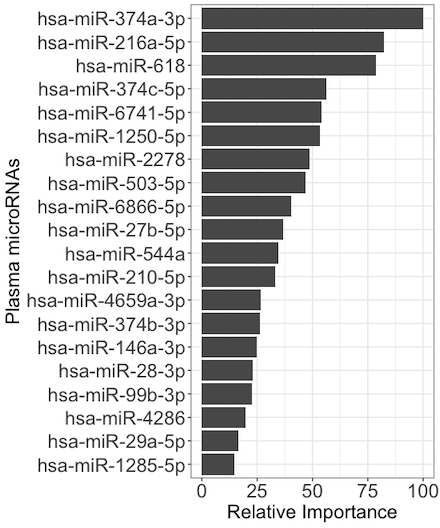
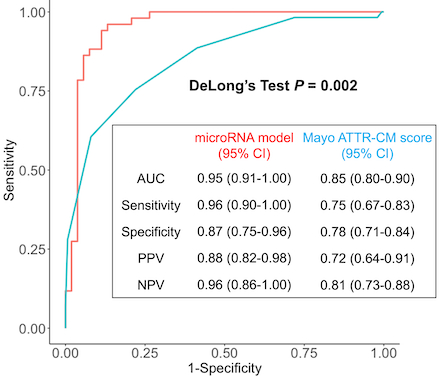
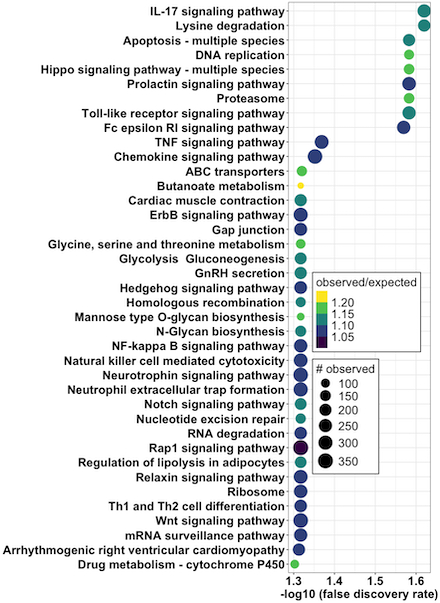
Results: A total of 311 participants (152 ATTR-CA, 159 LVH) were included. Of the 917 sequenced microRNAs, 48 were independently associated with ATTR-CM and used for model development in the training set. The top 20 most important microRNAs are shown in Figure 1. The microRNA model had an area under the receiver-operating-characteristic curve (AUC) of 0.95 (95% CI, 0.91-1.00) in the test set, outperforming the Mayo ATTR-CM score’s AUC of 0.85 (95% CI, 0.80-0.90; P = 0.002, Figure 2). In the test set, compared to the Mayo ATTR-CM score, the microRNA model had a positive NRI (0.21, 98% CI 0.008-0.41). Pathway analysis revealed 39 dysregulated pathways in patients with ATTR-CM, including the Hippo and tumor necrosis factor pathways (Figure 3).

Conclusions: This study identified circulating microRNAs that distinguished ATTR-CM from hLVH with high accuracy and identified signaling pathways associated with ATTR-CM.
  • Boursiquot, Brian  ( Columbia University Medical Center , New York , New York , United States )
  • Lu, Ree  ( Columbia University Medical Center , New York , New York , United States )
  • Akita, Keitaro  ( Columbia University Medical Center , New York , New York , United States )
  • Teruya, Sergio  ( Columbia University Medical Center , New York , New York , United States )
  • Bampatsias, Dimitrios  ( Columbia University Medical Center , New York , New York , United States )
  • Mirabal, Alfonsina  ( Columbia University Medical Center , New York , New York , United States )
  • Fifer, Michael  ( MASSACHUSETTS GEN HOSP , Boston , Massachusetts , United States )
  • Maurer, Mathew  ( Columbia University Medical Center , New York , New York , United States )
  • Shimada, Yuichi  ( Columbia University Medical Center , New York , New York , United States )
  • Author Disclosures:
    Brian Boursiquot: DO NOT have relevant financial relationships | Ree Lu: DO NOT have relevant financial relationships | Keitaro Akita: No Answer | Sergio Teruya: DO NOT have relevant financial relationships | Dimitrios Bampatsias: DO NOT have relevant financial relationships | Alfonsina Mirabal: DO NOT have relevant financial relationships | Michael Fifer: DO have relevant financial relationships ; Consultant:Cytokinetics:Active (exists now) ; Consultant:Imbria:Past (completed) ; Consultant:Edgewise:Active (exists now) ; Consultant:Bristol-Myers Squibb:Past (completed) ; Research Funding (PI or named investigator):Cytokinetics:Past (completed) | Mathew Maurer: DO have relevant financial relationships ; Advisor:Pfizer:Active (exists now) ; Advisor:Intellia:Active (exists now) ; Advisor:BrigdeBio:Active (exists now) ; Advisor:AstraZeneca:Active (exists now) ; Advisor:Ionis:Active (exists now) ; Advisor:Alnylam:Active (exists now) | Yuichi Shimada: No Answer
Meeting Info:

Scientific Sessions 2025

2025

New Orleans, Louisiana

Session Info:

Decoding the Molecular Basis of Disease: Using OMICS to Understand Pulmonary Vascular Disease

Saturday, 11/08/2025 , 10:45AM - 12:00PM

Moderated Digital Poster Session

More abstracts on this topic:
More abstracts from these authors:
You have to be authorized to contact abstract author. Please, Login
Not Available