
Endothelial Susceptibility-Related Genetic Variants and Hypertensive Disorders of Pregnancy
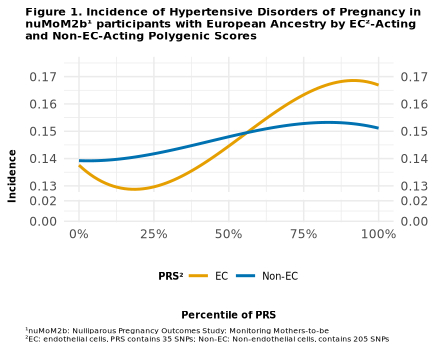
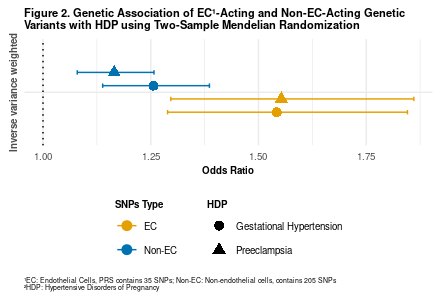
Abstract Body (Do not enter title and authors here): Introduction The hypertensive disorders of pregnancy (HDPs), i.e., preeclampsia and gestational hypertension, are characterized by endothelial dysfunction in pregnancy and are epidemiologically and genetically associated with risk for coronary artery disease (CAD). A recent study suggested that endothelial cell (EC)-acting CAD risk variants may identify individuals who benefit from more intensive lipid-lowering treatment. This study evaluated whether the same EC CAD genetic risk score is also associated with HDPs using comprehensive statistical genetic approaches. Hypothesis EC-acting risk variants are more strongly associated with HDPs than non-EC-acting risk variants. Methods We examined 35 previously identified EC-acting and 205 non-EC-acting risk variants associated with CAD. First, using the Nulliparous Pregnancy Outcomes Study: Monitoring Mothers-to-Be (nuMoM2b), a prospective, multicenter U.S. pregnancy cohort, we calculated polygenic scores (PRS) comprised of either EC-acting or non-EC-acting CAD risk variants. Scores were adjusted for population structure with ten principal components, then associated with HDPs using logistic regression models adjusted for age. Second, we tested the genetic association of EC-acting and non-EC-acting CAD variants with preeclampsia and gestational hypertension using two-sample Mendelian randomization (MR). Results Among 5,638 unrelated nuMoM2b participants of European ancestry, we observed higher incidence of HDPs in participants with higher EC-acting PRS (Figure 1). Each standard deviation of higher EC-acting PRS was associated with 1.10-fold increased odds of HDP (95% CI: 1.02–1.19; P=0.01). In contrast, the non-EC-acting PRS was not significantly associated with HDP risk (OR: 1.04, 95% CI: 0.97–1.12; P=0.25). In two-sample MR, EC-acting variants were strongly associated with both preeclampsia (P <0.001) and gestational hypertension (P = 0.009); genetic associations were stronger for EC-acting vs. non-EC-acting CAD risk variants for both outcomes (Pheterogeneity <0.05, Figure 2). Conclusion Using PRS and two-sample MR approaches, we observed enrichment for EC-acting genetic risk variants in women with HDPs. These findings support a shared genetic architecture between HDPs and CAD through endothelial dysfunction and suggest that women with a history of HDPs may benefit from more intensive lipid control for cardiovascular disease prevention.
Li, Linke
( Massachusetts General Hospital
, Boston
, Massachusetts
, United States
)
Zhang, Yu
( Indiana University
, Indianapolis
, Indiana
, United States
)
Truong, Buu
( Broad Institute of MIT and Harvard
, Cambridge
, Massachusetts
, United States
)
Yu, Zhi
( Massachusetts General Hospital
, Boston
, Massachusetts
, United States
)
Marston, Nicholas
( Brigham and Women's Hospital
, Boston
, Massachusetts
, United States
)
Gupta, Rajat
( Brigham and Women's Hospital
, Boston
, Massachusetts
, United States
)
Haas, David
( Indiana University
, Indianapolis
, Indiana
, United States
)
Liu, Nianjun
( Indiana University
, Indianapolis
, Indiana
, United States
)
Honigberg, Michael
( Massachusetts General Hospital
, Boston
, Massachusetts
, United States
)
Author Disclosures:
Linke Li:DO NOT have relevant financial relationships
| Yu Zhang:No Answer
| Buu Truong:DO NOT have relevant financial relationships
| Zhi Yu:DO NOT have relevant financial relationships
| Nicholas Marston:DO have relevant financial relationships
;
Research Funding (PI or named investigator):Ionis:Active (exists now)
; Other (please indicate in the box next to the company name):Janssen (DSMB):Active (exists now)
; Advisor:Radence:Active (exists now)
; Advisor:New Amsterdam:Past (completed)
; Advisor:Ionis:Expected (by end of conference)
; Advisor:Amgen:Past (completed)
; Speaker:Amgen:Past (completed)
; Research Funding (PI or named investigator):Amgen:Active (exists now)
| Rajat Gupta:No Answer
| David Haas:DO NOT have relevant financial relationships
| Nianjun Liu:No Answer
| Michael Honigberg:DO have relevant financial relationships
;
Research Funding (PI or named investigator):Genentech:Active (exists now)
; Advisor:Miga Health:Past (completed)
; Consultant:Comanche Biopharma:Past (completed)
; Research Funding (PI or named investigator):Novartis:Active (exists now)