Heart and Lung Transplantation by Citizenship Status: Achieving Equitable Outcomes Despite Inequitable Access
Abstract Body (Do not enter title and authors here): Introduction: Non-U.S. citizens, including undocumented immigrants and international patients, face substantial barriers to heart and lung transplantation in the U.S., including lack of insurance, restrictive policies, and inconsistent eligibility criteria. Despite this, they contribute meaningfully to the deceased donor organ pool. While kidney transplantation in non-citizens has received growing attention, access and outcomes in thoracic transplantation remain understudied. We examined disparities in transplant access and outcomes by citizenship status using national data.
Methods: We analyzed Organ Procurement and Transplantation Network data from 2015–2020 for deceased donors and adult heart- and lung-alone transplant recipients. To allow one-year follow-up, survival analyses included recipients transplanted through 2019. Recipients were categorized as U.S. citizens, non-citizen U.S. residents (NCR), or non-citizen non-residents (NCNR). ANOVA/Kruskal-Wallis and chi-square tests compared baseline characteristics across groups. Competing risk models estimated 1- and 3-year probabilities of transplant, removal for deterioration, remaining on the waitlist, or other reasons. Kaplan-Meier curves and multivariable Cox models assessed post-transplant survival, adjusting for demographic and clinical covariates.
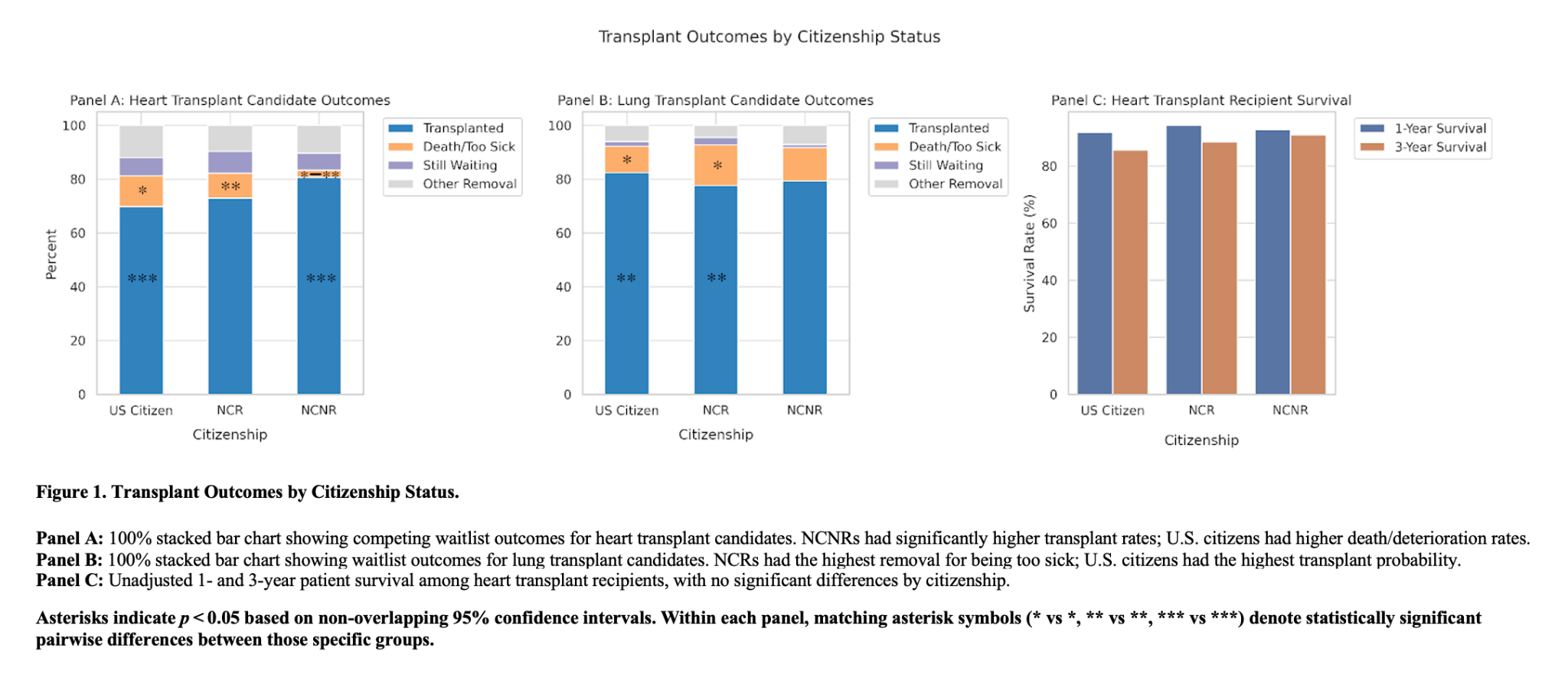
Results: Among 27,427 deceased donor transplants, NCR and NCNR recipients comprised <4% of heart and lung recipients, yet their donated organs were largely allocated to U.S. citizens. NCR and NCNR heart recipients showed higher illness severity at transplant (e.g., ICU admission, balloon pump use), while NCNR heart candidates had the highest 3-year transplant probability (80.7%), suggesting selective listing. NCR lung candidates faced the highest risk of removal for being too sick. Non-citizen lung recipients also had lower forced vital capacity, reduced walk distance, and higher steroid use. One- and three-year patient and graft survival were similar across citizenship groups. Citizenship status was not associated with post-transplant mortality or graft failure in adjusted models.
Conclusion: Although non-citizens contribute to the thoracic donor pool, they remain underrepresented as transplant recipients—even though they achieve equivalent outcomes once transplanted. These findings underscore ethical concerns and support reforms to expand equitable, standardized eligibility across centers.
Djelmami-hani, Rayan
(
Boston University Chobanian & Avedisian School of Medicine and Boston Medical Center
, Boston , Massachusetts , United States )
Rizzolo, Katherine
(
Boston University Chobanian & Avedisian School of Medicine and Boston Medical Center
, Boston , Massachusetts , United States )
Cervantes, Lilia
(
University of Colorado Anschutz Medical Campus
, Aurora , Colorado , United States )
Author Disclosures:
Rayan Djelmami-Hani:DO NOT have relevant financial relationships
| Katherine Rizzolo:No Answer
| Lilia Cervantes:DO NOT have relevant financial relationships
Lee Yura, Gharib Sina, London Stephanie, Yu Bing, Austin Thomas, Bartz Traci, Ladd-acosta Christine, Morrison Alanna, North Kari, Boerwinkle Eric, Shah Amil, Psaty Bruce