Cardiovascular Disease Predictive Models with Only Social Determinants and Behavioral Factors may be as Predictive as Traditional Risk Scores
Abstract Body (Do not enter title and authors here): Background: This study aimed to develop cardiovascular (CVD) predictive models using only social, environmental, and behavioral drivers of health. Traditional CVD risk scores incorporate clinical and behavioral factors shaped by upstream social determinants of health (SDOH). A model focused solely on upstream factors may enable earlier risk identification and prevention before conditions such as hypertension or diabetes develop.
Research Question: Can a CVD prediction model using only SDOH and behavioral risk factors perform comparably to current CVD risk scores?
Methods: The 2021 Medical Expenditure Panel Survey (MEPS) data was used to develop the models. MEPS included 18,435 participants in its SDOH survey. CVD, the outcome for all models, was defined using MEPS survey responses and ICD-10 codes for coronary artery disease, myocardial infarction, heart failure, and stroke. Predictors were organized according to the Vital Conditions of 1) Thriving Natural World, 2) Basic Needs for Health and Safety, 3) Humane Housing, 4) Meaningful Work and Wealth, 5) Lifelong Learning, 6) Reliable Transportation, and 7) Belonging and Civic Muscle. Age and sex were also included. Models were developed using LASSO, elastic net, random forest, XGBoost, and multivariable logistic regression. Internal validation assessed discrimination and calibration using AUC, Brier score, slope, and expected-to-observed ratios (E:O). The models were evaluated using k-fold cross-validation. The best models were applied within subgroups by age (+/- 65 years), sex, and race/ethnicity.
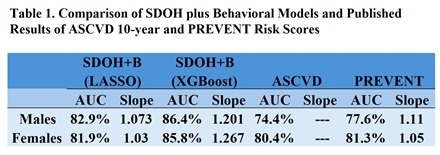
Results: LASSO (AUC 82.6%, slope 1.048, Brier 0.088, E:O 1.003) and XGBoost (AUC 86.3%, slope 1.23, Brier 0.086, E:O 1.0) were the top-performing models. Subgroup analyses showed good calibration, except among individuals aged 65 years or older. XGBoost identified community and social isolation as key predictors; LASSO emphasized healthcare barriers, adverse childhood events, smoking, and food insecurity. Both models selected stress, anxiety, income, financial strain, education, transportation, exercise, Medicaid, and social support.
Conclusion: SDOH plus behavioral models performed as well as or better than current CVD risk scores. A model focused on upstream factors can support prevention and risk stratification before clinical indicators arise and may be applicable across diverse settings.
Kjelstrom, Stephanie
(
Thomas Jefferson University
, Philadelphia , Pennsylvania , United States )
Hass, Richard
(
Thomas Jefferson University
, Philadelphia , Pennsylvania , United States )
Larson, Sharon
(
Thomas Jefferson University
, Philadelphia , Pennsylvania , United States )
Author Disclosures:
Stephanie Kjelstrom:DO NOT have relevant financial relationships
| Richard Hass:DO NOT have relevant financial relationships
| Sharon Larson:No Answer