Scientific Sessions 2025
/
Stroke, Cognition & Disparities
/
Glucagon-like Peptide-1 Receptor Agonists and Sodium-Glucose Cotransporter-2 Inhibitors Reduce Dementia Risk in Type 2 Diabetes: A Comprehensive Bayesian Network Meta-Analysis
American Heart Association
137
0
Final ID: Mo1011
Glucagon-like Peptide-1 Receptor Agonists and Sodium-Glucose Cotransporter-2 Inhibitors Reduce Dementia Risk in Type 2 Diabetes: A Comprehensive Bayesian Network Meta-Analysis
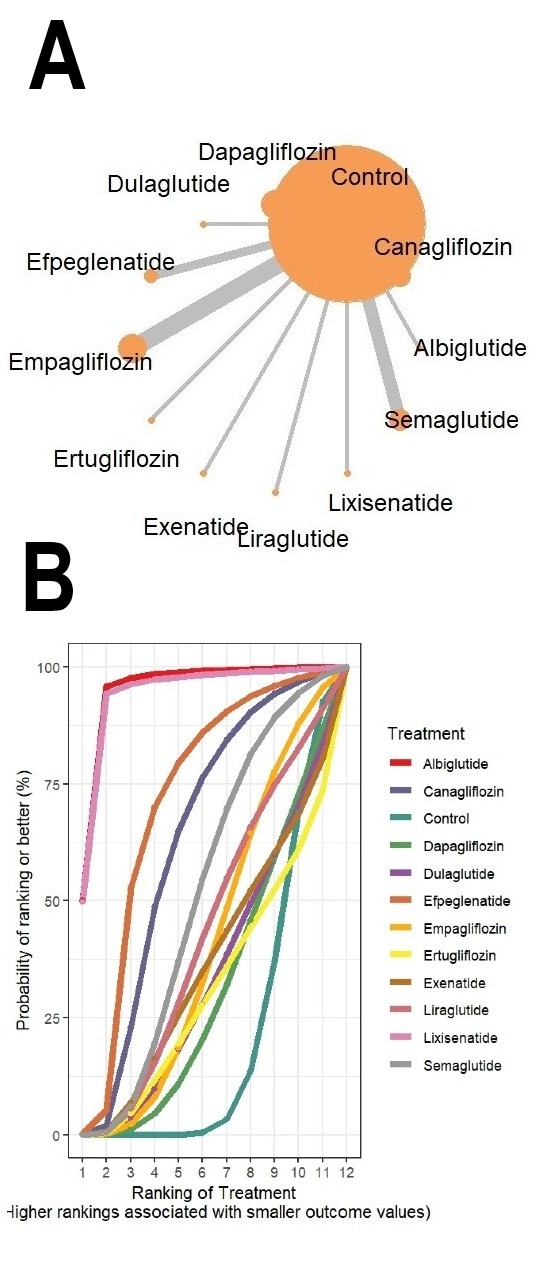
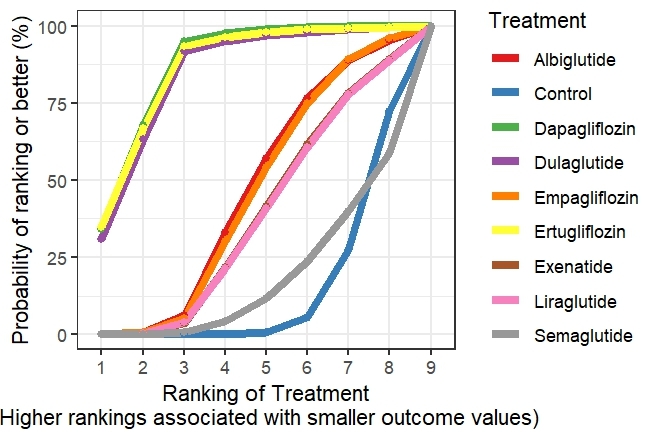
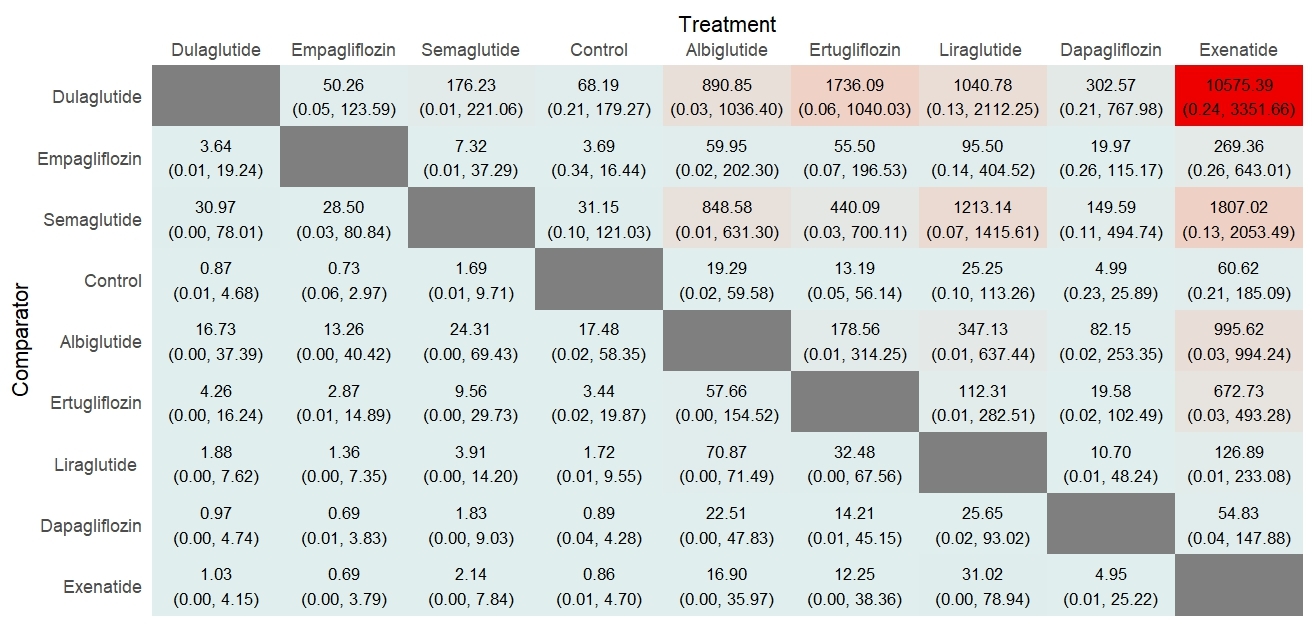
Abstract Body (Do not enter title and authors here): Background: Glucagon-like peptide-1 receptor agonists (GLP-1RAs) and sodium-glucose cotransporter-2 inhibitors (SGLT2is) are cardioprotective glucose-lowering therapies, but their impact on dementia risk in type 2 diabetes remains underexplored. Methods: We searched PubMed, Scopus, and Embase from inception to May 1, 2025, for randomized controlled trials (RCTs) comparing GLP-1RAs or SGLT2is with controls, reporting dementia or cognitive score changes. Included trials featured guideline-recommended drugs for cardiovascular risk reduction. A Bayesian network meta-analysis estimated risk ratios (RR) with 95% credible intervals (CrI) using Markov Chain Monte Carlo methods, with Gelman-Rubin diagnostics for convergence. Surface under the cumulative ranking curve (SUCRA) ranked treatments. Results: From 22 RCTs with 156,697 patients, therapies showed varied dementia risk reductions. For all-cause dementia versus control according to the SUCRA: albiglutide (RR: 0.03, 95% CrI: 0.00 to 0.08; SUCRA: 94.4%), lixisenatide (RR: 0.08, 95% CrI: 0.00 to 0.20; SUCRA: 93.62%), efpeglenatide (RR: 0.24, 95% CrI: 0.00 to 1.38; SUCRA: 70.09%), canagliflozin (RR: 0.31, 95% CrI: 0.01 to 1.47; SUCRA: 61.81%), semaglutide (RR: 0.50, 95% CrI: 0.03 to 1.98; SUCRA: 50.06%), liraglutide (RR: 2.12, 95% CrI: 0.02 to 9.89; SUCRA: 41.91%), empagliflozin (RR: 0.68, 95% CrI: 0.05 to 2.35; SUCRA: 39.63%), exenatide (RR: 4.13, 95% CrI: 0.02 to 20.28; SUCRA: 35.41%), dulaglutide (RR: 3.38, 95% CrI: 0.03 to 15.72; SUCRA: 32.89%), dapagliflozin (RR: 1.19, 95% CrI: 0.09 to 4.96; SUCRA: 30.37%), ertugliflozin (RR: 6.79, 95% CrI: 0.02 to 29.23; SUCRA: 30.1%), control (SUCRA: 19.67%). For vascular dementia versus control: dapagliflozin (RR: 0.01, 95% CrI: 0.00 to 0.08; SUCRA: 86.65%), ertugliflozin (RR: 0.03, 95% CrI: 0.00 to 0.16; SUCRA: 85.98%), dulaglutide (RR: 0.05, 95% CrI: 0.00 to 0.32; SUCRA: 84.35%), while semaglutide (RR: 3.83, 95% CrI: 0.05 to 21.72; SUCRA: 17.4%), and control (SUCRA: 13.2%). For Alzheimer’s dementia versus control: dulaglutide showed the lowest (RR: 0.87, 95% CrI: 0.01 to 4.68; SUCRA: 77.64%), while exenatide the highest (RR: 60.62, 95% CrI: 0.21 to 185.09; SUCRA: 23.36%), and control (SUCRA: 50.29%). Conclusions: GLP-1RAs and SGLT2is reduce dementia risk, with albiglutide and lixisenatide excelling for all-cause dementia, dapagliflozin and ertugliflozin for vascular dementia, and dulaglutide for Alzheimer’s. Higher risks with some drugs highlight tailored therapy needs.
Khalil, Ibrahim
(
Dhaka Medical College and Hospital
, Dhaka , Bangladesh )
Hossain, Md. Imran
(
Manikganj Medical College
, Manikganj , Bangladesh )
Akter, Mst. Mahmuda
(
Manikganj Medical College
, Manikganj , Bangladesh )
Rahman, Mohd Turzo
(
Flushing Hospital Medical Center
, Flushing , New York , United States )
Al-badri, Sajjad Ghanim
(
University of Baghdad, College of Medicine
, Baghdad , Iraq )
Promi, Sunjida Amin
(
Chittagong Medical College
, Chittagong , Bangladesh )
Author Disclosures:
Ibrahim Khalil:DO NOT have relevant financial relationships
| Md. Imran Hossain:No Answer
| Mst. Mahmuda Akter:No Answer
| Mohd Turzo Rahman:DO NOT have relevant financial relationships
| Sajjad Ghanim Al-Badri:No Answer
| Sunjida Amin Promi:No Answer
Elbahloul Mohammed A., Al-badri Sajjad Ghanim, Al Sakini Ahmed, Elgendy Islam, Mansour Ahmed, Mohamed Ahmed, Elazab Ahmed, Kasem Ahmed Wahdan, Kurmasha Yousif, Ibrahim Rahma, Al-shammari Ali Saad, Hassanin Mohammed Sabri