Low-Dose Semaglutide Attenuates Cardiac Lipid Content and Hepatic Steatosis in Cardiometabolic HFpEF: Weight Loss Independent Actions of GLP-1 Receptor Activation
Abstract Body (Do not enter title and authors here): Background: Heart failure with preserved ejection fraction (HFpEF) is a complex, multisystemic disorder associated with cardiometabolic comorbidities and significant mortality. Aberrant metabolic substrate utilization and ectopic accumulation of lipid droplets in cardiomyocytes and heaptocytes are implicated as critical drivers of cardiometabolic HFpEF. Semaglutide, a glucagon-like peptide-1 receptor agonist (GLP-1RA), has shown promising cardiovascular benefits in HFpEF patients with improvements in exercise capacity and quality of life. However, the specific effects of semaglutide on intracardiac and intrahepatic lipids in HFpEF remain largely unexplored.
Methods: We employed two models of cardiometabolic HFpEF. Male ZSF1 obese rats with established HFpEF (n=6/group) were randomized to either low-dose semaglutide (30 nmol/kg, SQ, twice weekly) or vehicle for 16 weeks. Female Göttingen minipigs (n=5/group) developed HFpEF following 8 weeks of aldosterone mimetic (i.e., DOCA) treatment in combination with a high-fat, high-salt Western diet. Pigs were randomized to control or low-dose semaglutide (8 nmol/kg, IM, once weekly, n=5/group) for 12 weeks. Comprehensive assessments of echocardiography, treadmill exercise, invasive hemodynamic measurements, quantification of myocardial and hepatic lipid deposition, and ultrastructural analysis via electron microscopy were performed.
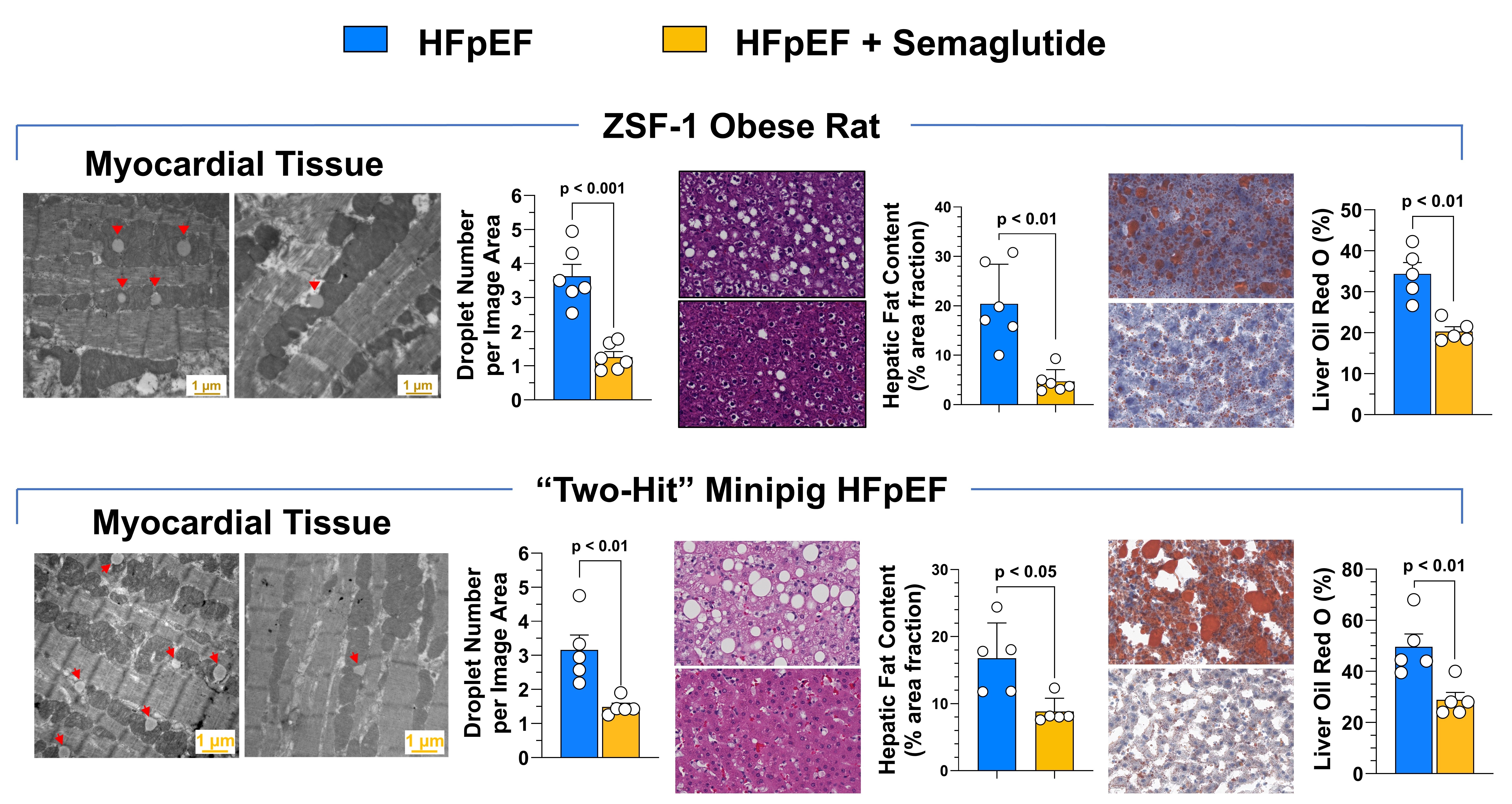
Results: Semaglutide treatment did not induce weight loss in either model of HFpEF but resulted in significant reductions in ectopic lipid accumulation. Specifically, semaglutide reduced both the number and size of intracardiac and intrahepatic lipid droplets. These reductions in lipid deposition were accompanied by improved cardiac function, as evidenced by enhanced left ventricular (LV) diastolic function (E/e') and lowered LV end-diastolic pressure (LVEDP). Furthermore, semaglutide attenuated fibrosis in both the heart and liver and improved vascular function in both HFpEF models. In the rat model, exercise capacity was also improved.
Conclusion: Semaglutide effectively reduced lipid accumulation across multiple organs relevant to HFpEF, including the heart, liver, and skeletal muscle, and this was associated with improved LV diastolic function and exercise performance. These findings highlight the potential of GLP-1RAs as a targeted therapy to mitigate the detrimental effects of ectopic lipid deposition in obese patients with cardiometabolic HFpEF.
Elbatreek, Mahmoud
(
Cedars-Sinai Medical Center
, Los Angeles , California , United States )
Li, Zhen
(
China Pharmaceutical University
, Nanjing , China )
Shah, Sanjiv
(
NORTHWESTERN UNIVERSITY
, Chicago , Illinois , United States )
Allerton, Timothy
(
Pennington Biomedical Research Cent
, Baton Rouge , Louisiana , United States )
Yang, Hsin-jung
(
Cedars Sinai Medical Center
, Los Angeles , California , United States )
Lefer, David
(
Cedars-Sinai Medical Center
, Los Angeles , California , United States )
Goodchild, Traci
(
Smidt Heart Institute Cedars Sinai
, Los Angeles , California , United States )
Author Disclosures:
Mahmoud Elbatreek:DO NOT have relevant financial relationships
| Zhen Li:DO NOT have relevant financial relationships
| Sanjiv Shah:DO NOT have relevant financial relationships
| Timothy Allerton:DO NOT have relevant financial relationships
| Hsin-jung Yang:DO NOT have relevant financial relationships
| David Lefer:DO NOT have relevant financial relationships
| Traci Goodchild:DO NOT have relevant financial relationships