
Trends in Incidence of Atrial Fibrillation in the Midwest USA from 2013 to 2023
Abstract Body (Do not enter title and authors here): Background: Atrial fibrillation (AF) is the most common sustained arrhythmia with prevalence increasing over the last decade. However, data on recent temporal trends in incidence of AF have been inconsistent, with some reports of increasing trends over time and others indicating no change in incidence over time. Therefore, we aimed to determine how the incidence of AF has changed over the last decade in a community in the Midwest USA.
Methods: Between 2013 and 2023, adults (aged 18 and older) with incident AF were identified in a 27-county region in the Midwest. AF was identified using diagnostic codes by employing an electronic algorithm requiring 1 inpatient code or 2 outpatient codes separated by >7 days but within 1 year. For total rates, age - and sex-adjusted incidence rates were standardized to the 2010 US total population. Poisson regression was used to calculate the incidence rate ratio of AF for 2023 vs 2013.
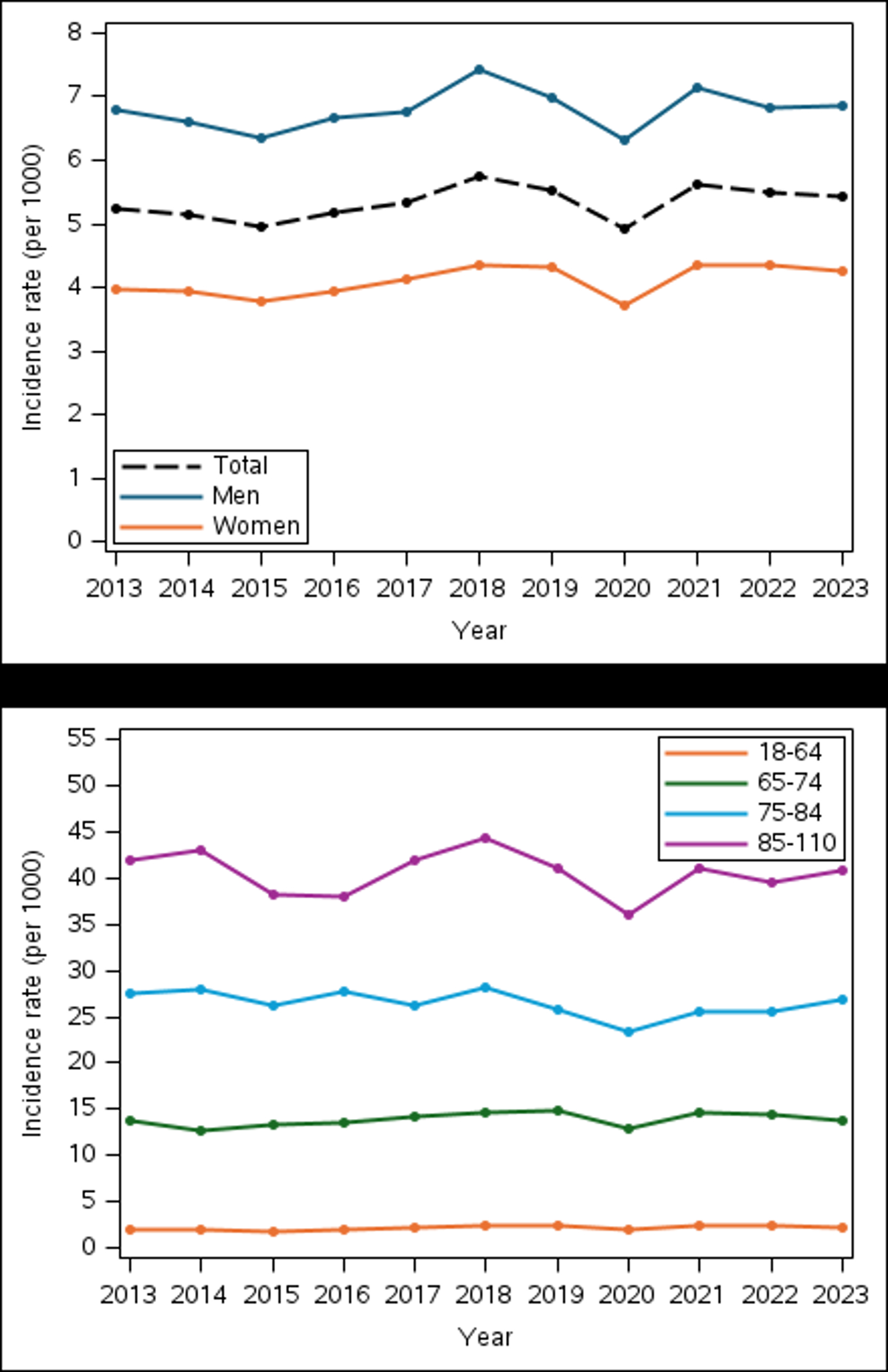
Results: We identified 44,930 individuals with incident AF from 2013 to 2023. Of these, 56.4% were male, the mean (SD) age was 72.8 (13.5) years, and 95.8% were non-Hispanic white. The age-and sex-adjusted incidence rates (per 1,000) and 95% confidence intervals standardized to the 2010 US total population were 5.24 (5.07-5.41) in 2013, 5.73 (5.56-5.91) in 2018, and 5.44 (5.28-5.61) in 2023. Although a drop in incidence was observed corresponding to the COVID-19 pandemic, a small increase in the overall incidence of AF was observed over time. The overall incidence rate ratio (95% CI) for 2023 vs 2013 was 1.07 (1.02-1.11), P=0.003. The incidence rates were higher in men compared to women and increased with older age (Figure 1). However, differences in AF incidence by sex were greatest in the youngest age group and attenuated with older age (incidence rate ratio (95% CI): 2.18 (2.10-2.28) for ages 18-64 years, 1.76 (1.70-1.83) for ages 65-74 years, 1.38 (1.33-1.42) for ages 75-84 years, and 1.23 (1.18-1.28) for ages 85 years and older).
Conclusion: In this 27-county region in the Midwest, although small in magnitude, a statistically significant increase in AF incidence was observed over time from 2013 to 2023. Furthermore, the incidence of AF was higher in men compared with women, especially in younger age groups.
Salama, Peter
( University of Minnesota
, Minneapolis
, Minnesota
, United States
)
Deshmukh, Abhishek
( Mayo Clinic
, Rochester
, Minnesota
, United States
)
Chamberlain, Alanna
( MAYO CLINIC
, Rochester
, Minnesota
, United States
)
Tordsen, Walker
( University of Minnesota
, Minneapolis
, Minnesota
, United States
)
Manemann, Sheila
( MAYO CLINIC
, Rochester
, Minnesota
, United States
)
Killian, Jill
( Mayo Clinic
, Rochester
, Minnesota
, United States
)
Vaughan, Lisa
( Mayo Clinic
, Rochester
, Minnesota
, United States
)
Gersh, Bernard
( Mayo Clinic
, Rochester
, Minnesota
, United States
)
Siontis, Konstantinos
( Mayo Clinic
, Rochester
, Minnesota
, United States
)
Noseworthy, Peter
( MAYO CLINIC
, Rochester
, Minnesota
, United States
)
Desimone, Christopher
( MAYO CLINIC
, Rochester
, Minnesota
, United States
)
Author Disclosures:
Peter Salama:DO NOT have relevant financial relationships
| Abhishek Deshmukh:DO NOT have relevant financial relationships
| Alanna Chamberlain:DO have relevant financial relationships
;
Research Funding (PI or named investigator):Exact Sciences :Past (completed)
| Walker Tordsen:No Answer
| Sheila Manemann:DO NOT have relevant financial relationships
| Jill Killian:DO NOT have relevant financial relationships
| Lisa Vaughan:No Answer
| Bernard Gersh:DO NOT have relevant financial relationships
| Konstantinos Siontis:No Answer
| Peter Noseworthy:DO have relevant financial relationships
;
Royalties/Patent Beneficiary:Anumana:Active (exists now)
| Christopher Desimone:DO NOT have relevant financial relationships