Logo

American Heart Association

  17
  0


Final ID: MP2674

Circulating extracellular vesicle-derived CAPG as a novel molecule associated with pathophysiology and outcomes in heart failure

Abstract Body (Do not enter title and authors here): Introduction:
Extracellular vesicles (EVs) facilitate the transportation of active biomolecules, including proteins, and play crucial roles in intercellular and interorgan communications under both physiological and pathological conditions. However, the proteome or clinical relevance of the circulating EVs in heart failure has yet to be elucidated.

Aims:
We sought to illustrate the distinct proteomic profile of circulating EVs and to identify the clinical significance in patients with heart failure.

Methods:
We isolated and purified circulating EVs from patient serum using size-exclusion chromatography. Quantitative proteomic analysis of the EVs was conducted through mass spectrometry in a discovery cohort comprising 15 hospitalized patients with heart failure with reduced ejection fraction (HFrEF) and 8 non-heart failure control subjects. Associations between EV-derived molecules and clinical outcomes were examined in a cohort of 95 consecutive HFrEF patients with dilated cardiomyopathy.

Results:
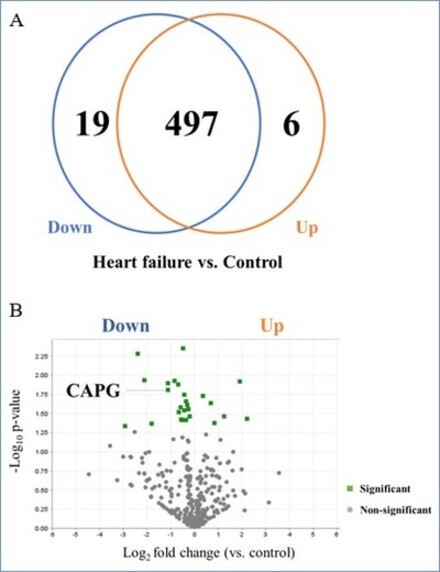
In the discovery cohort, quantitative proteomics identified a total of 522 proteins within circulating EVs. Among these, 19 molecules were significantly down-regulated and 6 were up-regulated in patients with HFrEF compared to controls (Figure 1). Notably, macrophage-capping protein (CAPG) emerged as one of the most down-regulated molecules in HFrEF. CAPG is known to regulate cytoplasmic and nuclear structures through potential interactions with actin, suggesting a role in gene regulation and cellular remodeling. In the validation cohort (mean age, 56.9 years: 66.3% male), we assessed the levels of EV-derived CAPG (EV-CAPG) and found that patients with lower EV-CAPG showed more enlarged left ventricular dimensions and higher BNP levels. During a median follow-up period of 1313 days, patients with decreased EV-CAPG exhibited significantly lower event-free survival from the composite outcomes of cardiac death and worsening heart failure (Figure 2). In a multivariable Cox proportional hazard model, low EV-CAPG was independently associated with increased risks of the cardiac events (hazard ratio, 2.73; 95% confidence interval, 1.01-7.36; P = 0.04).

Conclusion:
Reduced levels of circulating EV-CAPG are associated with adverse clinical outcomes in patients with HFrEF. EV-CAPG may represent a novel molecular target involved in the pathogenesis of heart failure.
  • Okochi, Satoshi  ( Fukushima Medical University , Fukushima , Japan )
  • Oikawa, Masayoshi  ( Fukushima Medical University , Fukushima , Japan )
  • Kobayashi, Atsushi  ( Fukushima Medical University , Fukushima , Japan )
  • Yoshihisa, Akiomi  ( Fukushima Medical University , Fukushima , Japan )
  • Takeishi, Yasuchika  ( Fukushima Medical University , Fukushima , Japan )
  • Misaka, Tomofumi  ( Fukushima Medical University , Fukushima , Japan )
  • Oowada, Koji  ( Fukushima Medical University , Fukushima , Japan )
  • Kusano, Ryota  ( Fukushima Medical University , Fukushima , Japan )
  • Suzuki, Yoshinori  ( Fukushima Medical University , Fukushima , Japan )
  • Ogawara, Ryo  ( Fukushima Medical University , Fukushima , Japan )
  • Ichimura, Shohei  ( Fukushima Medical University , Fukushima , Japan )
  • Yokokawa, Tetsuro  ( Fukushima Medical University , Fukushima , Japan )
  • Sato, Takamasa  ( Fukushima Medical University , Fukushima , Japan )
  • Author Disclosures:
    Satoshi Okochi: DO NOT have relevant financial relationships | Masayoshi Oikawa: No Answer | Atsushi Kobayashi: No Answer | Akiomi Yoshihisa: DO NOT have relevant financial relationships | Yasuchika Takeishi: DO NOT have relevant financial relationships | Tomofumi Misaka: DO NOT have relevant financial relationships | Koji Oowada: DO NOT have relevant financial relationships | Ryota Kusano: DO NOT have relevant financial relationships | Yoshinori Suzuki: DO NOT have relevant financial relationships | Ryo Ogawara: DO NOT have relevant financial relationships | Shohei Ichimura: DO NOT have relevant financial relationships | Tetsuro Yokokawa: DO NOT have relevant financial relationships | Takamasa Sato: DO NOT have relevant financial relationships
Meeting Info:

Scientific Sessions 2025

2025

New Orleans, Louisiana

Session Info:

Innovative Approaches and Insights Into HF Therapies

Monday, 11/10/2025 , 09:15AM - 10:15AM

Moderated Digital Poster Session

More abstracts on this topic:
A validated metabolite-based biomarker score for fruit and vegetable intake and associations with all-cause mortality and incident cardiometabolic diseases

Oude Griep Linda, Li Chunxiao, Koulman Albert, Imamura Fumiaki, Wareham Nicholas, Forouhi Nita

Assessing the Role of Charlson Comorbidity Index in Predicting Mortality Among Patients Requiring Rapid Response Team within 24 Hours of Admission

Salamatbad Gidon, Palati Sai, Lin Kuan-yu, Leung Christian, Wang Cassie, Jassal Ajay, Li Shuojohn, Guntaka Saimanoj, Chang Joshua, Jnani Jack, Patel Pushpendra, Cyr Andrew, Weintraub Spencer, Griffin Matthew, Alvarez Villela Miguel, Pierce Matthew, Shknevskiy Shusterman Vlad, Bhatt Madhav, Suleman Saman, Nuvvula Sri, Lin Allan, Dahal Kripa, Elkhechen Nader

More abstracts from these authors:
Macrophage Extracellular Traps Promote Maladaptive Cardiac Remodeling And Heart Failure Via PAD4-dependent Mechanisms

Ichimura Shohei, Miura Saori, Ueda Koki, Oikawa Masayoshi, Ikeda Kazuhiko, Ishida Takafumi, Takeishi Yasuchika, Misaka Tomofumi, Kusano Ryota, Oowada Koji, Suzuki Yoshinori, Okochi Satoshi, Ogawara Ryo, Miura Shunsuke, Yokokawa Tetsuro

Macrophage Extracellular Traps In Myocardial Tissue Are Associated With Adverse Clinical Outcomes In Patients With Heart Failure

Ichimura Shohei, Yokokawa Tetsuro, Sato Takamasa, Oikawa Masayoshi, Kobayashi Atsushi, Yoshihisa Akiomi, Takeishi Yasuchika, Misaka Tomofumi, Oowada Koji, Kusano Ryota, Suzuki Yoshinori, Okochi Satoshi, Ogawara Ryo, Sato Yu, Miura Shunsuke

You have to be authorized to contact abstract author. Please, Login
Not Available