
Logo

American Heart Association

  20
  0


Final ID: MP310

Redefining Cardiotoxicity Surveillance in Targeted Immunotherapy: Cytokine Release Syndrome as a High-Yield Trigger for Detecting Cancer Therapy-Related Cardiac Dysfunction After CAR-T Therapy

Abstract Body (Do not enter title and authors here): Introduction:
Chimeric antigen receptor T-cell (CAR-T) therapy offers durable remissions in hematologic malignancies but carries a substantial risk of cancer therapy–related cardiac dysfunction (CTRCD). Current imaging strategies are predominantly event-driven, initiated after overt cardiovascular deterioration, leading to underdiagnosis of subclinical or evolving dysfunction. Cytokine release syndrome (CRS), a near-universal CAR-T complication, represents a biologically and temporally linked trigger for cardiac injury. We hypothesized that CRS-guided echocardiography, independent of MACE, would improve CTRCD detection and enable earlier intervention.

Methods:
We retrospectively analyzed 81 CAR-T recipients with pre- and post-treatment echocardiograms. CTRCD was defined by: (1) LVEF <50% or >10% decline, (2) >15% GLS reduction, or (3) either (LVEF or GLS). Surveillance performance was compared between CRS- and MACE-triggered imaging. Univariable and stratified logistic regression assessed associations between CRS grade and CTRCD risk. ROC analysis evaluated GLS reduction as a predictor of LVEF-defined CTRCD.

Results:
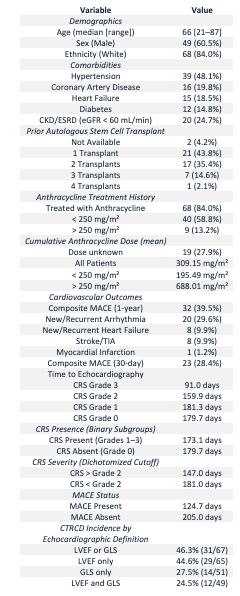
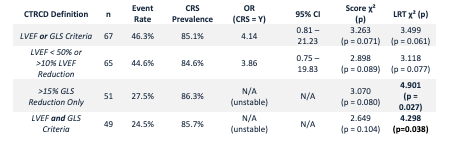
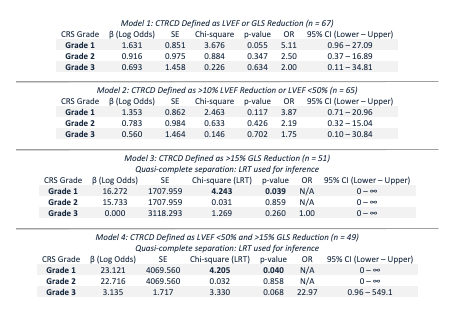
CTRCD occurred in 46.3% of patients based on the composite “LVEF or GLS” definition; LVEF-defined CTRCD occurred in 44.6%, GLS-defined CTRCD in 27.5%, and dual-criteria CTRCD (both LVEF and GLS abnormalities) in 24.5%. CRS occurred in 85.1%, mostly Grades 1–2. CRS-based surveillance detected 93.5% of all CTRCD cases and 100% of GLS-only and dual-criteria cases, compared to 48.4–58.3% detection via MACE-based imaging. MACE-based surveillance missed over 50% of affected patients across all CTRCD definitions. Logistic regression models revealed elevated CTRCD risk with any CRS exposure; Grade 1 CRS conferred the strongest odds (OR 5.11, p = 0.055). Quasi-complete separation occurred in GLS-only and dual-criteria models, as all CTRCD cases occurred in patients with CRS. ROC analysis showed that GLS reduction >8.63% predicted LVEF-defined CTRCD with an AUC of 0.766 (sensitivity 66.7%, specificity 87.5%).

Conclusion:
CRS is a powerful and reproducible trigger for detecting CTRCD defined by LVEF and/or GLS. Compared to MACE-driven imaging, CRS-based surveillance offers greater sensitivity and earlier detection of subclinical dysfunction. Event-triggered imaging misses over half of cases. Our findings support integrating CRS-based surveillance into post-CAR-T care to improve early detection, risk stratification, and cardioprotection.
  • Henson, Jeffrey  ( UAMS , Little Rock , Arkansas , United States )
  • Vallurupalli, Srikanth  ( UAMS , Little Rock , Arkansas , United States )
  • Spears, Garrett  ( UAMS , Little Rock , Arkansas , United States )
  • Daughdrill, Brett  ( UAMS , Little Rock , Arkansas , United States )
  • Vellanki, Sruthi  ( UAMS , Little Rock , Arkansas , United States )
  • Trikannad, Anup Kumar  ( UAMS , Little Rock , Arkansas , United States )
  • Odueke, Adetayo  ( UAMS , Little Rock , Arkansas , United States )
  • Mohan Lal, Bhavesh  ( UAMS , Little Rock , Arkansas , United States )
  • Pandey, Toshali  ( UAMS , Little Rock , Arkansas , United States )
  • Gentille, Cesar  ( UAMS , Little Rock , Arkansas , United States )
  • Author Disclosures:
    Jeffrey Henson: DO NOT have relevant financial relationships | Srikanth Vallurupalli: No Answer | Garrett Spears: DO NOT have relevant financial relationships | Brett Daughdrill: No Answer | Sruthi Vellanki: No Answer | anup kumar Trikannad: No Answer | Adetayo Odueke: No Answer | Bhavesh Mohan Lal: No Answer | Toshali Pandey: DO NOT have relevant financial relationships | Cesar Gentille: No Answer
Meeting Info:

Scientific Sessions 2025

2025

New Orleans, Louisiana

Session Info:

Cardiac Imaging in Cancer Therapy: Risk Prediction, Detection, and AI-Driven Insight

Saturday, 11/08/2025 , 12:15PM - 01:25PM

Moderated Digital Poster Session

More abstracts on this topic:
A Novel Echocardiography Risk Score Predicted Mortality In Patients With Heart Failure With Preserved Ejection Fraction.

Iwakura Katsuomi, Yoshio Yasumura, Hikoso Shungo, Okada Katsuki, Nakatani Daisaku, Sotomi Yohei, Sakata Yasushi, Tanaka Nobuaki, Okada Masato, Okamura Atsunori, Heitaro Watanabe, Seo Masahiro, Hayashi Takaharu, Yano Masamichi, Yamada Takahisa

A Competency-Based Screening Echocardiography Curriculum Designed for Rural American Indian Community Health Representatives

Thoroughman Rose, Riley Alan, De Loizaga Sarah, Adams David, Beaton Andrea, Buonfiglio Samantha, Danforth Kristen, Masyuko Sarah, Miller Mccall, Yadava Mrinal

More abstracts from these authors:
Class 1C Antiarrhythmic Drugs are Safe in Patients with Arrhythmia-induced Cardiomyopathy Following Recovery of Left Ventricular Ejection Fraction

Pohlkamp Ryan, Chidambaram Vignesh, Kumar Amudha, Ghanta Nikhila, Odueke Adetayo, Vallurupalli Srikanth, Paydak Hakan

You have to be authorized to contact abstract author. Please, Login
Not Available