High Dietary Inflammatory Index, Not Total Calorie Intake, Predicts Cardiometabolic Mortality in Non-Obese U.S. Adults: NHANES 2007–2018
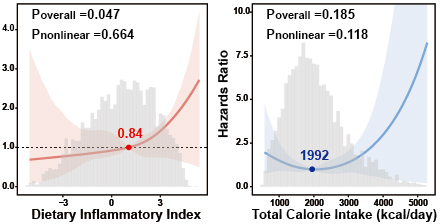
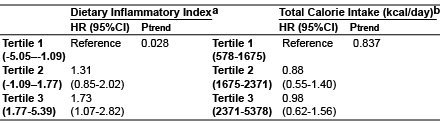
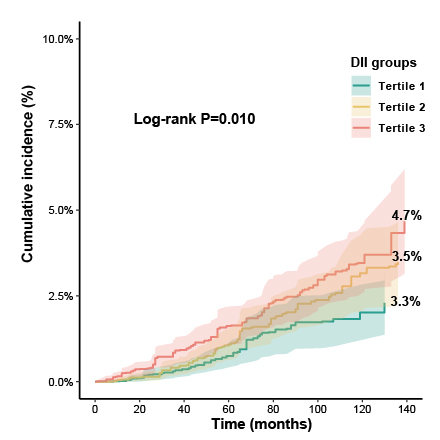
Abstract Body (Do not enter title and authors here): Background:The American Heart Association has emphasized the impact of dietary patterns on cardiometabolic health. Inflammation plays a central role in the pathogenesis of cardiometabolic diseases. The dietary inflammatory index (DII) is a validated tool for quantifying the overall inflammatory potential of diet. However, evidence regarding the association between DII and cardiometabolic mortality in non-obese adults remains limited. Methods: We analyzed 7,595 adults aged over 20 years with a body mass index less than 30 kg/m2 from NHANES 2007–2018. Cardiometabolic mortality was defined as death from heart disease, cerebrovascular disease, diabetes mellitus. Daily DII and total caloric intake were estimated using 24-hour dietary recall. Statistical analyses were conducted after accounting for the complex survey design (including weighting, clustering, and stratification). Associations of DII and total caloric intake with cardiometabolic mortality were assessed using restricted cubic spline analysis and Cox proportional hazards models, adjusting for potential confounders. Kaplan–Meier survival curves were used to estimate cumulative cardiometabolic mortality incidence across DII tertiles. Results: During a median follow-up of 79 months, 208 cardiometabolic deaths occurred (147 from heart disease, 39 from cerebrovascular disease, and 22 from diabetes mellitus). The mean ± SD of DII was 0.69 ± 0.08, and the median (interquartile range) of total caloric intake was 1992 (1503–2600) kcal/day. Among non-obese adults, a positive dose–response relationship was observed between DII and cardiometabolic mortality (adjusted HR [95% CI]: 1.13 [1.03–1.24]; Poverall = 0.047; Pnonlinear = 0.664). Compared with the lowest DII tertile (−5.05 to −0.19), the highest tertile (1.77 to 5.39) was associated with a 73% increased risk (Ptrend = 0.028), and correspondingly showed a higher cumulative incidence of cardiometabolic mortality (4.7% vs. 3.3%; log-rank test, P = 0.010) in Kaplan–Meier analysis. In contrast, total caloric intake was not significantly associated with cardiometabolic mortality in non-obese adults. Conclusions: DII demonstrated a strong predictive value for cardiometabolic mortality among non-obese adults. Reducing dietary inflammation, rather than calorie restriction, might better promote cardiometabolic health on non-obese population.
Xiao, Ying
(
Fuwai Hospital, Chinese Academy of Medical Sciences & Peking Union Medical College
, Beijing , China )
You, Hongzhao
(
Fuwai Hospital, Chinese Academy of Medical Sciences & Peking Union Medical College
, Beijing , China )
Yuan, Jiansong
(
Fuwai Hospital, Chinese Academy of Medical Sciences & Peking Union Medical College
, Beijing , China )
Yang, Weixian
(
Fuwai Hospital, Chinese Academy of Medical Sciences & Peking Union Medical College
, Beijing , China )
Author Disclosures:
Ying Xiao:DO NOT have relevant financial relationships
| Hongzhao You:No Answer
| Jiansong Yuan:No Answer
| Weixian Yang:DO NOT have relevant financial relationships