Trends and Disparities in Mortality due to Obesity and Arrhythmias in the U.S: 1999-2023
Abstract Body (Do not enter title and authors here): Background: Obesity and arrhythmias are two converging epidemics contributing to rising cardiovascular mortality in the U.S. Yet, national-level mortality trends where both conditions co-occur remain poorly characterized.
Research Question: How do mortality trends associated with arrhythmias and obesity among U.S. adults vary by sex, race/ethnicity, geographic region, and urbanization level between 1999 and 2023?
Methods: We conducted a retrospective analysis using the Centers for Disease Control and Prevention Wide-ranging Online Data for Epidemiologic Research (CDC WONDER) Multiple Cause of Death database. Arrhythmia-related deaths with co-listed obesity were extracted for U.S. adults between 1999 and 2023. Age-adjusted mortality rates (AAMRs) were calculated, and Joinpoint regression was used to estimate annual percentage changes (APCs) and average annual percentage changes (AAPCs) and identify significant trends.
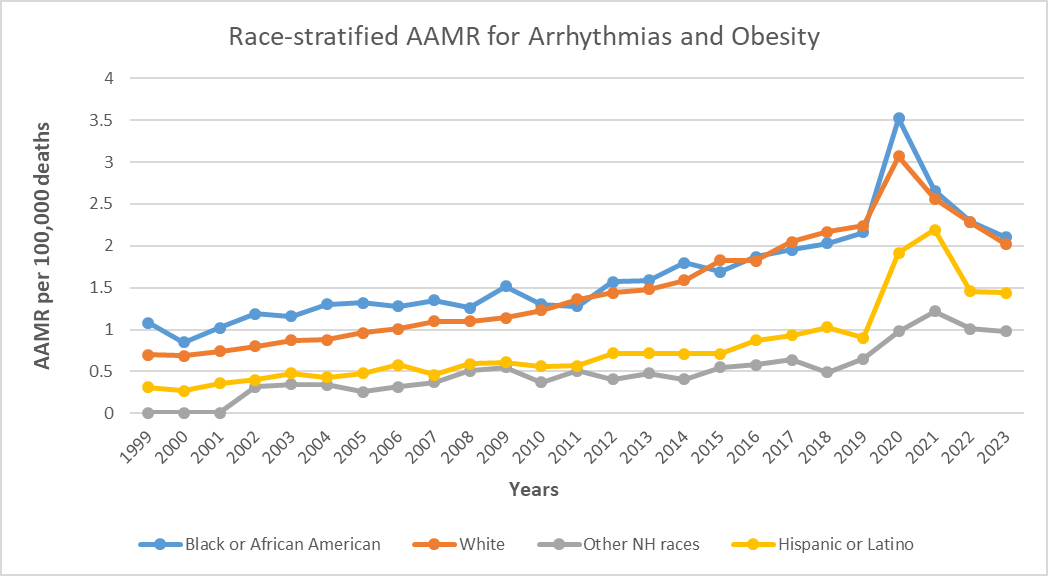
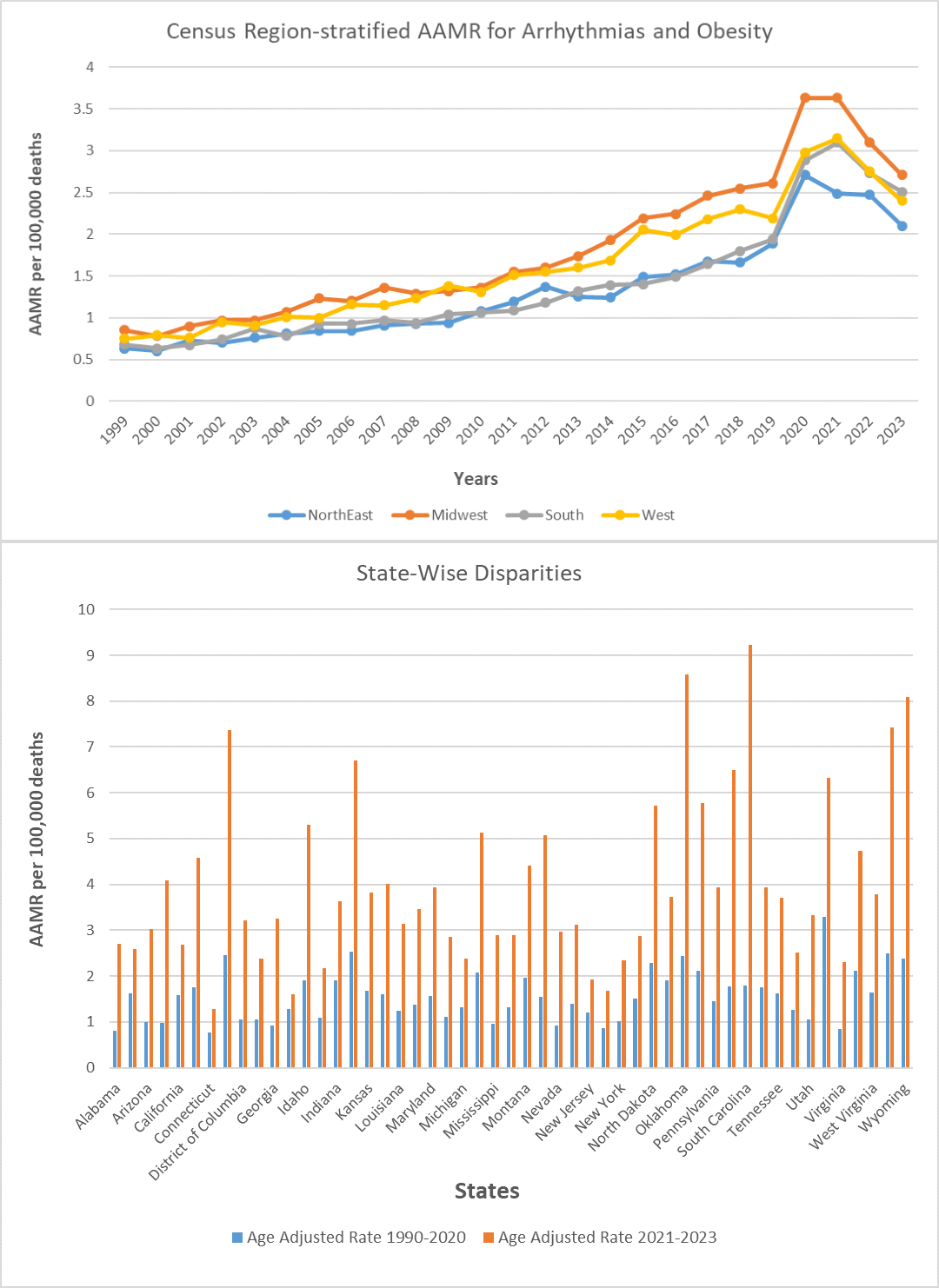
Results: A total of 95,224 deaths were recorded between 1999 and 2023 (52,330 males and 42,894 females). The overall AAMR increased more than four-fold from 0.7 in 1999 to 2.94 in 2023 (AAPC: +6.25%; 95% CI: 5.22–7.29; p < 0.000001), peaking at 3.79 in 2021. Male AAMR rose from 0.82 to 3.62 (AAPC: +6.83%), while female AAMR increased from 0.63 to 2.38 (AAPC: +5.71%). Non-Hispanic (NH) Black individuals had the highest AAMRs throughout (peak: 3.52 in 2020), while Hispanic individuals exhibited the steepest relative increase (from 0.31 in 1999 to 2.19 in 2021; AAPC: +5.96%). Geographically, noncore rural counties experienced the highest burden (peak AAMR: 3.97 in 2020; AAPC: +7.85%), while large urban centers had the most rapid recent growth. State-level disparities revealed peak AAMRs of 9.22 in South Carolina, 8.59 in Oklahoma, and 7.43 in Wisconsin. Regionally, the South exhibited the highest overall increase (AAPC: +5.81%), while the Midwest had the highest peak AAMR (3.63 in 2021) and most pronounced post-2021 decline (APC: –13.45%).
Conclusions: Mortality due to arrhythmias with obesity as a contributing factor has escalated sharply across the U.S over the past two decades, with the most pronounced impacts seen in males, NH Black individuals, rural populations, and the Southern and Midwestern states. These results highlight the need for further investigation into the factors contributing to the observed disparities and trends in obesity and arrhythmias-related mortality rates.
Rao, Asad Gul
( Dow University of Health Sciences
, Karachi
, Pakistan
)
Parvez, Amna
( Liaquat National Medical College
, Karachi
, Pakistan
)
Pervez, Neha
( Dow University of Health Sciences
, Karachi
, Pakistan
)
Murtaza, Sana
( Punjab Medical College
, FAISALABAD
, Pakistan
)
Shahzad, Zoha
( The Brookdale Hospital University Medical Center
, Brooklyn
, New York
, United States
)
Author Disclosures:
Asad Gul Rao:DO NOT have relevant financial relationships
| amna parvez:DO NOT have relevant financial relationships
| Neha Pervez:No Answer
| Sana Murtaza:DO NOT have relevant financial relationships
| Areeba Shams Sarwari:DO NOT have relevant financial relationships
| Zoha Shahzad:No Answer
Ali Muhammad Faizan, Khan Muhammad, Sharif Aleena, Hossain Mohammad, Ahmad Husnain, Eltawansy Sherif, Faizan Muhammad, Ahmed Ashraf, Abdul Malik Mohammad Hamza Bin, Pahwani Ritesh, Patel Rahul, Mehdi Hassan