Logo

American Heart Association

  24
  0


Final ID: MP76

Multifactorial Cardiogenic Shock: Integrating Percutaneous and Device-Based Strategies When Advanced Heart Replacement Therapies Are Contraindicated

Abstract Body (Do not enter title and authors here): Clinical Case:
A 62-year-old male with a history of HTN, HLD, and AUD, presented with an inferior STEMI.
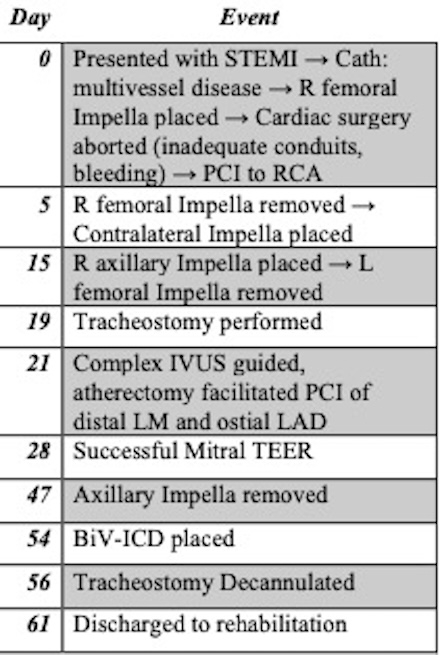
Angiography revealed a 95% mid RCA culprit lesion and severe multivessel disease: 50% distal LM, 99% ostial LAD, 80% mid LAD stenosis, and 100% proximal LCx occlusion with L-L, R-L collateral filling. An Impella CP was placed for narrow pulse pressure and LVEDP of 50 mmHg. The patient was referred for CABG, which was aborted due to access site bleeding, poor conduits and surgical targets.
PCI of the RCA showed restoration of TIMI 3 flow. TTE revealed a LVEDVI of 127 ml/m2 with an EF of 16%, LBBB dyssynchrony, and severe MR. An Impella 5.5 was placed via the right axillary artery. He underwent complex IVUS guided, atherectomy facilitated PCI of the distal LM and ostial LAD. Revascularization of the LCx was unsuccessful.
He required prolonged intubation due to dynamic MR causing recurrent flash pulmonary edema. He underwent percutaneous mitral valve repair with reduction in MR. A BiV–ICD was placed for recurrent VT and resynchronization therapy. He was liberated from the ventilator and discharged on GDMT.

Discussion:
Here we present a patient with a STEMI causing acute-on-chronic heart failure, as suggested from his baseline LBBB and dilated LV, complicated by monomorphic VT and severe MR. This poses the challenges of addressing each contributor to his cardiogenic shock versus upfront advanced heart replacement therapies such as OHT or LVAD. The patient’s AUD and smoking history precluded him from OHT and he was a poor candidate for LVAD given recurrent VT. Thus, we were left with an approach of weighing each targeted intervention’s expected benefits against the benefits of LVAD therapy.
CABG in our patient was infeasible so the revascularization strategy was driven by hemodynamic stability. In hemodynamically unstable patients, revascularizing only the culprit lesion has demonstrated a reduction in all-cause mortality as compared to multivessel PCI. A percutaneous repair was deemed to be the only feasible option to reduce the patient’s secondary MR. Attention was paid to the trans-mitral gradient should an LVAD be needed downstream. The decision to pursue CRT-D was made given LBBB and prolonged QRS.
This case underscores the complexity of managing multifactorial cardiogenic shock in which advanced heart replacement therapies are contraindicated. A multidisciplinary, stepwise approach can achieve favorable clinical outcomes.
  • Fox, Sam  ( UMass Chan Medical School , Worcester , Massachusetts , United States )
  • Fandino-rubio, Nicolas  ( UMass Chan Medical School , Wayland , Massachusetts , United States )
  • Jones, Tyler  ( UMass Chan Medical School , Worcester , Massachusetts , United States )
  • Asirwatham, Matthew  ( UMass Chan Medical School , Worcester , Massachusetts , United States )
  • Gottbrecht, Matthew  ( UMass Chan Medical School , Wayland , Massachusetts , United States )
  • Author Disclosures:
    Sam Fox: DO NOT have relevant financial relationships | Nicolas Fandino-Rubio: DO NOT have relevant financial relationships | Tyler Jones: No Answer | Matthew Asirwatham: DO NOT have relevant financial relationships | Matthew Gottbrecht: No Answer
Meeting Info:

Scientific Sessions 2025

2025

New Orleans, Louisiana

Session Info:

Cases that Challenge: Lessons from the Frontlines

Saturday, 11/08/2025 , 03:15PM - 04:30PM

Moderated Digital Poster Session

More abstracts on this topic:
Cell-free DNA Analysis Profiles End-Organ Injury and Predicts Outcomes with Left Ventricular Assist Device Implantation

Park Ashley, Rodrigo Maria, Shah Keyur, Valantine Hannah, Shah Palak, Agbor-enoh Sean, Andargie Temesgen, Hill Tom, Redekar Neelam, Tian Xin, Park Woojin, Kong Hyesik, Cavagna Isabella, Jang Moon

Bile Acid Dysregulation in Response to Right Heart Failure and Hepatic Congestion

Park Arick, Yang Bin, Parvathaneni Adeesh, Fu Christina, Byrnes Kathleen, Haeusler Rebecca, Schilling Joel

You have to be authorized to contact abstract author. Please, Login
Not Available