Physical Activity Preserves Exercise Capacity Over Two Years Of Breast Cancer Treatment (WF-97415)
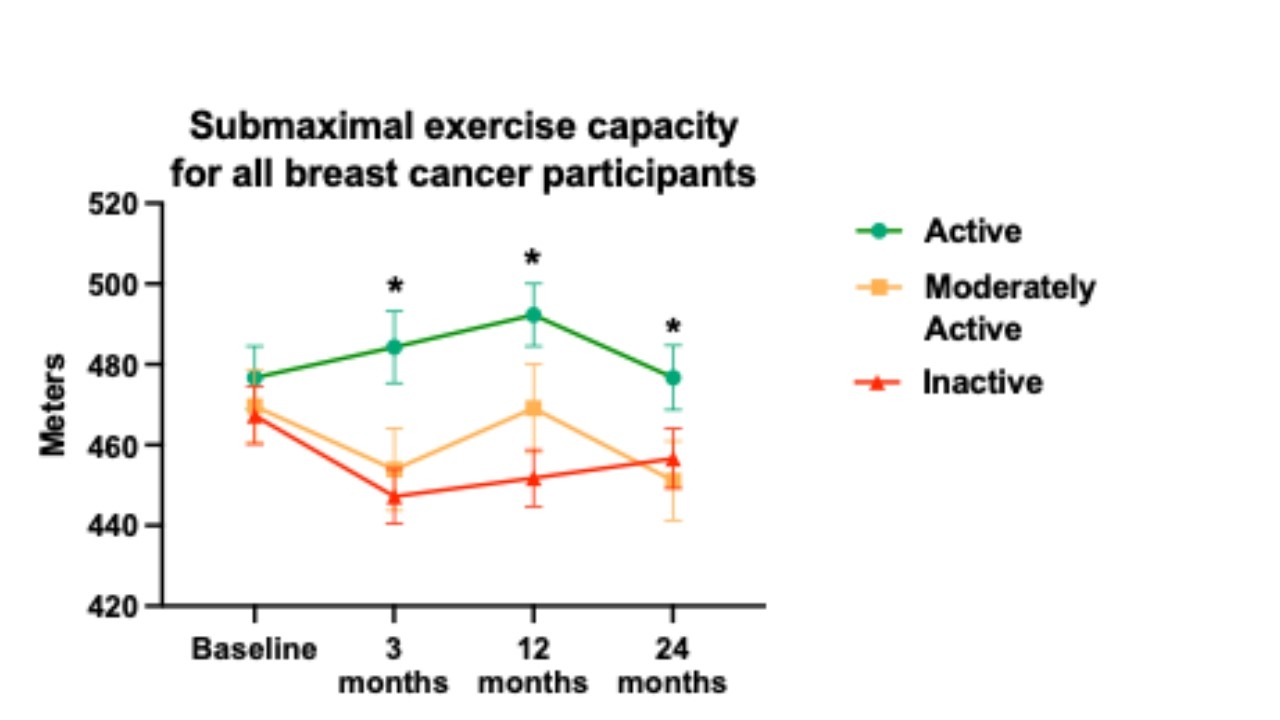
Abstract Body (Do not enter title and authors here): Introduction: Women treated for breast cancer (BC) often experience declines in exercise capacity and cardiac function which increases their heart failure risk. Physical activity (PA) participation during BC treatment may prevent these declines, but the long-term impacts of PA on exercise capacity and cardiac function in BC survivors are unknown. Research Question: This study evaluated PA participation prior to initiating BC treatment through 24-month follow-up and tested if women who reported being physically active had better exercise capacity and cardiac function relative to inactive women. Methods: Women with stage I-III BC (n=236) were enrolled in a multi-site prospective cohort study conducted through the Wake Forest NCORP Research Base (NCT02791581). Participants were categorized as active, moderately active, or inactive from self-reported PA surveys. Exercise capacity was determined by 6-minute walk distance (6MWD) and cardiac function [left ventricular ejection fraction (LVEF) and LV mean circumferential strain, LV strain] was measured by cardiac magnetic resonance imaging prior to BC treatment and then at 3-, 12- and 24-month follow-up. Analyses were adjusted for age, BMI, race, fatigue, comorbidities, and BC treatment. Results: Participants average (±SD) age was 56±11 years, 76% were White, and 52% were diagnosed with stage II BC. PA participation declined from baseline to 3-month follow-up but increased to baseline levels at 12- and 24-month follow-up. At baseline, active and inactive participants had similar exercise capacity (mean difference ± SE=17.4±10.4 m, p=0.21), LVEF (0.76±0.60, p=0.41), and LV strain (-0.71±0.87, p=0.69). 6MWD declined from baseline to 3-months among inactive participants only (-21.9±8.5 m, p=0.01). Active participants had higher exercise capacity relative to inactive participants at 3-months (42.5±11.3 m, p<0.001), 12-months (39.2±10.3 m, p<0.001), and 24-months (31.2±10.9 m, p=0.01) follow-up. LVEF and LV strain were similar between active and inactive participants throughout follow-up. Conclusions: Over 24 months, physically active women with BC maintained a higher submaximal exercise capacity compared to inactive individuals while cardiac function was similar between the groups. These data suggest that maintaining PA during BC treatment is important for preserving submaximal exercise capacity long-term, which reflects the ability to perform activities of daily living in BC survivors.
Bellissimo, Moriah
(
VCU School of Medicine
, Richmond , Virginia , United States )
Ambrosio, Matthew
(
VIRGINIA COMMONWEALTH UNIVERSITY
, Richmond , Virginia , United States )
Johnson, Kristin
(
VIRGINIA COMMONWEALTH UNIVERSITY
, Richmond , Virginia , United States )
Canada, Justin
(
VIRGINIA COMMONWEALTH UNIVERSITY
, Richmond , Virginia , United States )
Jordan, Jennifer
(
Virginia Commonwealth University
, Richmond , Virginia , United States )
Ladd, Amy
(
VIRGINIA COMMONWEALTH UNIVERSITY
, Richmond , Virginia , United States )
Brubaker, Peter
(
Wake Forest University
, Winston Salem , North Carolina , United States )
Mihalko, Shannon
(
Wake Forest University
, Winston Salem , North Carolina , United States )
Dagostino, Ralph
(
Wake Forest School of Medicine
, Winston Salem , North Carolina , United States )
O'connell, Nathaniel
(
Wake Forest School of Medicine
, Winston Salem , North Carolina , United States )
Ky, Bonnie
(
University of Pennsylvania
, Philadelphia , Pennsylvania , United States )
Wagner, Lynne
(
University of North Carolina Chapel Hill
, Chapel Hill , North Carolina , United States )
Hackney, Mary Helen
(
VIRGINIA COMMONWEALTH UNIVERSITY
, Richmond , Virginia , United States )
Weaver, Kathryn
(
Wake Forest University
, Winston Salem , North Carolina , United States )
Lesser, Glenn
(
Wake Forest University
, Winston Salem , North Carolina , United States )
Lucas, Alexander
(
Virginia Commonwealth University
, Richmond , Virginia , United States )
Fuemmeler, Bernard
(
VIRGINIA COMMONWEALTH UNIVERSITY
, Richmond , Virginia , United States )
Larose, Jessica
(
VCU School of Medicine
, Richmond , Virginia , United States )
Salloum, Fadi
(
VIRGINIA COMMONWEALTH UNIV
, Richmond , Virginia , United States )
Hundley, William
(
Virginia Commonwealth University
, Richmond , Virginia , United States )
Author Disclosures:
Moriah Bellissimo:DO NOT have relevant financial relationships
| Nathaniel O'Connell:No Answer
| Bonnie Ky:No Answer
| Lynne Wagner:No Answer
| Mary Helen Hackney:DO NOT have relevant financial relationships
| Kathryn Weaver:DO NOT have relevant financial relationships
| Glenn Lesser:DO NOT have relevant financial relationships
| Alexander Lucas:DO NOT have relevant financial relationships
| Bernard Fuemmeler:DO NOT have relevant financial relationships
| Jessica LaRose:No Answer
| Fadi Salloum:DO have relevant financial relationships
;
Research Funding (PI or named investigator):NIH:Active (exists now)
; Advisor:NovoMedix, Inc:Active (exists now)
; Research Funding (PI or named investigator):AHA:Active (exists now)
| Matthew Ambrosio:DO NOT have relevant financial relationships
| William Hundley:DO NOT have relevant financial relationships
| Kristin Johnson:DO NOT have relevant financial relationships
| Justin Canada:DO NOT have relevant financial relationships
| Jennifer Jordan:DO NOT have relevant financial relationships
| Amy Ladd:DO NOT have relevant financial relationships
| Peter Brubaker:DO NOT have relevant financial relationships
| Shannon Mihalko:DO NOT have relevant financial relationships
| Ralph Dagostino:No Answer