
Logo

American Heart Association

  92
  0


Final ID: MP326

Coronary Microvascular Dysfunction Related to Disease Severity in Patients with Transthyretin Amyloid Cardiomyopathy

Abstract Body (Do not enter title and authors here): Background: The importance of coronary microvascular dysfunction in heart failure and cardiomyopathies is attracting attention. However, the significance of coronary microvascular dysfunction in transthyretin amyloid cardiomyopathy (ATTR-CM) is unclear. The prevalence and pathophysiology of coronary microvascular dysfunction in ATTR-CM was evaluated in this study.
Methods: We prospectively studied patients with ATTR-CM diagnosed between January 2023 and March 2025 at Kochi Medical School Hospital. Coronary microvascular dysfunction was assessed using a pressure wire during catheterization and was defined as Coronary Flow Reserve (CFR) < 2.0, Index of Microcirculatory Resistance (IMR) ≥ 25, or both.
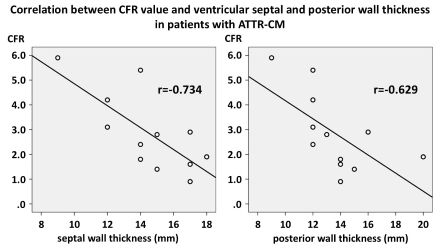
Results: Coronary microcirculation was evaluated in 12 patients with ATTR-CM. The median age was 79 years [IQR 77-81 years], 7 (58%) were male. IMR and CFR were positive in seven patients (58%) and five patients (42%), respectively. All CFR positive patients were also IMR positive. Patients with positive IMR had more atrial fibrillation (5 vs. 0, p=0.028) and higher relative wall thickness (median 0.72 vs. 0.58, p=0.048). Patients with positive CFR were older at diagnosis of ATTR-CM (median 82 vs. 77 years, p=0.030), had more atrial fibrillation (5 vs. 0, p=0.001), and had thicker ventricular septal wall thickness (median 17mm vs. 14mm, p=0.048) and left ventricular posterior wall thickness (median 14mm vs. 12mm, p=0.030). There was a significant negative correlation between CFR value and ventricular septal wall thickness (r=-0.734, p=0.007). Chest pain was present in two patients in the coronary microvascular dysfunction positive group and absent in the coronary microvascular dysfunction negative group.
Conclusion: Approximately 60% of patients with ATTR-CM had coronary microvascular dysfunction. Patients with ATTR-CM complicated by coronary microvascular dysfunction had thicker left ventricular wall thickness and a higher frequency of atrial fibrillation. The presence of coronary microvascular dysfunction may be associated with the progression of the pathogenesis of ATTR-CM.
  • Miyamoto, Yuya  ( Kochi University , Kochi city , Japan )
  • Noguchi, Tatsuya  ( Kochi University , Kochi city , Japan )
  • Osaki, Miyako  ( Kochi University , Kochi city , Japan )
  • Moriki, Toshihiro  ( Kochi University , Kochi city , Japan )
  • Ochi, Yuri  ( Kochi University , Kochi city , Japan )
  • Baba, Yuichi  ( Kochi University , Kochi city , Japan )
  • Hirota, Takayoshi  ( Kochi University , Kochi city , Japan )
  • Kubo, Toru  ( Kochi University , Kochi city , Japan )
  • Yamasaki, Naohito  ( Kochi University , Kochi city , Japan )
  • Kitaoka, Hiroaki  ( Kochi University , Kochi , Japan )
  • Author Disclosures:
    Yuya Miyamoto: DO NOT have relevant financial relationships | Hiroaki Kitaoka: DO NOT have relevant financial relationships | Tatsuya Noguchi: DO NOT have relevant financial relationships | Miyako Osaki: No Answer | Toshihiro Moriki: DO NOT have relevant financial relationships | Yuri Ochi: DO NOT have relevant financial relationships | Yuichi BABA: DO NOT have relevant financial relationships | Takayoshi Hirota: No Answer | Toru Kubo: DO NOT have relevant financial relationships | Naohito Yamasaki: No Answer
Meeting Info:

Scientific Sessions 2025

2025

New Orleans, Louisiana

Session Info:

Advancing Frontiers in Amyloid: Imaging and Emerging Insights

Saturday, 11/08/2025 , 01:45PM - 02:45PM

Moderated Digital Poster Session

More abstracts on this topic:
Abrupt cardiac rupture of the patient with ATTR amyloidosis

Tagata Kento, Yutaro Nomoto, Tao Koji, Kataoka Tetsuro, Ohishi Mitsuru

Comparison of Thermodilution and Doppler Flow Velocity Derived Indexes of Coronary Physiology using Intracoronary Adenosine in Patients with Angina and Unobstructed Coronary Arteries (ANOCA)

Lauinger Louisa, Hubert Astrid, Seitz Andreas, Bekeredjian Raffi, Mcchord Johanna, Ong Peter

More abstracts from these authors:
End-stage hypertrophic cardiomyopathy is caused by a combination of variants in genes associated with various cardiomyopathies

Hiruma Takashi, Hatano Masaru, Takimoto Eiki, Akazawa Hiroshi, Morita Hiroyuki, Kubo Toru, Kitaoka Hiroaki, Takeda Norihiko, Komuro Issei, Inoue Shunsuke, Dai Zhehao, Nomura Seitaro, Katoh Manami, Ko Toshiyuki, Ishida Junichi, Amiya Eisuke, Takeda Norifumi

You have to be authorized to contact abstract author. Please, Login
Not Available