Monocyte to Lymphocytes Ratio as a Superior Predictor of Major Cardiovascular Events compared to hs-CRP in Patients with Angina and Nonobstructive Coronary Artery Disease
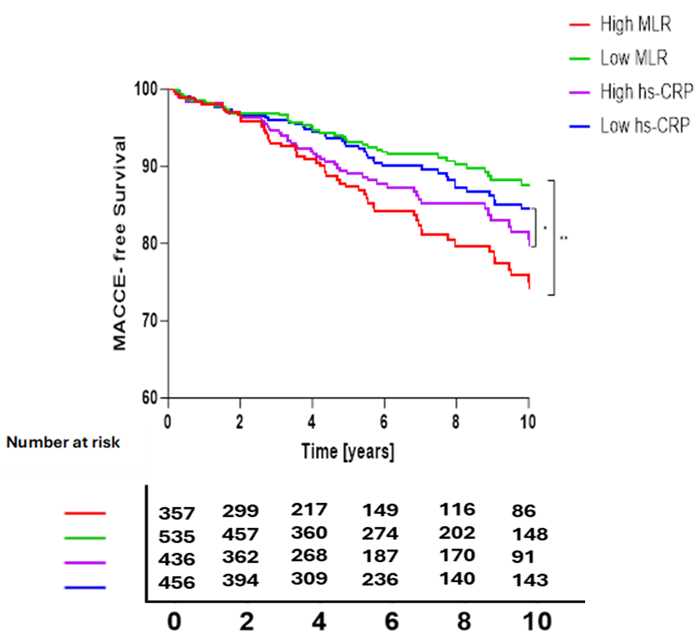
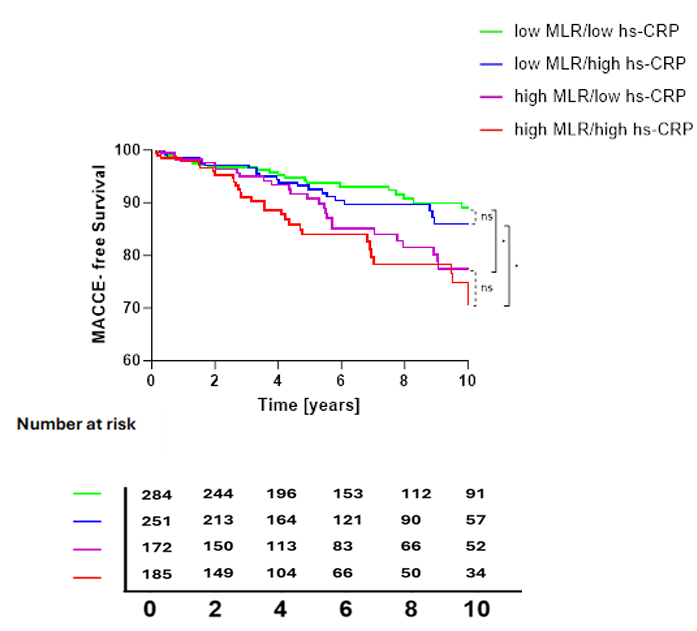
Abstract Body (Do not enter title and authors here): Background An increasing recognition of angina and nonobstructive coronary artery disease (ANOCA) underscores the importance of this patient group. While inflammation is a well-established key driver in the initiation and progression of atherosclerosis, its role in early stage is less clear. The current study was designed to assess the predictive value of monocyte-lymphocyte ratio(MLR) in comparison with hs-CRP in these patients. Method This observational cohort study included patients with chest pain and nonobstructive coronary artery disease <40% stenosis in major coronary arteries on clinically indicated elective coronary angiography who underwent invasive physiological coronary reactivity testing for evaluation of coronary vasomotor function between 1997-2021. Preprocedural MLR was categorized as high (≥0.30) or low (<0.30) using the best cutoff value for predicting major adverse cardiovascular and cerebrovascular events (MACCE) determined by ROC curves. Preprocedural Hs-CRP levels ≥1 and <1 mg/L were classified as high or low, respectively. MACCE comprised cardiovascular death, nonfatal myocardial infarction, heart failure, stroke, and late revascularization. Kaplan-Meier plots, Log-rank test, and Cox regression analysis were used for analysis. Result Among 892 patients (median age 52 [IQR: 43- 61] years, 69% females), 40% had high MLR and 49% had high hs-CRP, respectively. Over a 10-year follow-up, 125 patients (14%) experienced MACCE. In univariable analysis, high MLR level (p < 0.001) and high hs-CRP (p = 0.045) were associated with worse outcomes. (Figure 1) In multivariate Cox regression after adjusting for age, body mass index, creatinine, hypertension, hyperlipidemia, and diabetes mellitus, MLR remained a significant predictor of MACCE (HR=1.75, 95% CI=1.20- 2.55, p = 0.004), whereas hs-CRP lost its significance (HR=1.26, 95% CI=0.857- 1.848, p=0.241). Stratifying patients into four groups of high MLR/high hs-CRP (21%), high MLR/low hs-CRP (19%), low MLR/high hs-CRP (28%), and low MLR/low hs-CRP (32%) revealed that high MLR was associated with increased MACCE in both groups with high and low hs-CRP, while in both high MLR and low MLR groups, hs-CRP levels made no difference in MACCE incidences. (Figure 2). Conclusion elevated MLR is a strong independent predictor of MACCE in patients with ANOCA, superior to hs-CRP. These findings highlight the potential of MLR as a valuable, readily available marker for risk stratification in early atherosclerosis.
Kalhor, Parvin
(
Mayo Clinic
, Rochester , Minnesota , United States )
Mahmoudi Hamidabad, Negin
(
Mayo Clinic
, Rochester , Minnesota , United States )
Hellou, Elias
(
Mayo Clinic
, Rochester , Minnesota , United States )
Nogami, Kai
(
Mayo Clinic
, Rochester , Minnesota , United States )
Manzato, Matteo
(
Mayo Clinic
, Rochester , Minnesota , United States )
Lerman, Lilach
(
Mayo Clinic
, Rochester , Minnesota , United States )
Lerman, Amir
(
Mayo Clinic
, Rochester , Minnesota , United States )
Author Disclosures:
parvin kalhor:DO NOT have relevant financial relationships
| Negin Mahmoudi Hamidabad:No Answer
| Elias Hellou:DO NOT have relevant financial relationships
| Kai Nogami:No Answer
| Matteo Manzato:DO NOT have relevant financial relationships
| Lilach Lerman:DO have relevant financial relationships
;
Employee:Mayo Clinic:Active (exists now)
; Research Funding (PI or named investigator):NIH:Active (exists now)
; Consultant:Livekidney.Bio:Active (exists now)
; Consultant:RiboCure:Active (exists now)
; Consultant:Cellergy:Active (exists now)
; Consultant:CureSpec:Active (exists now)
| Amir Lerman:DO NOT have relevant financial relationships