Polygenic score analyses in a large multinational HCM clinical cohort identifies effects on disease penetrance and severity
Abstract Body (Do not enter title and authors here): Background Disease expressivity in hypertrophic cardiomyopathy (HCM) varies widely, ranging from unaffected genetically predisposed individuals to life-threatening complications. Polygenic scores (PGS) were shown to predict disease penetrance of HCM-causing rare genetic variants (HCMrv) and HCM-related outcomes in large biobanks. However, the utility of PGS in clinical cohorts remains unclear.
Research Questions Can PGS predict disease penetrance in carriers of HCMrv in the clinical setting? Is PGS associated with disease severity and complications in individuals with HCM?
Methods We studied a well-characterized clinical HCM cohort from Canada, Italy, the Netherlands and Spain, comprising 6,111 individuals affected by HCM and/or carrying a HCMrv. We used SBayesRC to derive a novel PGS for HCM from the largest published genome-wide association study. Standardized ancestry-adjusted PGS were calculated for all individuals and tested for association with HCM penetrance, maximal left ventricular wall thickness (MLVWT) and major adverse clinical events (MACE) using logistic, linear and Cox regression models, respectively, with adjustment for sex, rare variant status, site, and other covariates as relevant. MACE were defined as major ventricular arrhythmic or heart failure event, stroke, septal reduction therapy or all-cause mortality.
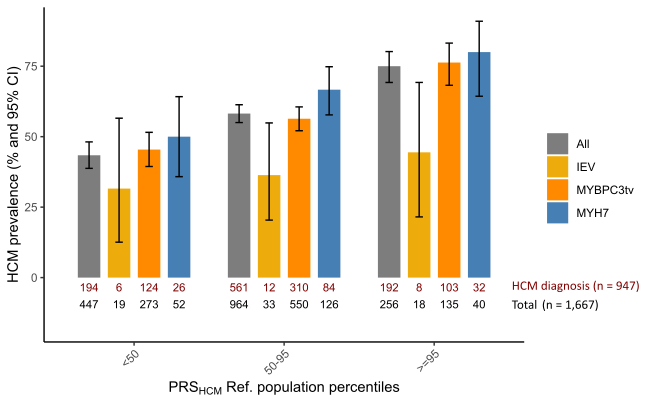
Results PGS was tested for association with HCM in the subset of 1,667 relatives carrying a HCMrv (age at last follow-up 47 ± 19, 49% female), of which 57% meet diagnostic criteria for HCM. PGS was associated with a diagnosis of HCM (Odds ratio 1.6 per standard deviation [SD] increase in PGS; 95% CI: 1.4-1.8). Male sex and hypertension also independently increased penetrance by 3-fold and 2-fold, respectively. HCM-penetrance increased with increasing PGS, in the entire set as well as in carriers of MYH7 pathogenic variants, MYBPC3 truncating variants, or intermediate effect variants (Figure). In 4,949 affected individuals (age at diagnosis 48 ± 17, 33% female, 49% carrying HCMrv), PGS was associated with disease severity. Each SD increase in PGS was associated with a 0.5 mm increase in MLVWT (95% CI: 0.3-0.6), and a 12% increase in lifetime risk of MACE (Hazard ratio 1.12, 95% CI: 1.06-1.18).
Conclusions PGS assessment may enhance risk stratification and personalize monitoring strategies—guiding the timing, frequency, and scope of clinical evaluations in both genetically predisposed individuals and patients with manifest HCM.
Jorda, Paloma
(
Montreal Heart Institute, and Faculty of Medicine, Université de Montréal
, Montreal , Quebec , Canada )
Lipov, Alex
(
Amsterdam UMC, University of Amsterdam
, Amsterdam , Netherlands )
Gimeno Blanes, Juan Ramon
(
University Hospital Virgen Arrixaca
, Murcia , Spain )
Castillo, Ismael
(
Montreal Heart Institute, and Faculty of Medicine, Université de Montréal
, Montreal , Quebec , Canada )
Walsh, Roddy
(
Cardiovascular & Genomics Research Institute, City St George's University of London
, London , United Kingdom )
Poel, Edwin
(
Amsterdam UMC, University of Amsterdam
, Amsterdam , Netherlands )
Moussa, Samuel
(
Montreal Heart Institute, and Faculty of Medicine, Université de Montréal
, Montreal , Quebec , Canada )
Haydarlou, Poeya
(
Amsterdam UMC, University of Amsterdam
, Amsterdam , Netherlands )
Baas, Annette
(
University Medical Centre Utrecht, Utrecht University
, Utrecht , Netherlands )
Michels, Michelle
(
Thorax Center, Erasmus University Medical Centre
, Rotterdam , Netherlands )
Christiaans, Imke
(
University Medical Centre Groningen, University of Groningen
, Groningen , Netherlands )
Paterson, Natasha
(
Tenaya Therapeutics
, San Francisco , California , United States )