Heart Failure Exacerbates Renal Medullary Hypoxia and Increases Acute Kidney Injury Risk After Cardiopulmonary Bypass in Sheep.
Abstract Body (Do not enter title and authors here): Background: Acute kidney injury (AKI) is a major unresolved complication of cardiac surgery, particularly in patients with pre-existing heart failure (HF). Mechanistic insight has been limited by the lack of large animal models replicating this complex clinical scenario. We developed a novel ovine model of HF with continuous, region-specific assessment of renal perfusion and oxygenation before, during, and after cardiopulmonary bypass (CPB).
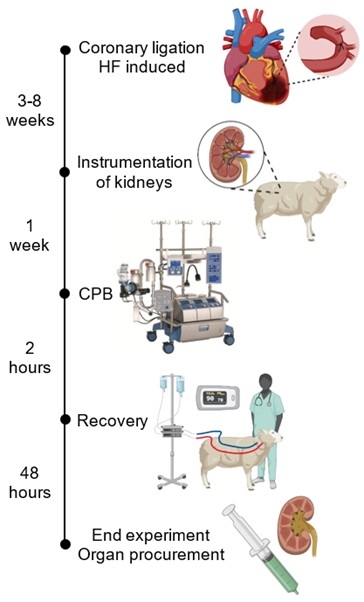
Methods: Merino ewes (30-45 kg) were instrumented to continuously measure cardiac output (CO), mean arterial pressure (MAP), renal blood flow (RBF), renal oxygen delivery (RDO2), and renal cortical and medullary perfusion and oxygenation (PO2) across the pre- (conscious), intra- (anesthetized) and post-CPB (conscious) phases. HF was induced via coronary artery ligation and defined by ≥30% increase in heart rate and ≥30% reduction in left ventricular ejection fraction. HF (n=9) and healthy control (n=8) animals underwent 2 h of CPB with aortic cross-clamp (pump flow 2.4 L/min/m2, target MAP 70 mmHg), followed by 48 h recovery.
Results: Compared to the pre-CPB (conscious) state, CPB reduced RBF and RDO2 similarly in both groups (RBF: −56% HF, −55% control; RDO2: −64% HF, −68% control; all p<0.01). Renal medullary perfusion and PO2 also declined in both groups during CPB (perfusion: HF −71%, p=0.02; control −56%, p=0.08; PO2: HF −42%, p=0.03; control −46%, p=0.5), with no significant intergroup differences. However, by 48 h post-CPB, medullary PO2 had recovered in controls but remained markedly suppressed in HF animals (8.0 ± 3.7 vs 30.6 ± 5.5 mmHg, p=0.02), despite similar MAP, CO, RBF, cortical perfusion, and cortical PO2. Postoperative AKI was more frequent in HF animals (55% vs 12.5%, OR 8.75). Across all animals, those with AKI had lower post-CPB medullary PO2 than those without AKI (18.7 ± 3.5 vs 31.3 ± 3.5 mmHg, p=0.04). Conventional markers (urine output, creatinine clearance) did not differ significantly between groups at any stage, underscoring their limited sensitivity to early, region-specific injury.
Conclusion: This is the first large-animal model to replicate the perioperative course of cardiac surgery with CPB in the setting of heart failure, enabling continuous, region-specific monitoring of renal oxygenation. Persistent medullary hypoxia emerged as a key driver of postoperative AKI, highlighting a novel and potentially targetable mechanism in high-risk patients with HF.
Trask-marino, Anton
(
The Florey
, Melbourne , Victoria , Australia )
Marino, Bruno
(
Cellsaving and Perfusion Resources
, Melbourne , Victoria , Australia )
Cochrane, Andrew
(
The Florey
, Melbourne , Victoria , Australia )
Mccall, Peter
(
Austin Health
, Heidelberg , Victoria , Australia )
Raman, Jai
(
Townsville University Hospital
, Townsville , Queensland , Australia )
Furukawa, Taku
(
The Florey
, Melbourne , Victoria , Australia )
Ow, Connie
(
The Florey
, Melbourne , Victoria , Australia )
Booth, Lindsea
(
The Florey
, Melbourne , Victoria , Australia )
May, Clive
(
The Florey
, Melbourne , Victoria , Australia )
Lankadeva, Yugeesh
(
The Florey
, Melbourne , Victoria , Australia )
Author Disclosures:
Anton Trask-Marino:DO NOT have relevant financial relationships
| Yugeesh Lankadeva:No Answer
| Bruno Marino:No Answer
| Andrew Cochrane:No Answer
| peter McCall:No Answer
| Jai Raman:No Answer
| Taku Furukawa:No Answer
| Connie Ow:No Answer
| Lindsea Booth:DO NOT have relevant financial relationships
| Clive May:DO NOT have relevant financial relationships