Socioeconomic, Lifestyle, and Psychosocial Correlates of Racial and Ethnic Disparities in Hypertension Prevalence, Control and Incidence: The Multi-Ethnic Study of Atherosclerosis
Abstract Body (Do not enter title and authors here): Background: Hypertension (HTN) is a key driver of cardiovascular disease (CVD). Racial and ethnic disparities in HTN have been noted, yet the contributions of socioeconomic, lifestyle, and psychosocial factors underlying disparities remain understudied. We examined the associations between race/ethnicity and HTN outcomes, accounting for these factors.
Methods: We analyzed 5,492 participants in the Multi-Ethnic Study of Atherosclerosis (MESA), a prospective cohort of adults aged 45-84 years free of clinical CVD at baseline. Outcomes included baseline prevalent HTN (BP≥140/90 mmHg and/or BP medication use), HTN treatment and control, and incident HTN over ~16 years. Multivariable regression models were used to estimate associations between race/ethnicity and each outcome using sequential modeling, adjusting for age, sex, education, income, insurance, neighborhood SES, BMI, exercise, diet, smoking, alcohol, social support, discrimination, and chronic stress.
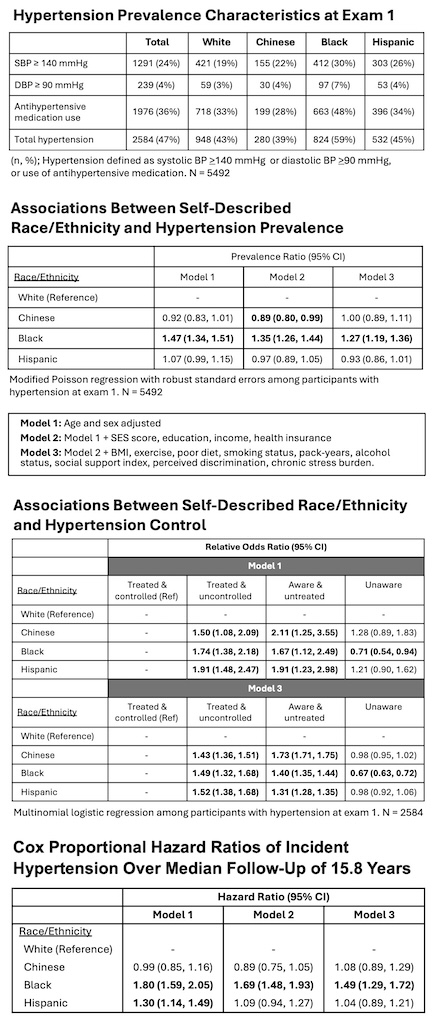
Results: (See figure) At baseline, 47% had HTN. Prevalence was highest among Black followed by Hispanic, White, and Chinese participants. Adjustment for socioeconomic, lifestyle, and psychosocial factors reduced the prevalence ratio for Black compared to White participants, but remained significantly elevated. Chinese participants had lower HTN odds in partially adjusted models, but this association was not significant after full adjustment. Among those with HTN, all non-White groups had higher odds of being in the “treated but uncontrolled” category compared to “treated and controlled,” relative to White participants, even after full adjustment. Black participants were more aware of their HTN. Among 2,906 normotensive participants with follow-up data, Black participants had the highest HTN incidence, which, although attenuated, remained significant after full adjustment. The higher incidence for Hispanic participants was not significant after full adjustment.
Conclusion: Adjustment for socioeconomic, lifestyle, and psychosocial factors substantially reduced the magnitude of racial and ethnic disparities in HTN outcomes, suggesting a significant contribution of these factors. These findings underscore the importance of addressing barriers to improve HTN outcomes.
Baffoe-bonnie, Helena
(
Johns Hopkins University
, Baltimore , Maryland , United States )
Sarpong, Jeremiah
(
Johns Hopkins University
, Baltimore , Maryland , United States )
Hansen, Spencer
(
University of Washington
, Seattle , Washington , United States )
Shea, Steven
(
Columbia University
, New York , New York , United States )
Hirsch, Jana
(
Drexel University
, Philadelphia , Pennsylvania , United States )
Mcclelland, Robyn
(
University of Washington
, Seattle , Washington , United States )
Post, Wendy
(
Johns Hopkins University
, Baltimore , Maryland , United States )
Author Disclosures:
Helena Baffoe-Bonnie:DO NOT have relevant financial relationships
| Jeremiah Sarpong:DO NOT have relevant financial relationships
| Spencer Hansen:DO NOT have relevant financial relationships
| Steven Shea:No Answer
| Jana Hirsch:DO NOT have relevant financial relationships
| Robyn McClelland:No Answer
| Wendy Post:DO NOT have relevant financial relationships