Associations Between Absolute Blood Eosinophil Count and Subclinical Atherosclerotic Plaque in the Multi-Ethnic Study of Atherosclerosis
Abstract Body: Background Prior studies have demonstrated associations between eosinophil activation products and incident stroke. We sought to investigate associations between blood eosinophil count and imaging markers of atherosclerosis (carotid artery plaque [CAP] and coronary artery calcium [CAC]) in the Multi-Ethnic Study of Atherosclerosis (MESA).
Methods The MESA enrolled adults aged 45-84 years, free of atherosclerotic cardiovascular disease (ASCVD) at baseline. ASCVD risk factors, blood eosinophils, CAP presence and score (0-12) and CAC presence and Agatston score were measured at exam 5. Logistic and linear regression models were employed to test the association of blood eosinophils, CAP and CAC presence and score (log[score+1]) adjusted for biologic confounders.
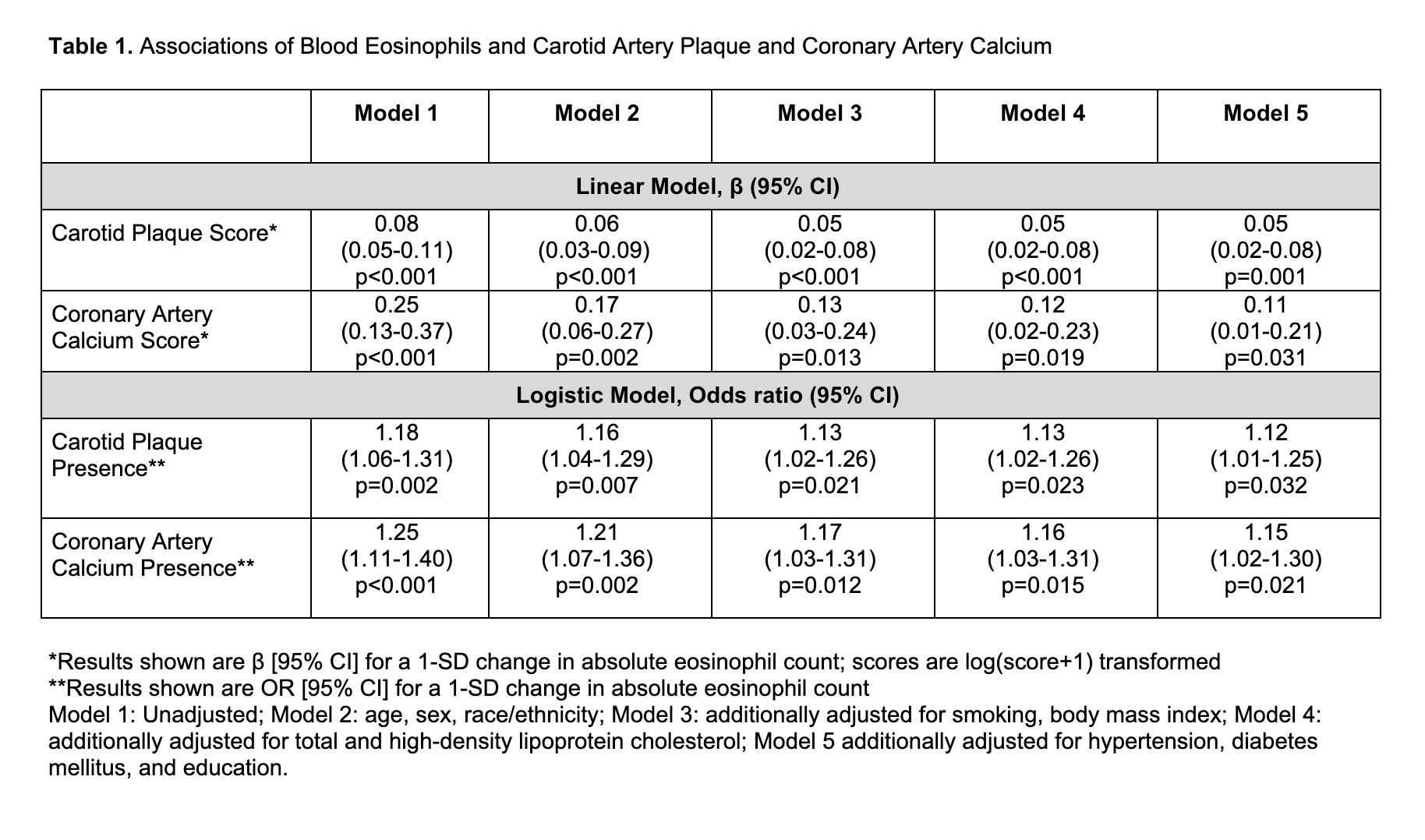
Results The 2,166 participants were a mean (standard deviation [SD]) 69.6 (9.3) years old, 53% female, 29% Hispanic, 28% Black, 1% Chinese. The median (interquartile range) eosinophil count was 0.1 (0.1, 0.2)x10E3/uL, CAP score= 2 (0,4) and CAC score= 45 (0, 292) Agatston units. In risk-factor adjusted models (Table 1; model 5), increased blood eosinophil count (per 1 SD [0.15 x10E3/uL]) was associated with CAP (β = 0.05 [95% CI 0.02-0.08, p = 0.001) and CAC (β = 0.11, [95% CI: 0.01-0.21], p = 0.03) score. Similar associations were seen with eosinophils and CAP (Odds ratio [OR] = 1.12, [95% CI: 1.01-1.25], p = 0.03) and CAC (OR = 1.15, [95% CI: 1.02-1.30], p = 0.02) presence.
Conclusions In a large, contemporary, multiethnic, U.S. cohort, blood eosinophils were strongly associated with imaging measures of atherosclerosis even after adjustment for ASCVD risk factors. These data suggest potential roles of T2/eosinophilic inflammation in atherosclerosis.
Mathis, Nyla
(
University of Wisconsin School of Medicine and Public Health
, Madison , Wisconsin , United States )
Tattersall, Matthew
(
UNIVERSITY OF WISCONSIN HOSPITAL
, Madison , Wisconsin , United States )
Hansen, Spencer
(
University of Washington
, Seattle , Washington , United States )
Dasiewicz, Alison
(
The Hospital for Sick Children
, Toronto , Ontario , Canada )
Esnault, Stephane
(
University of Wisconsin-Madison
, Madison , Wisconsin , United States )
Siddiqui, Salman
(
Imperial College London
, London , United Kingdom )
Mathur, Sameer
(
University of Wisconsin School of Medicine and Public Health
, Madison , Wisconsin , United States )
Jarjour, Nizar
(
University of Wisconsin School of Medicine and Public Health
, Madison , Wisconsin , United States )
Denlinger, Loren
(
University of Wisconsin School of Medicine and Public Health
, Madison , Wisconsin , United States )
Mcclelland, Robyn
(
University of Washington
, Seattle , Washington , United States )
Stein, James
(
UNIV WISCONSIN MED SCH
, Madison , Wisconsin , United States )
Johansson, Mats
(
University of Wisconsin School of Medicine and Public Health
, Madison , Wisconsin , United States )
Author Disclosures:
Nyla Mathis:DO NOT have relevant financial relationships
| Robyn McClelland:No Answer
| James Stein:DO have relevant financial relationships
;
Independent Contractor:Lilly:Active (exists now)
; Independent Contractor:Silence Therapeutics:Past (completed)
; Royalties/Patent Beneficiary:UptoDate:Active (exists now)
; Independent Contractor:Novartis:Active (exists now)
| Mats Johansson:DO have relevant financial relationships
;
Research Funding (PI or named investigator):Hoffmann-La Roche:Active (exists now)
| Matthew Tattersall:DO NOT have relevant financial relationships
| Spencer Hansen:DO NOT have relevant financial relationships
| Alison Dasiewicz:No Answer
| Stephane Esnault:No Answer
| salman siddiqui:No Answer
| Sameer Mathur:DO have relevant financial relationships
;
Consultant:AstraZeneca:Active (exists now)
; Research Funding (PI or named investigator):Areteia:Active (exists now)
; Consultant:Regeneron:Active (exists now)
; Consultant:GSK:Active (exists now)
| Nizar Jarjour:No Answer
| Loren Denlinger:No Answer