Comparative 1-Year Outcomes of Dofetilide Versus Amiodarone for Atrial Fibrillation in Hypertrophic Cardiomyopathy: A Propensity-Matched Study.
Abstract Body (Do not enter title and authors here): Background: Atrial fibrillation (AF) in hypertrophic cardiomyopathy (HCM) presents unique therapeutic challenges, particularly regarding the selection of antiarrhythmic agents. While amiodarone demonstrates high efficacy for rhythm control, its use is limited by cumulative extracardiac toxicity. Dofetilide, a pure class III antiarrhythmic agent with minimal non-cardiac side effects, may offer a safer alternative, although concerns about proarrhythmic risk remain.
Research Question: Among adults with HCM and AF, does dofetilide improve 1-year cardiovascular outcomes compared with amiodarone?
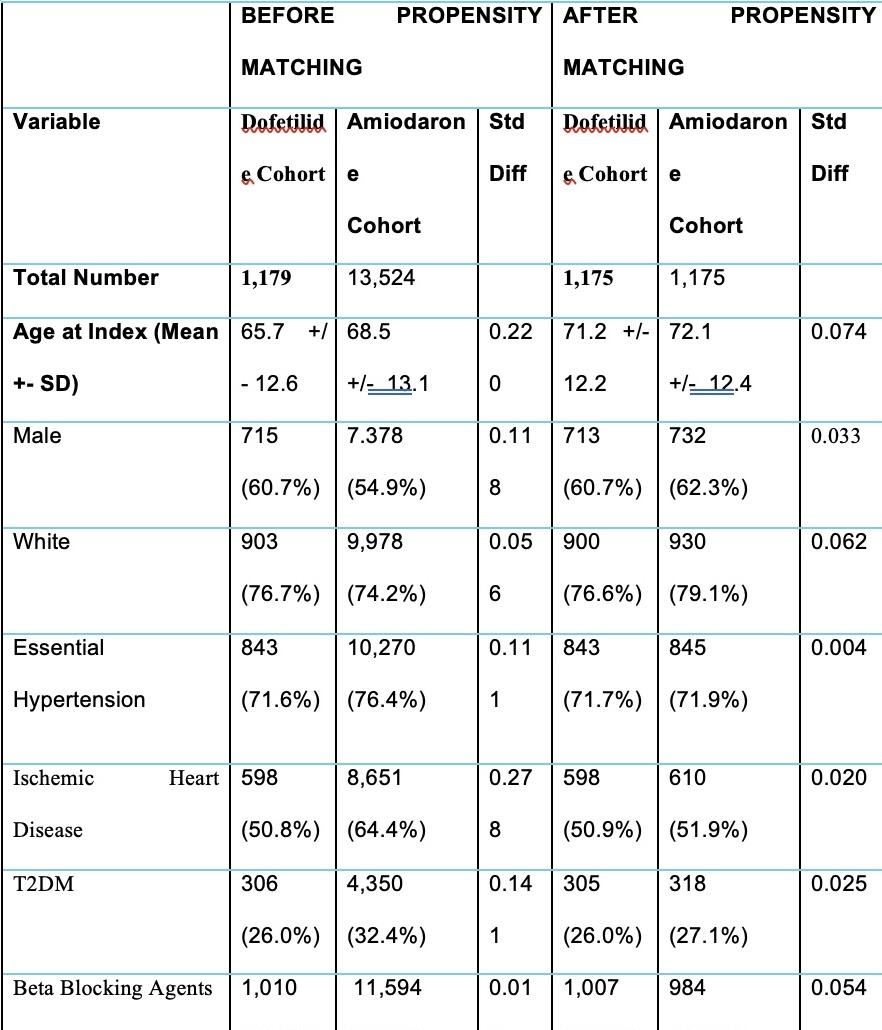
Methods: We queried the TriNetX US Collaborative Network for adults ≥18 years with concomitant HCM and AF started on antiarrhythmic therapy between 2004 and 2023. Patients with end-stage renal disease were excluded. Two treatment cohorts were defined: dofetilide users (n=1,179) and amiodarone users (n=13,524). One-to-one propensity-score matching on demographics and major comorbidities produced balanced groups of 1,175 per arm. Primary endpoints were all-cause mortality and three-point major adverse cardiovascular events (MACE: acute myocardial infarction, cerebral infarction, or death). Secondary endpoints included AF recurrence, all-cause hospitalization, and a composite of ventricular tachyarrhythmias. Hazard ratios with 95% confidence intervals were computed.
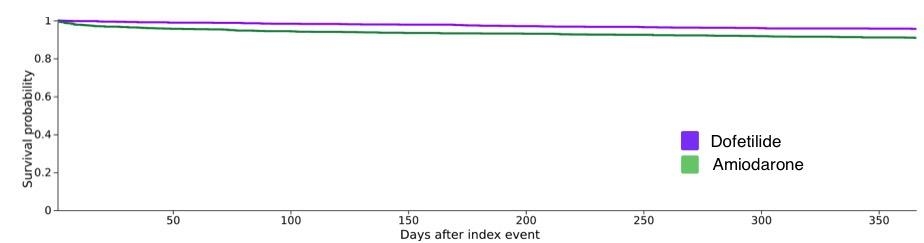
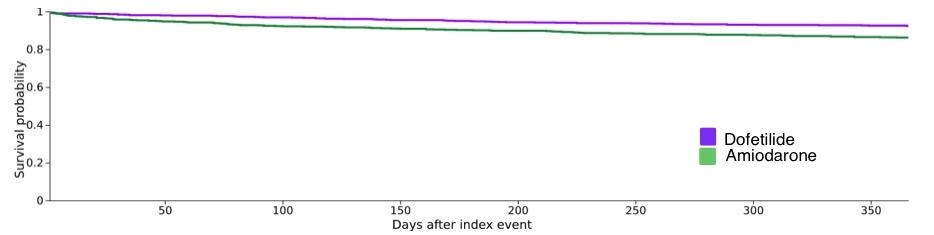
Results: Dofetilide demonstrated significantly lower one-year all-cause mortality versus amiodarone (4.5% vs 11.0%; HR 0.39, 95% CI 0.28-0.53) and reduced MACE (7.6% vs 13.0%; HR 0.54, 95% CI 0.40-0.74), driven by decreased death and ischemic stroke. Hospitalization was lower with dofetilide (30.3% vs 34.7%; HR 0.82, 95% CI 0.71-0.94). However, AF recurrence occurred more frequently with dofetilide (89.0% vs 79.1%; HR 1.36, 95% CI 1.24-1.48, p<0.001). Composite ventricular tachyarrhythmias showed a numerically higher but statistically non-significant trend with dofetilide (7.4% vs 4.7%; HR 1.49, 95% CI 0.99-2.24).
Conclusions: In this large, real-world, propensity-matched analysis of HCM patients with AF, dofetilide was associated with markedly improved one-year survival and reduced major adverse cardiovascular events compared to amiodarone, despite higher AF recurrence rates. These findings challenge conventional amiodarone preference in structural heart disease and support prospective randomized trials to optimize antiarrhythmic strategies in this high-risk population.
Olayiwola, Olalekan
(
Saint Peter's University Hospital
, New Brunswick , New Jersey , United States )
Okorigba, Efeturi
(
West Virginia University
, Morgantown , West Virginia , United States )
Otabor, Emmanuel
(
Jefferson Einstein Philadelphia
, Philadelphia , Pennsylvania , United States )
Hassan, Abdulraheem
(
Saint Peter's University hospital
, NEW BRUNSWICK , New Jersey , United States )
Daniel, Emmanuel
(
Trinity Health Ann Arbor
, Ypsilanti , Michigan , United States )
Santos Argueta, Hector
(
Cook County Health
, Chicago , Illinois , United States )
Agrawal, Ankit
(
Cleveland Clinic
, Cleveland , Ohio , United States )
Patel, Manank
(
Saint Peter's University Hospital
, New Brunswick , New Jersey , United States )
Singal, Dinesh
(
Saint Peter's University Hospital
, New Brunswick , New Jersey , United States )
Author Disclosures:
Olalekan Olayiwola:DO NOT have relevant financial relationships
| Efeturi Okorigba:DO NOT have relevant financial relationships
| Emmanuel Otabor:DO NOT have relevant financial relationships
| Abdulraheem Hassan:DO NOT have relevant financial relationships
| Emmanuel Daniel:DO NOT have relevant financial relationships
| Hector Santos Argueta:DO NOT have relevant financial relationships
| Ankit Agrawal:DO NOT have relevant financial relationships
| Manank patel:DO NOT have relevant financial relationships
| Dinesh Singal:DO NOT have relevant financial relationships