
Logo

American Heart Association

  15
  0


Final ID: Su3019

Episodes of Higher Glucose Are Associated with Paroxysmal Atrial Fibrillation Occurrences During Continuous Glucose and Heart Rhythm Monitoring in Older Adults with Diabetes: the Atherosclerosis Risk in Communities (ARIC) Study

Abstract Body (Do not enter title and authors here): Background: Cardiac arrhythmias, particularly atrial fibrillation (AF), are highly prevalent in diabetes due, in part, to cardiac autonomic neuropathy. More frequent AF may contribute to negative cardiovascular outcomes such as stroke and heart failure. It is unknown if episodes of higher glucose are associated with paroxysmal AF occurrences.

Hypothesis: Episodes of higher glucose levels are associated with higher risks of paroxysmal AF onset.

Methods: We invited Atherosclerosis Risk in Communities participants with diabetes at visits 9 and 10 (2021-2023) to undergo 14 days of concurrent continuous glucose monitoring (CGM) and “patch” electrocardiographic (ECG) monitoring regardless of arrhythmia history. Among them, we modelled the odds of episodic AF onset, defined as the transition from sinus rhythm to an AF episode (>30 seconds of irregularly irregular rhythm without P-waves), based on same-hour glucose using multilevel logistic regression, and 4-hour CGM data preceding AF onset using generalized scalar-on-function regression.

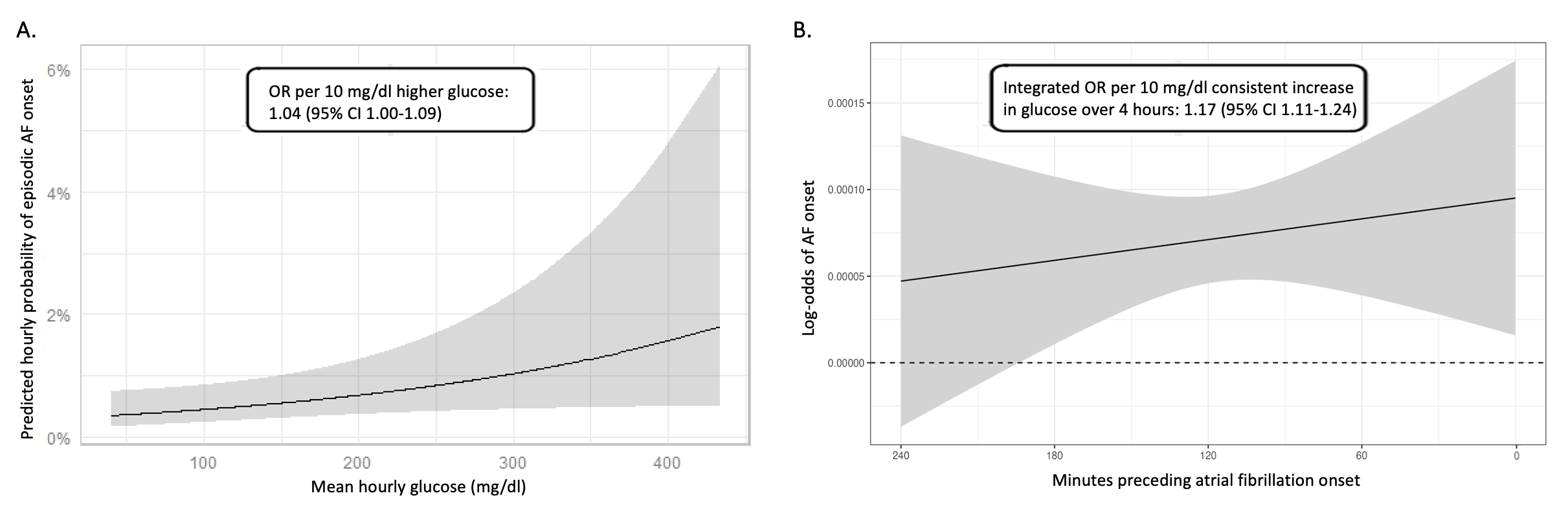
Results: Of 211 CGM-ECG study participants, AF was detected in 18. Ten individuals with at least one episodic AF onset (mean age 81 years, 5 females, 3 Black adults) formed the analytic sample where a total of 129 days of ECG data and 11,453 glucose measurements were analyzed. Among individual monitoring periods, the number of AF episodes ranged from 1 to 159, and the median CGM time below (<70 mg/dl), in (70-180 mg/dl), and above (>180 mg/dl) range was 2%, 65%, and 32%, respectively. Using multilevel logistic regression dividing data into distinct one-hour intervals and accounting for diurnal patterns and participant random effects, we found a 4% higher odds of AF onset per 10 mg/dl higher same-hour mean glucose (odds ratio [OR] 1.04, 95% confidence interval [CI] 1.00-1.09, p=0.04; Figure 1A). Generalized scalar-on-function regression with participant random effects and adjustment for time of day found a potentiating association between AF onset and glucose elevations accumulated over 4 preceding hours (per 10 mg/dl consistent elevation over 4 hours, integrated OR 1.17, 95% CI 1.11-1.24, p<0.001; Figure 1B).

Conclusion: Among older, US community-dwelling adults with diabetes, the risk of a paroxysmal AF episode was preceded by higher glucose levels for up to 4 hours as measured by CGM. This finding highlights the importance of continuous monitoring with wearable devices and timely detection of hyperglycemia as a marker of AF risk.
  • Luo, Shengyuan  ( Johns Hopkins University , Baltimore , Maryland , United States )
  • Echouffo, Justin  ( Johns Hopkins Hospital , Baltimore , Maryland , United States )
  • Zeger, Scott  ( Johns Hopkins University , Baltimore , Maryland , United States )
  • Chen, Lin Yee  ( UNIVERSITY OF MINNESOTA , Minneapolis , Minnesota , United States )
  • Selvin, Elizabeth  ( JOHNS HOPKINS UNIVERSITY , Baltimore , Maryland , United States )
  • Sartini, Joseph  ( Johns Hopkins University , Baltimore , Maryland , United States )
  • Wang, Dan  ( Johns Hopkins University , Baltimore , Maryland , United States )
  • Rooney, Mary  ( Johns Hopkins University , Baltimore , Maryland , United States )
  • Shin, Jung-im  ( Johns Hopkins University , Baltimore , Maryland , United States )
  • Wallace, Amelia  ( JH Bloomberg Sch. of Public Health , Baltimore , Maryland , United States )
  • Minhas, Anum  ( Johns Hopkins University , Baltimore , Maryland , United States )
  • Soliman, Elsayed  ( WAKE FOREST SCHOOL OF MEDICINE , Winston Salem , North Carolina , United States )
  • Lutsey, Pamela  ( University of Minnesota , Minneapolis , Minnesota , United States )
  • Author Disclosures:
    Shengyuan Luo: DO NOT have relevant financial relationships | Justin Echouffo: DO NOT have relevant financial relationships | Scott Zeger: DO have relevant financial relationships ; Advisor:Embold:Active (exists now) | Lin Yee Chen: DO NOT have relevant financial relationships | Elizabeth Selvin: DO NOT have relevant financial relationships | Joseph Sartini: DO NOT have relevant financial relationships | Dan Wang: DO NOT have relevant financial relationships | Mary Rooney: DO NOT have relevant financial relationships | Jung-Im Shin: DO have relevant financial relationships ; Research Funding (PI or named investigator):Bayer:Active (exists now) | Amelia Wallace: DO NOT have relevant financial relationships | Anum Minhas: DO NOT have relevant financial relationships | Elsayed Soliman: DO NOT have relevant financial relationships | Pamela Lutsey: DO NOT have relevant financial relationships
Meeting Info:

Scientific Sessions 2025

2025

New Orleans, Louisiana

Session Info:

Population Science and Arrhythmia Trends

Sunday, 11/09/2025 , 03:15PM - 04:15PM

Abstract Poster Board Session

More abstracts on this topic:

A Large Animal Model of Persistent Atrial Fibrillation

Mostafizi Pouria, Goldman Steven, Moukabary Talal, Lefkowitz Eli, Ref Jacob, Daugherty Sherry, Grijalva Adrian, Cook Kyle Eric, Chinyere Ike, Lancaster Jordan, Koevary Jen

A novel deep learning framework identified associated genes and Interpretable deep learning translation of GWAS findings for drug repurposing in Atrial Fibrillation

Tonegawa-kuji Reina, Xu Jielin, Guntupalli Suman, Barnard John, Chung Mina, Cheng Feixiong

More abstracts from these authors:
Symptoms of Hypoglycemia in Older Adults With and Without Diabetes

Daya Malek Natalie, Fang Michael, Wang Dan, Windham B Gwen, Valint Arielle, Echouffo Justin, Selvin Elizabeth

Joint Associations of Objectively Measured Physical Activity and Cardiovascular-Kidney-Metabolic Syndrome with All-Cause Mortality in US Adults

Sartini Joseph, Rooney Mary, Schrack Jennifer, Mcevoy John, Ndumele Chiadi, Zeger Scott, Selvin Elizabeth, Fang Michael

You have to be authorized to contact abstract author. Please, Login
Not Available