
Impact of the DASH4D Diet on Post-prandial Glucose Patterns assessed by Continuous Glucose Monitoring in Adults with Type 2 Diabetes
Abstract Body: Introduction: In a recent randomized trial, we showed that a DASH-style diet optimized for adults with type 2 diabetes (DASH4D) reduced mean glucose assessed by continuous glucose monitoring (CGM). However, the impact of DASH4D on postprandial glycemic response (PPGR), or glucose dynamics following meal taking, is unclear.
Objective: Quantify the effect of the DASH4D diet on the PPGR time series and evaluate the proportion of the overall glycemic benefit of the DASH4D diet attributable to PPGR.
Methods: The DASH4D trial had a 4-period crossover design. Adults with type 2 diabetes were randomized to an order of four diets: DASH4D or a typical American dietary pattern (comparison), each with lower or higher sodium. Calories were adjusted to maintain a stable weight. As sodium was not expected to impact PPGR, we combined the lower and higher sodium arms within each diet. Feeding periods were 5 weeks, with ≥ 1 week break between periods. CGM devices were worn from the 3rd to 5th weeks, recording up to 14 days of data. In a subset of participants, staff recorded meal timing during CGM wear. We fit a functional model regressing the PPGR time series (CGM glucose 1 hour before to 4 hours after meal start time) on diet type, including participant-specific random effects and adjustment for age, sex, body mass index (BMI), and time of day. We also applied functional regression-based mediation analyses to estimate the proportion of the diet effect on mean glucose that was mediated by differences in PPGR.
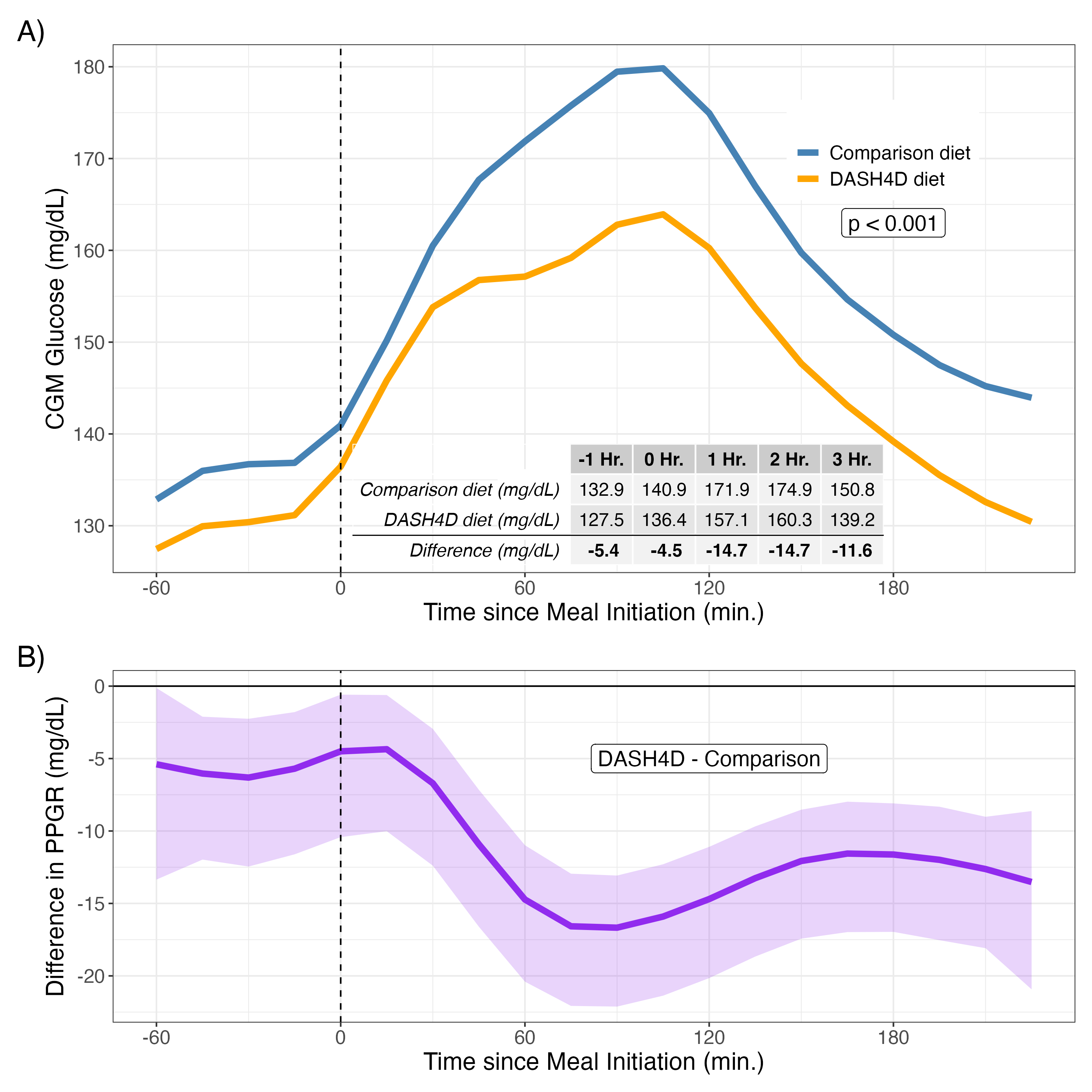
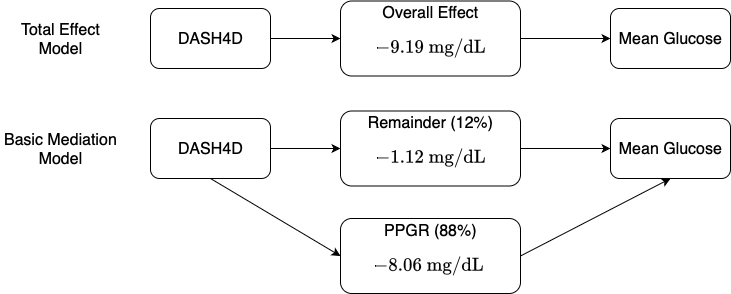
Results: We collected PPGR data from 768 meals across the 65 participants who consented to meal monitoring (median age 68 years, 66% female). The DASH4D diet reduced PPGR, ranging from a difference -4.5 mg/dL at meal onset to -14.7 mg/dL from 1-2 hours after the start of the meal (Fig. 1a). There was a significant difference in PPGR between the DASH4D and comparison diets over the entire observation period (Fig. 1b). Differences in PPGR mediated 88% of the overall effect of the DASH4D diet on CGM mean glucose (Fig. 2).
Conclusion: Among adults with type 2 diabetes, the DASH4D diet improved glycemic control primarily by reducing PPGR.
Sartini, Joseph
(
Johns Hopkins University
, Baltimore , Maryland , United States )
Rooney, Mary
(
Johns Hopkins University
, Baltimore , Maryland , United States )
Wang, Dan
(
Johns Hopkins University
, Baltimore , Maryland , United States )
Rebholz, Casey
(
Johns Hopkins University
, Baltimore , Maryland , United States )
Echouffo, Justin
(
Johns Hopkins Hospital
, Baltimore , Maryland , United States )
Mitchell, Christine
(
Johns Hopkins University
, Baltimore , Maryland , United States )
Yeh, Hsin-chieh
(
Johns Hopkins University
, Baltimore , Maryland , United States )
Appel, Lawrence
(
Johns Hopkins University
, Baltimore , Maryland , United States )
Pilla, Scott
(
Johns Hopkins University
, Baltimore , Maryland , United States )
Zeger, Scott
(
Johns Hopkins University
, Baltimore , Maryland , United States )
Selvin, Elizabeth
(
Johns Hopkins University
, Baltimore , Maryland , United States )
Fang, Michael
(
Johns Hopkins University
, Baltimore , Maryland , United States )