
Logo

American Heart Association

  18
  0


Final ID: Su4008

Genetic Variants Drive Phenotypic Diversity and Adverse Outcomes in Left Ventricular Hypertrabeculation

Abstract Body (Do not enter title and authors here): Background: Left ventricular hypertrabeculation (LVHT), often also known as left ventricular non-compaction, describes a cardiac phenotype characterized by prominent trabeculae and deep intertrabecular recesses. Genetic background of LVHT remains poorly understood. Moreover, the clinical relevance of genetic variants in LVHT has not been well described.
Aims: This study aimed to characterize the genetic structure of a large LVHT cohort and investigate the impact of underlying genotype on clinical features and outcomes.
Methods: Unrelated subjects with a cardiac magnetic resonance (CMR) - confirmed diagnosis of LVHT from four tertiary hospitals in China between 2010 and 2023 were prospectively included. Diagnosis of LVHT necessitated both the following CMR criteria: 1) long-axis (end-diastolic): a noncompacted (NC) /compacted(C) ratio >2.3 in ≥1 LV segments; 2) short-axis (end-diastolic): a NC/C ratio ≥3 in ≥1 of segments 1–3/7-16, or a NC/C ratio ≥2 in ≥1 of segments 4-6. Whole exome sequencing was conducted in all subjects. Primary endpoint was a composite of major adverse cardiovascular events (MACE). Cox proportional hazards model was used in statistical analysis.
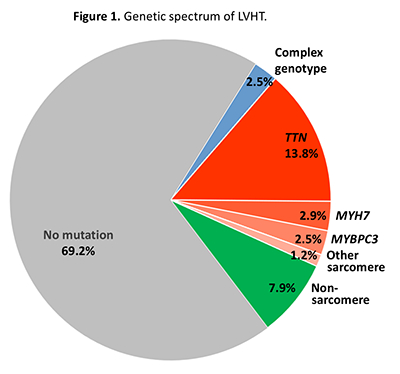
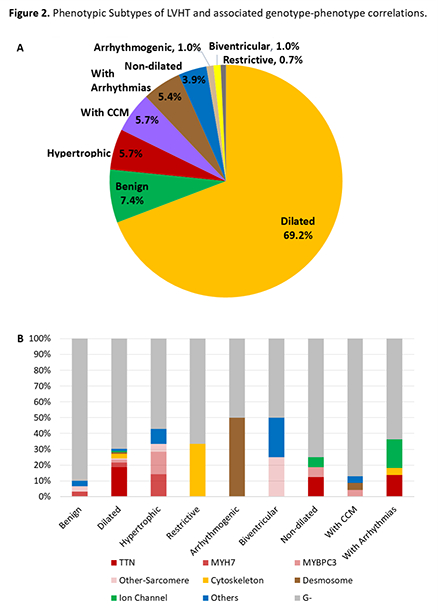
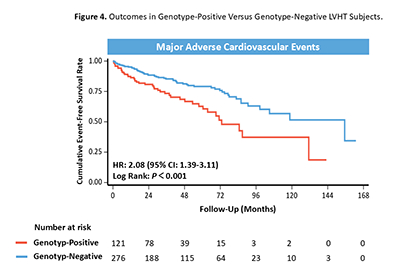
Results: A total of 406 subjects diagnosed with LVHT were included in the study. The median age at diagnosis was 38 years (IQR 26-52), with 67% males and 88% adults. Overall, 136 pathogenic (P) or likely pathogenic (LP) variants were found in 125 subjects (30.8%). TTN (13.8%) was the most common gene, followed by MYH7 (2.9%) and MYBPC3 (2.5%) (Figure 1). Subjects presented with at least 9 sub-phenotypes, the dilated being the most prevalent type (69.2%), followed by the benign type (7.4%), the hypertrophic type (5.7%), LVHT with congenital cardiovascular malformations (5.7%) (Figure 2A). TTN (19%) was the most prevalent gene identified in the dilated group, MYH7 and MYBPC3 (14%) were the most prevalent genes in the hypertrophic group (Figure 2B). During a median follow-up of 35.7 months, combined covariate analysis revealed that genotype-positive status was independently associated with MACE (HR: 1.69; 95% CI: 1.12-2.56; P=0.013) (Figure 3).
Conclusions: LVHT possesses a heterogeneous nature, exhibiting diverse genetic and phenotypic profiling. Subjects with LVHT carrying P/LP variants have worse prognosis. Therefore, genetic testing may contribute to prognostic stratification and management guidance in these subjects.
  • Yang, Kun-qi  ( Fuwai Hospital, National Center for Cardiovascular Diseases, Chinese Academy of Medical Sciences and Peking Union Medical College , Beijing , China )
  • Zhang, Xinmin  ( Beijing Children's Hospital, Capital Medical University, National Center for Children's Health (Beijing) , Beijing , China )
  • Wang, Tianjie  ( Fuwai Hospital, National Center for Cardiovascular Diseases, Chinese Academy of Medical Sciences and Peking Union Medical College , Beijing , China )
  • Wang, Yong  ( Fuwai Hospital, National Center for Cardiovascular Diseases, Chinese Academy of Medical Sciences and Peking Union Medical College , Beijing , China )
  • Sun, Yuqing  ( Beijing Anzhen Hospital, Capital Medical University, National Clinical Research Center for Cardiovascular Diseases , Beijing , China )
  • Zhang, Bo  ( Fuwai Yunnan Hospital, Chinese Academy of Medical Sciences, Affiliated Cardiovascular Hospital of Kunming Medical University , Kunming , China )
  • Ma, Menghuai  ( Fuwai Yunnan Hospital, Chinese Academy of Medical Sciences, Affiliated Cardiovascular Hospital of Kunming Medical University , Kunming , China )
  • Li, Jing-hui  ( Fuwai Hospital, National Center for Cardiovascular Diseases, Chinese Academy of Medical Sciences and Peking Union Medical College , Beijing , China )
  • Xi, Shaozhi  ( The Second Medical Center & National Clinical Research Center for Geriatric Diseases, Chinese PLA General Hospital , Beijing , China )
  • Wang, Chi  ( Fuwai Yunnan Hospital, Chinese Academy of Medical Sciences, Affiliated Cardiovascular Hospital of Kunming Medical University , Kunming , China )
  • Xu, Haobo  ( Fuwai Hospital, National Center for Cardiovascular Diseases, Chinese Academy of Medical Sciences and Peking Union Medical College , Beijing , China )
  • Fan, Peng  ( Fuwai Hospital, National Center for Cardiovascular Diseases, Chinese Academy of Medical Sciences and Peking Union Medical College , Beijing , China )
  • Zhu, Fasheng  ( Fuwai Hospital, National Center for Cardiovascular Diseases, Chinese Academy of Medical Sciences and Peking Union Medical College , Beijing , China )
  • Maimaiti, Xier  ( The First People's Hospital of Aksu District , Aksu District , China )
  • Wang, Huanghuang  ( Fuwai Hospital, National Center for Cardiovascular Diseases, Chinese Academy of Medical Sciences and Peking Union Medical College , Beijing , China )
  • Guan, Hao  ( Fuwai Hospital, National Center for Cardiovascular Diseases, Chinese Academy of Medical Sciences and Peking Union Medical College , Beijing , China )
  • Gao, Lijian  ( Fuwai Hospital, National Center for Cardiovascular Diseases, Chinese Academy of Medical Sciences and Peking Union Medical College , Beijing , China )
  • Yuan, Jiansong  ( Fuwai Hospital, National Center for Cardiovascular Diseases, Chinese Academy of Medical Sciences and Peking Union Medical College , Beijing , China )
  • Ma, Lihong  ( Fuwai Hospital, National Center for Cardiovascular Diseases, Chinese Academy of Medical Sciences and Peking Union Medical College , Beijing , China )
  • Gao, Ling-gen  ( The Second Medical Center & National Clinical Research Center for Geriatric Diseases, Chinese PLA General Hospital , Beijing , China )
  • Zhu, Da  ( Fuwai Yunnan Hospital, Chinese Academy of Medical Sciences, Affiliated Cardiovascular Hospital of Kunming Medical University , Kunming , China )
  • Zhang, Yaohua  ( Peking University Third Hospital; Key Laboratory of Molecular Cardiovascular Science, Ministry of Education , Beijing , China )
  • Hu, Yuxiao  ( Fuwai Hospital, National Center for Cardiovascular Diseases, Chinese Academy of Medical Sciences and Peking Union Medical College , Beijing , China )
  • Qin, Xiuchuan  ( Beijing Anzhen Hospital, Capital Medical University, National Clinical Research Center for Cardiovascular Diseases , Beijing , China )
  • Hu, Aihua  ( Beijing Children's Hospital, Capital Medical University, National Center for Children's Health (Beijing) , Beijing , China )
  • Zhou, Xianliang  ( Fuwai Hospital, National Center for Cardiovascular Diseases, Chinese Academy of Medical Sciences and Peking Union Medical College , Beijing , China )
  • Duru, Firat  ( University of Zurich , Zurich , Switzerland )
  • Yang, Weixian  ( Fuwai Hospital, National Center for Cardiovascular Diseases, Chinese Academy of Medical Sciences and Peking Union Medical College , Beijing , China )
  • Tian, Tao  ( Fuwai Hospital, National Center for Cardiovascular Diseases, Chinese Academy of Medical Sciences and Peking Union Medical College , Beijing , China )
  • Kong, Dan  ( Fuwai Hospital, National Center for Cardiovascular Diseases, Chinese Academy of Medical Sciences and Peking Union Medical College , Beijing , China )
  • Chen, Liang  ( State Key Laboratory of Cardiovascular Disease, Fuwai Hospital, National Center for Cardiovascular Diseases, Chinese Academy of Medical Sciences and Peking Union Medical College , Beijing , China )
  • Yin, Weihua  ( Fuwai Hospital, National Center for Cardiovascular Diseases, Chinese Academy of Medical Sciences and Peking Union Medical College , Beijing , China )
  • Lin, Yahui  ( Fuwai Hospital, National Center for Cardiovascular Diseases, Chinese Academy of Medical Sciences and Peking Union Medical College , Beijing , China )
  • Li, Xiaoni  ( Fuwai Hospital, National Center for Cardiovascular Diseases, Chinese Academy of Medical Sciences and Peking Union Medical College , Beijing , China )
  • Lu, Peipei  ( Fuwai Hospital, National Center for Cardiovascular Diseases, Chinese Academy of Medical Sciences and Peking Union Medical College , Beijing , China )
  • Author Disclosures:
    Kun-Qi Yang: DO NOT have relevant financial relationships | Xinmin Zhang: No Answer | Tianjie Wang: No Answer | Yong Wang: No Answer | Yuqing Sun: No Answer | Bo Zhang: No Answer | Menghuai Ma: No Answer | Jing-Hui Li: No Answer | Shaozhi Xi: No Answer | Chi Wang: No Answer | Haobo Xu: No Answer | Peng Fan: No Answer | Fasheng Zhu: No Answer | Xier Maimaiti: No Answer | Huanghuang Wang: No Answer | Hao Guan: No Answer | Lijian Gao: No Answer | Jiansong Yuan: No Answer | Lihong Ma: No Answer | Ling-Gen Gao: No Answer | Da Zhu: No Answer | Yaohua Zhang: No Answer | Yuxiao Hu: No Answer | Xiuchuan Qin: No Answer | Aihua Hu: No Answer | Xianliang Zhou: No Answer | Firat Duru: No Answer | Weixian Yang: No Answer | Tao Tian: No Answer | Dan Kong: No Answer | Liang Chen: No Answer | Weihua Yin: No Answer | Yahui Lin: No Answer | Xiaoni Li: No Answer | Peipei Lu: No Answer
Meeting Info:

Scientific Sessions 2025

2025

New Orleans, Louisiana

Session Info:

Predicting and Treating Genetic Cardiomyopathies

Sunday, 11/09/2025 , 11:30AM - 12:30PM

Abstract Poster Board Session

More abstracts on this topic:
Ambient Air Pollution Heightens Prevalence and Adverse Impacts of Clonal Hematopoiesis of Indeterminate Potential

Abohashem Shady, Natarajan Pradeep, Tawakol Ahmed, Aldosoky Wesam, Uddin Md Mesbah, Civieri Giovanni, Lau Hui Chong, Abikaram Krystel, Assefa Alula, Rajagopalan Sanjay, Osborne Michael

A Randomized Clinical Trial Evaluating Vitamin D Normalization on Major Adverse Cardiovascular-Related Events Among Acute Coronary Syndrome Patients: The TARGET-D Trial

May Heidi, Colipi Dominique, Whiting Tyler, Muhlestein Joseph, Le Viet, Anderson Jeffrey, Babcock Daniel, Wayman Libby, Bair Tami, Knight Stacey, Knowlton Kirk, Iverson Leslie

You have to be authorized to contact abstract author. Please, Login
Not Available