
Logo

American Heart Association

  17
  0


Final ID: MP2444

Long-Term Survival in Pediatric Heart Transplantation: A PHTS-SRTR Linkage Study

Abstract Body (Do not enter title and authors here): BACKGROUND: There is a growing population of adult survivors after pediatric heart transplantation (HTx). Little is known about long-term outcomes, particularly after transition to adult care. We aimed to: (1) characterize the survival of pediatric HTx recipients and (2) identify risk factors associated with mortality in long-term survivors.
METHODS: Data from the Pediatric Heart Transplant Society (PHTS) registry were linked using direct identifiers to the Scientific Registry of Transplant Recipients (SRTR) to identify patients (aged ≤18 years) who underwent first HTx between 1993 and 2020. Patients with ≥3 years of PHTS follow-up were included in the risk factor analysis. The primary outcome was patient death in the SRTR, which includes verified deaths from the Social Security Administration Death Master File. Kaplan-Meier analysis, competing risk analysis, and Cox proportional hazard modeling were used to assess survival and identify pre- and early post-HTx risk factors for mortality for 3-year conditional survivors.
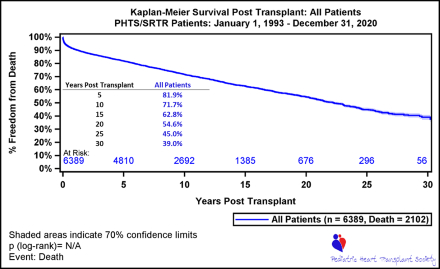
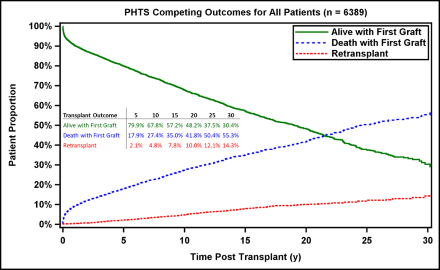
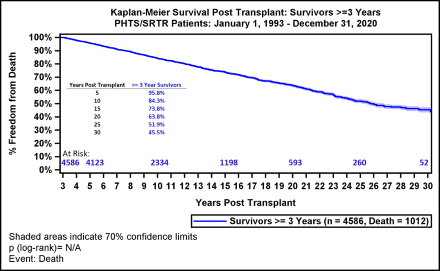
RESULTS: A 94% linkage rate was achieved between the two databases (n=6389). The mean age at HTx was 6.6 years, and 3227 (51%) had congenital heart disease. Median survival was 22 years, and the retransplant rate was 14% at 30 years. For 3-year conditional survivors, the 30-year survival was 46%. In this group, both infants and single ventricle patients who underwent primary HTx had a 30-year survival of 58%. Common causes of death were non-rejection cardiovascular in 367 (36%), rejection in 181 (18%) and malignancy or PTLD in 62 (6%). Independent risk factors for mortality included older age at HTx, black race, donor sex mismatch, mechanical ventilation at HTx, higher steroid exposure, number of rejection episodes and recent diagnosis of cardiac allograft vasculopathy (p<0.05 for all). Patients transplanted between 11-18 years and with 3+ rejection episodes in the first 3 years had the highest hazard of mortality (HR 2.2, 95% CI 1.8-2.7 and HR 2.2, 95% CI 1.8-2.8).
CONCLUSIONS: We established a novel and robust data linkage, enabling the longest-term survival analysis of pediatric HTx recipients to date. Pediatric HTx is an effective therapy that allows half of patients to survive ≥22 years. Age at HTx and early rejection are more influential on long-term survival than underlying diagnosis or stage of palliation. Increasing retransplant rates and preventing early rejection are strategies which may improve long-term pediatric HTx survival.
  • Kamsheh, Alicia  ( Washington University in St. Louis , Saint Louis , Missouri , United States )
  • Koehl, Devin  ( University of Alabama at Birmingham , Murray , Utah , United States )
  • Cantor, Ryan  ( University of Alabama at Birmingham , Murray , Utah , United States )
  • Choudhry, Swati  ( Baylor College of Medicine , Houston , Texas , United States )
  • Hayes, Emily  ( Nationwide Childrens Hospital , Columbus , Ohio , United States )
  • Hsu, Daphne  ( ALBERT EINSTEIN COLLEGE OF MEDICINE , Bronx , New York , United States )
  • Canter, Charles  ( Washington University in St. Louis , Saint Louis , Missouri , United States )
  • Kirklin, James  ( University of Alabama at Birmingham , Murray , Utah , United States )
  • Beasley, Gary  ( University of Iowa , Iowa City , Iowa , United States )
  • Author Disclosures:
    Alicia Kamsheh: DO NOT have relevant financial relationships | Devin Koehl: No Answer | Ryan Cantor: DO have relevant financial relationships ; Employee:Kirklin Solutions - PHTS Data Coordinating Center Employee:Active (exists now) ; Other (please indicate in the box next to the company name):Berlin Heart - DSMB for Active Driver CAP Study:Active (exists now) | Swati Choudhry: DO NOT have relevant financial relationships | Emily Hayes: DO NOT have relevant financial relationships | Daphne Hsu: DO have relevant financial relationships ; Consultant:Bayer :Active (exists now) ; Consultant:Rocket Pharmaceuticals:Active (exists now) | Charles Canter: No Answer | James Kirklin: DO have relevant financial relationships ; Other (please indicate in the box next to the company name):Carmat - Chair of Clinical Events Committee for the cliical trial of Carmat total artificial heart:Past (completed) ; Other (please indicate in the box next to the company name):Xvivo - CHAIR OF Clinical Events Committee for their trial on continuous perfusion of donor hearts.:Active (exists now) | Gary Beasley: No Answer
Meeting Info:

Scientific Sessions 2025

2025

New Orleans, Louisiana

More abstracts on this topic:
Artificial Intelligence-Enhanced Electrocardiographic Phenotyping Unveils Novel Lethal Cardiovascular & Sudden Death Risk Signatures in Traditionally Low Risk Populations

Barker Joseph, Syan Jasjit, Jenkins Alex, Ribeiro Antonio, Annis Jeffrey, Camelo Lidyane, Oliveira Clara, Paixao Gabriela, Brant Luisa, Ribeiro Antonio, Ge Junbo, Fathieh Sina, Kramer Daniel, Waks Jonathan, Brittain Evan, Peters Nicholas, Figtree Gemma, Khattak Gul Rukh, Sau Arunashis, Ng Fu Siong, Pastika Libor, Birdi Aidan, Zeidaabadi Boroumand, Patlatzoglou Konstantinos, Liang Yixiu, Aggour Hesham, El-medany Ahmed

β1 Adrenergic Receptor Autoantibodies Promote Heart Failure Though Activation of Prostaglandin E2 Receptor EP1/Phosphodiesterase 4B Pathway

Cao Ning, Qiu Hui, Li Hongwei

More abstracts from these authors:
Impact of Donor and Recipient Risk Matching on Survival After Pediatric Heart Transplantation

Townsend Madeleine, Profita Elizabeth, Miller Elyse, Simmonds Jacob, Bansal Neha, Conway Jennifer, Koehl Devin, Cantor Ryan, Kirklin James, Lim Heang, Lynn Melodie, Hussain Sabena

Psychoactive medication use in pediatric heart transplant recipients: An assessment of prevalence, risk factors, and outcomes

Schauer Jenna, Zaim Nadia, Zhao Hong, Brosbe Micah, Aljohani Othman, Cantor Ryan, Fraser Anna, Haregu Firezer, Hope Kyle, Kirklin James, Thompson Consuela, Urschel Simon

You have to be authorized to contact abstract author. Please, Login
Not Available