Logo

American Heart Association

  14
  0


Final ID: MP2327

Comparative Performance of an Artificial Intelligence-driven Electrocardiography Score with Traditional Risk Stratification Tools for Perioperative Risk Assessment in Non-cardiac Surgery

Abstract Body (Do not enter title and authors here): Background: The role of electrocardiography (ECG) has been limited in the preoperative risk evaluation in noncardiac surgery due to its low prognostic value. Recent advances in artificial intelligence (AI) have enabled the extraction of subtle features from ECG that can be used in risk prediction.
Research question: Can AI-enabled ECG predict 30-day postoperative mortality in patients undergoing non-cardiac surgery, outperforming conventional risk stratification tools?
Methods: A retrospective cohort of 46,135 adults who underwent non-cardiac surgery at a tertiary center between 2020 and 2021 was analyzed. Preoperative ECG images acquired within 30 days before surgery were used as input to a previously developed CNN-based deep-learning algorithm to generate QCG-Critical score – a probability score ranging from 0 to 100 – that reflects the risk for critical conditions such as shock, respiratory failure, and cardiac arrest. The QCG-Critical score was evaluated for its ability to predict 30-day in-hospital mortality. Secondary outcomes included 7-day mortality, prolonged mechanical ventilation, unplanned percutaneous coronary intervention (PCI), and heart failure within 30 days postoperatively.
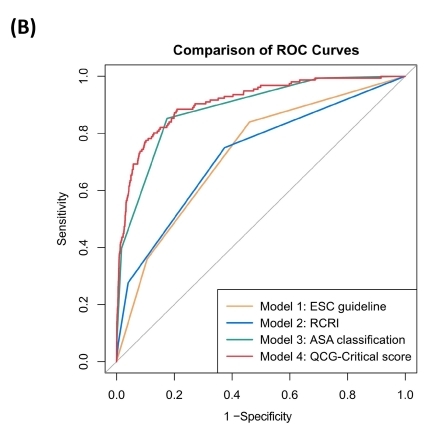
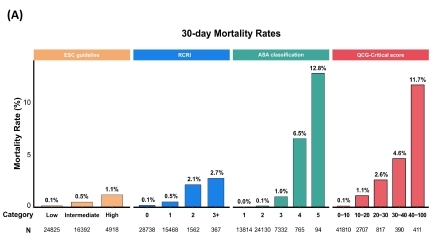
Results: The overall 30-day postoperative mortality rate was 0.34%. Patients with higher QCG-Critical score showed increased mortality, with a 30-day postoperative morality rate of 11.7% among patients with scores >40. The QCG-Critical score demonstrated strong predictive performance for 30-day mortality (AUROC: 0.909), outperforming the ESC guidelines (0.728) and RCRI (0.725), and was comparable to the ASA classification (0.886). The performance of QCG-Critical score remained consistent across subgroups stratified by age, sex, emergency operation, anesthesia type, and conventional risk groups. The QCG-Critical score also demonstrated good performance for predicting 7-day mortality (AUROC: 0.933), unplanned PCI (0.857), prolonged mechanical ventilation (0.829), and heart failure (0.774).
Conclusion: The preoperative QCG-Critical score accurately predicted postoperative mortality and other adverse outcomes, outperforming conventional risk stratification tools. The QCG-Critical may serve as a fast, accessible, and integrable tool for perioperative risk assessments in routine surgical care.
  • Kim, Yerin  ( Seoul National University Bundang H , Seongnam , Korea (the Republic of) )
  • Choi, Hong-mi  ( Seoul National University Bundang H , Seongnam , Korea (the Republic of) )
  • Kim, Joonghee  ( Seoul National University Bundang H , Seongnam , Korea (the Republic of) )
  • Park, Jiesuck  ( Seoul National University Bundang H , Seongnam , Korea (the Republic of) )
  • Lee, Ji Hyun  ( Seoul National University Bundang H , Seongnam , Korea (the Republic of) )
  • Yoon, Yeonyee  ( Seoul National University Bundang H , Seongnam , Korea (the Republic of) )
  • Oh, Il-young  ( Seoul National University Bundang H , Seongnam , Korea (the Republic of) )
  • Song, In-ae  ( Seoul National University Bundang H , Seongnam , Korea (the Republic of) )
  • Cho, Youngjin  ( Seoul National University Bundang H , Seongnam , Korea (the Republic of) )
  • Author Disclosures:
    Yerin Kim: DO NOT have relevant financial relationships | Hong-Mi Choi: DO NOT have relevant financial relationships | Joonghee Kim: No Answer | Jiesuck Park: DO NOT have relevant financial relationships | Ji Hyun Lee: No Answer | Yeonyee Yoon: No Answer | Il-young Oh: No Answer | In-Ae Song: No Answer | Youngjin Cho: No Answer
Meeting Info:

Scientific Sessions 2025

2025

New Orleans, Louisiana

Session Info:

AI & Digital Tools in CVD Research

Monday, 11/10/2025 , 10:45AM - 11:55AM

Moderated Digital Poster Session

More abstracts from these authors:
Revascularization of Patients with Low-Density Non-Calcified Plaque was Associated with Lower Occurrence of Acute Coronary Syndrome

Malkasian Shant, Conte Edoardo, Maffei Erica, Plank Fabian, Pontone Gianluca, Feuchtner Gudrun, Samady Habib, Park Hyung-bok, Danad Ibrahim, Cho Iksung, Bax Jeroen, Hubbard Logan, Lee Ji Hyun, Baskaran Lohendran, Hadamitzky Martin, Budoff Matthew, Stone Peter, Heo Ran, Cury Ricardo, Lee Sang-eun, Al'aref Subhi, Stuijfzand Wijnand, Nurmohamed Nick, Lu Yao, Kim Yong-jin, Cademartiri Filippo, Virmani Renu, Narula Jagat, Rizvi Asim, Chinnaiyan Kavitha, Villines Todd, Leipsic Jonathon, Shaw Leslee, Chang Hyuk-jae, Molloi Sabee, Choi Andrew, Marques Hugo, Van Rosendael Alexander, Chow Benjamin, Andreini Daniele

You have to be authorized to contact abstract author. Please, Login
Not Available