
A Body Shape Index at Age 25-64 Predicts Mortality and CHD Hospitalization
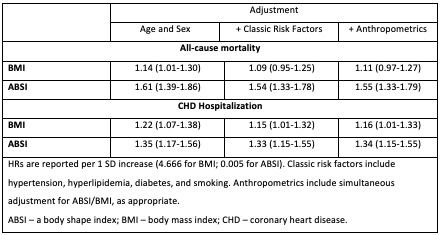
Abstract Body (Do not enter title and authors here): Introduction: Obesity is a known risk factor for cardiovascular disease (CVD) morbidity and mortality. A body shape index (ABSI) is a waist circumference (WC) measure of abdominal obesity independent of body mass index (BMI) that has been shown to predict mortality and numerous clinical outcomes. Aims: To study the predictive value of ABSI in conjunction with BMI for all-cause mortality and coronary heart disease (CHD) hospitalization among adult participants. Methods: Participants (n=2,225) were drawn from the First Israeli National Health and Nutrition Survey (1999-2001), constituting adults aged 25-64. Baseline anthropometrics, including weight, height, and WC, were measured and expressed as their allometric indices: BMI (weight/height2) and ABSI [WC/(BMI2/3*height1/2)]. Follow-up lasted through 2021 for mortality and 2022 for hospitalizations. Cox regressions assessed the adjusted risk of all-cause mortality and CHD hospitalization. Results: The baseline mean [SD] age was 43 [11] years, and 50% were women. The correlation between BMI and WC was 0.78, and 0.02 for BMI and ABSI. Over a median follow-up of 21 years, 247 (11.1%) deaths occurred. The multivariable-adjusted hazard ratios (HRs) for mortality per 1 SD increase in BMI and ABSI were 1.11 (95% CI: 0.97; 1.27) and 1.55 (95% CI: 1.33; 1.79), respectively (Table). ABSI exhibited a significant association with mortality risk across all standard BMI categories; adjusted for demographics and classic CVD risk factors, the HRs (95% CIs) per 1 SD increase in ABSI were 1.38 (1.01; 1.88) for individuals with a BMI of 18.5-24.9, 1.70 (1.34; 2.16) for BMI 25.0-29.9, and 1.46 (1.13; 1.87) for BMI ≥30.0. Among CVD-free participants at baseline (n=2,146), 267 (12.4%) were hospitalized for CHD during follow-up. The latter had higher ABSI (0.082 vs. 0.078, P<.001) and BMI (28.1 vs. 26.7, P<.001) than individuals who remained free of CHD. An increase in the adjusted HR was seen for both ABSI [1.34 (95% CI: 1.15; 1.55)] and BMI [1.16 (95% CI: 1.01; 1.33)] (Table). Conclusion: In a 20-year prospective study of a middle-aged cohort, baseline ABSI was a stronger predictor of mortality than BMI and predicted CHD hospitalization independently of BMI.
Shafran, Itamar
( Tel Aviv University
, Tel Aviv
, Israel
)
Krakauer, Nir
( The City College of New York
, New York City
, New York
, United States
)
Krakauer, Jesse
( Associated Physicians/Endocrinology
, Berkley
, Michigan
, United States
)
Cohen, Gali
( Tel Aviv University
, Tel Aviv
, Israel
)
Gerber, Yariv
( Tel Aviv University
, Tel Aviv
, Israel
)
Author Disclosures:
Itamar Shafran:DO NOT have relevant financial relationships
| Nir Krakauer:DO NOT have relevant financial relationships
| Jesse Krakauer:DO NOT have relevant financial relationships
| Gali Cohen:DO NOT have relevant financial relationships
| Yariv Gerber:DO NOT have relevant financial relationships