Trends in Atrial Fibrillation and Flutter Disability Adjusted Life Year Rates Attributable to Metabolic Risk Factors in The United States: An Analysis of the Global Burden of Disease, 1990-2021
Abstract Body (Do not enter title and authors here): Background: Atrial fibrillation (AF) and atrial flutter (AFL) are the most prevalent sustained cardiac arrhythmias globally, contributing to significant morbidity and mortality. Metabolic risk factors such as high systolic blood pressure (SBP) and elevated body mass index (BMI) are established contributors to the development of AF/AFL via structural and electrical remodeling of the atria.
Methods: Data were extracted from the Global Burden of Disease (GBD) Results curated by the Institute for Health Metrics and Evaluation. DALY rates attributed to AF/AFL due to risk factors such as high BMI and high SBP were obtained for adults aged > 20 years. Temporal trends were analyzed using the Joinpoint Regression tool and changes in trends through logarithmic regression modeling. Annual percent changes (APC) and average APC were computed. Analyses were done stratified by risk factors and genders.
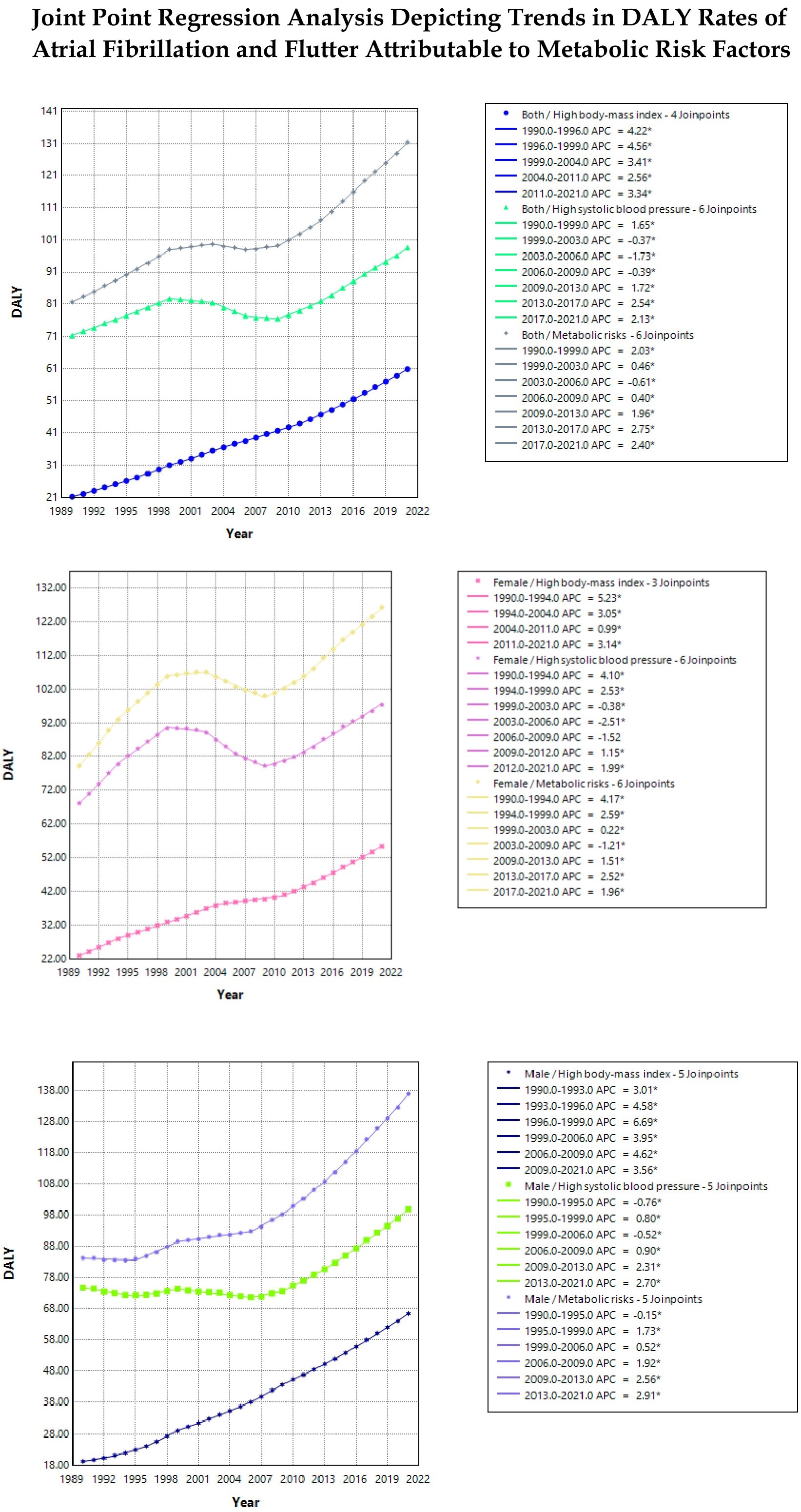
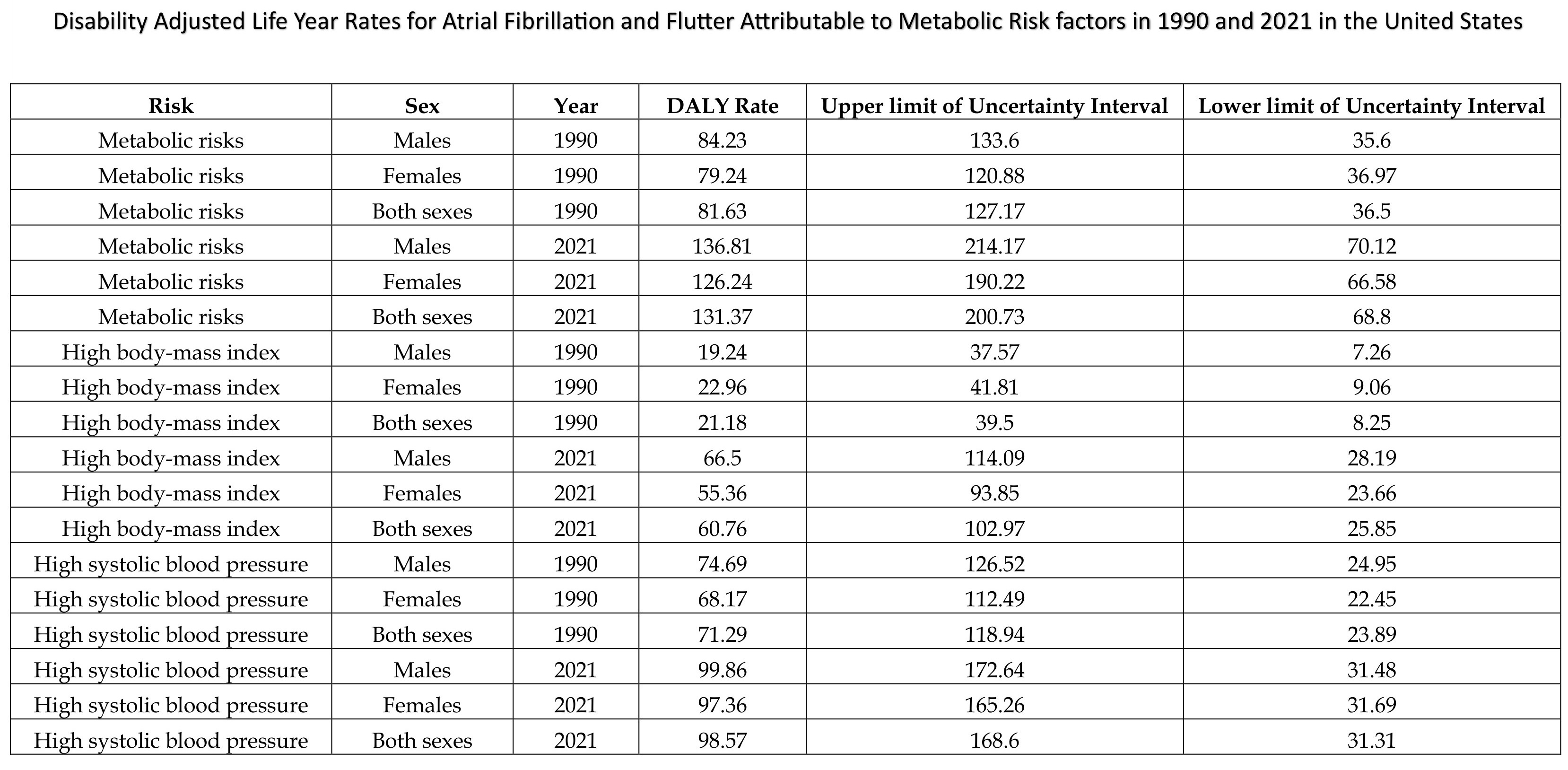
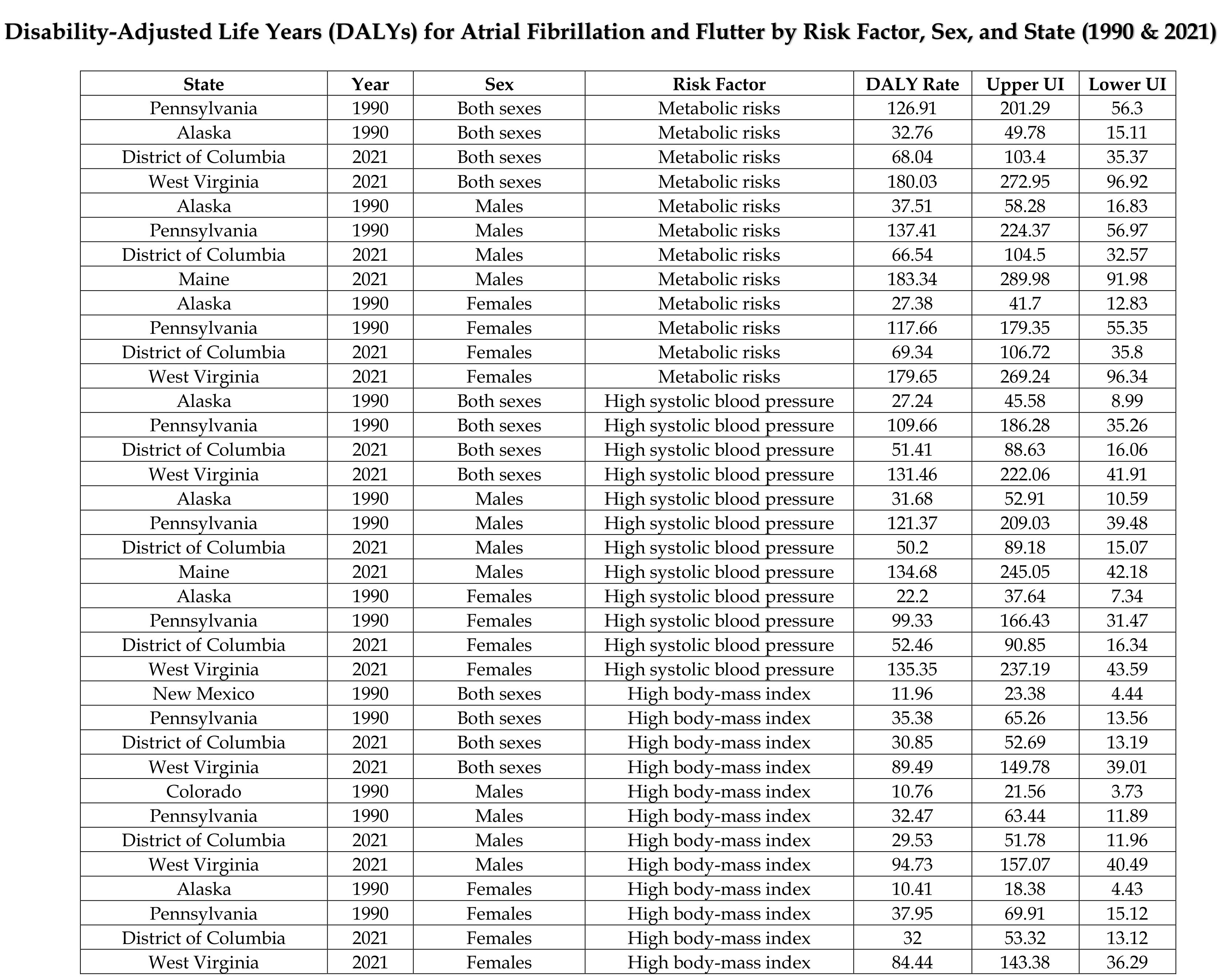
Results: From 1990 to 2021, DALYs attributable to AF/AFL due to high BMI, high SBP, and both increased significantly. Among the total population, the AAPC for high BMI was 3.46% (95% CI: 3.44–3.48), for high SBP was 1.04% (95% CI: 1.02–1.05), and for metabolic risks was 1.54% (95% CI: 1.53–1.55), all with p-values <0.001. In females, the AAPC for high BMI was 2.89% (95% CI: 2.87–2.91), for SBP was 1.17% (95% CI: 1.15–1.20), and for metabolic risks was 1.51% (95% CI: 1.49–1.53). Females showed early periods of steep increases, particularly in BMIMI (5.23%, 1990–1994), followed by gradual growth. SBP trends in females showed a notable decline between 2003 and 2006 (–2.51%) followed by renewed increases. For both risks, females showed strong positive trends after 2009. In males, the AAPC for high BMI was the highest across all groups at 4.09% (95% CI: 4.07–4.12), with a rapid rise between 1996 and 2000 (6.69%). The AAPC for SBP in males was lower at 0.93% (95% CI: 0.92–0.95), while for both risks, it showed a steady increase with an AAPC of 1.58% (95% CI: 1.56–1.59). Multiple inflection points with consistent upward trends resumed after 2009 for all three risk categories.
Conclusion: The burden of AF/AFL attributable to high BMI, high SBP, and both risks has risen substantially in U.S. adults over the past three decades. This upward trend was consistent across both genders. These findings highlight the growing public health impact of modifiable cardiometabolic risk factors and highlight the urgent need for demographic-specific strategies focused on risk reduction and prevention.
Vempati, Roopeessh
( Trinity Health Oakland
, Pontiac
, Michigan
, United States
)
Nair, Rajiv
( Trinity Health Oakland Hospital
, Pontiac
, Michigan
, United States
)
Varma, Yash
( Trinity Health Oakland Hospital
, Pontiac
, Michigan
, United States
)
Toquica Gahona, Christian
( Trinity Health Oakland Hospital
, Pontiac
, Michigan
, United States
)
Jain, Hritvik
( AIIMS Jodhpur
, Jodhpur
, India
)
Popat, Apurva
( Marshfield Clinic Health System
, Marshfield
, Wisconsin
, United States
)
Parul, Fnu
( Sparrow Hospital-MSU
, Lansing
, Michigan
, United States
)
Ha, Quang Dat
( Trinity Health Oakland Hospital
, Pontiac
, Michigan
, United States
)
Bansal, Nahush
( University of Toledo
, Toledo
, Ohio
, United States
)
Reddy, Madhu
( University of Kansas Health System
, Kansas City
, Kansas
, United States
)
Author Disclosures:
Roopeessh Vempati:DO NOT have relevant financial relationships
| Rajiv Nair:DO NOT have relevant financial relationships
| Yash Varma:DO NOT have relevant financial relationships
| Christian Toquica Gahona:No Answer
| Hritvik Jain:DO NOT have relevant financial relationships
| Apurva Popat:DO NOT have relevant financial relationships
| FNU Parul:DO NOT have relevant financial relationships
| Quang Dat Ha:DO NOT have relevant financial relationships
| Nahush Bansal:DO NOT have relevant financial relationships
| Madhu Reddy:No Answer