ROS Scavenging Attenuates Parasympathetic Nerve Activity and Overlying Complex Fractionated Atrial Electrograms (CFAEs) in Persistent Atrial Fibrillation—New Mechanistic Insights in Atrial Fibrillation
Abstract Body (Do not enter title and authors here): Background: Reactive oxygen species (ROS), complex fractionated atrial electrograms (CFAEs), and the autonomic nervous system play an important role in atrial fibrillation (AF). However, their mechanisms are complex, and their real time feedback responses to ROS scavenging remain unsettled.
Objective: We hypothesized that parasympathetic nerve activity (PNA) and overlying CFAEs are uniquely sensitive to acute ROS scavenging with N acetylcysteine (NAC).
Methods: We induced persistent AF in 15 dogs (> 1 year old, 25 to 35kg) by rapid atrial pacing (RAP) (600 beats/min) for 3 to 17 weeks and performed high-density epicardial mapping pre/post-NAC, intravenous, 100mg/kg) using an epicardial mapping-plaque in the posterior left atrium (PLA) (130 electrodes, electrode-distance 2.5mm). In 4 dogs, we recorded parasympathetic nerve recordings using implanted telemetry (Data Sciences International, Harvard Bioscience Inc.) in the superior left ganglionic plexi (SLGP) using a high pass (150 Hz) and low pass (1000 Hz) filter pre and post-NAC (intravenous, 100mg/kg) at baseline and in persistent AF. We assessed parasympathetic nerve activity (PNA) by integrating the nerve signal amplitude (1 to 2 hours) over time in 5 minute segments (Matlab, MathWorks) and analyzed synchronous real time electrograms EGMs (high and low pass filter setting 10, 100Hz) and CFAEs. We quantified CFAEs with peak to peak sensitivity of 0.05 mV to avoid sensing noise.
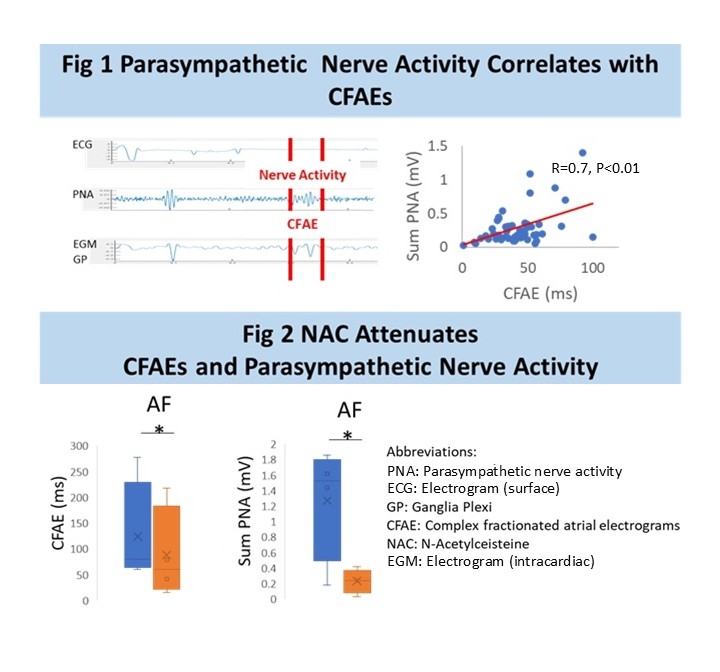
Results: In high-resolution mapping, >20% of the fractionated signals were sensitive to ROS scavenging in persistent AF in the PLA. In persistent AF, at the SLGP, we discovered a clear relationship between simultaneous recordings of PNA and overlying CFAEs (Figure 1). PNA correlated with CFEAs (R=0.6, P<0.01) at the SLGP (Figure 1). Post-NAC administration, at the SLGP, CFAEs were significantly reduced by 35% in persistent AF (P<0.05). NAC led to a significant reduction of PNA of 81% (P<0.05) in persistent AF at the SLGP (Figure 2).
Conclusion: Acute scavenging of ROS with NAC reduces CFAEs and parasympathetic nerve activity in persistent AF. This data provides evidence for a mechanistic linkage between mitochondrial ROS, autonomic nerve activity, and overlying CFAEs in AF.
Rottmann, Markus
(
University of Chicago
, Chicago , Illinois , United States )
Johnson, David
(
University of Chicago
, Chicago , Illinois , United States )
Yoo, Shin
(
University of Chicago
, Chicago , Illinois , United States )
Arora, Rishi
(
University of Chicago
, Chicago , Illinois , United States )
Author Disclosures:
Markus Rottmann:DO NOT have relevant financial relationships
| David Johnson:No Answer
| Shin Yoo:No Answer
| Rishi Arora:DO have relevant financial relationships
;
Ownership Interest:Inomagen Therapeutics:Active (exists now)