
Uncovering the Mechanistic Linkage Between Parasympathetic Nerve Activity and Overlying Complex Fractionated Atrial Electrograms in the Development of Persistent Atrial Fibrillation
Abstract Body (Do not enter title and authors here): Background The mechanistic linkage of complex fractionated atrial electrograms (CFAEs) and the relationship with the autonomic nervous system in the development of persistent atrial fibrillation are complex and not well understood.
Objective To test the hypothesis that CFAEs are accompanied by an increase in parasympathetic nerve firing, enhancing the development of persistent AF. We also hypothesized that the CFAE prevalence and CFAE variability increase over time in the development of persistent AF.
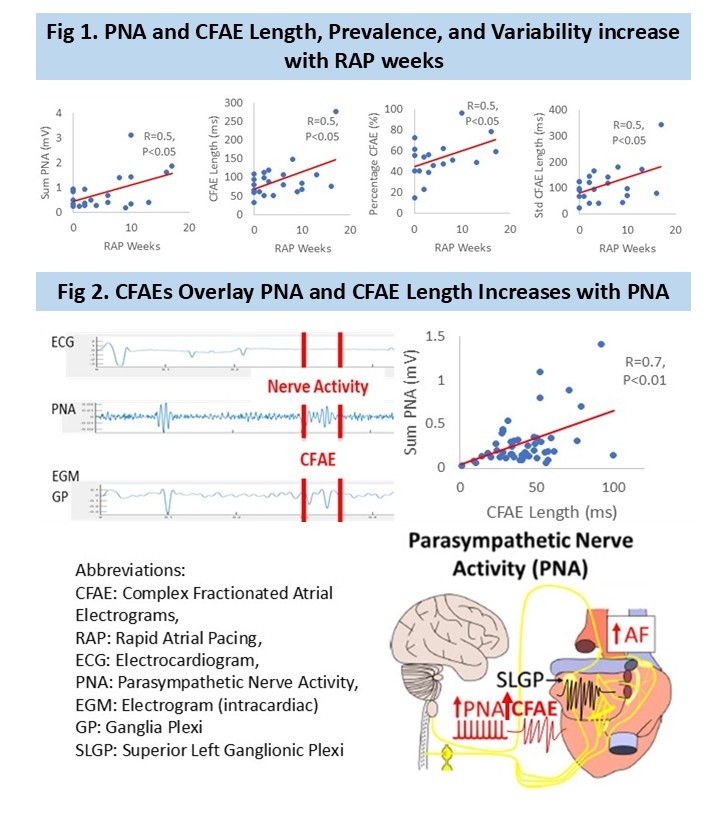
Methods Persistent AF was induced in 5 dogs (> 1 year old, 25 to 35kg) by rapid atrial pacing (RAP) (600 beats/min) for 3 to 17 weeks. We recorded parasympathetic nerve recordings using implanted telemetry (DSI, Harvard Bioscience) in the superior left ganglionic plexi (SLGP) (1 hour) (high and low pass filter 150, 1000Hz) over weeks of RAP. Parasympathetic nerve activity (PNA) was assessed by integrating the signal amplitude over time in 5 minute segments (Matlab). We synchronously analyzed electrograms (EGMs) (high and low pass filter 10, 100Hz) and quantified complex fractionated electrograms (CFAEs) with peak-to-peak sensitivity of 0.05 mV. We also assessed the prevalence of CFAEs (percentage CFAE (%)) as times when CFAEs were observed vs. total time and the CFAE variability as the standard deviation of CFAE length.
Results PNA increased with increasing weeks of RAP (R=0.5, P<0.05) (Figure 1). Over RAP weeks, CFAE length (R=0.5, P<0.05), CFAE prevalence (R=0.5, P<0.05), and CFAE variability (standard deviation of CFAE length) (R=0.5, P<0.05) increased (Figure 1). We detected a clear relationship between parasympathetic nerve activity and CFAEs. CFAEs were synchronously overlying PNA, and CFAE length correlated with PNA (R=0.7, P<0.05) (Figure 2).
Conclusion Persistent atrial fibrillation develops over time with increasing parasympathetic nerve activity and increasing CFAE lengths, CFAE prevalence, and CFAE variability. This data provides new insights into the mechanistic linkage between the heart rate, autonomic nerve activity, and overlying CFAEs in the development of persistent AF.
Rottmann, Markus
(
University of Chicago
, Chicago , Illinois , United States )
Yoo, Shin
(
University of Chicago
, Chicago , Illinois , United States )
Mikhailov, Aleksei
(
University of Chicago
, Chicago , Illinois , United States )
Johnson, David
(
University of Chicago
, Chicago , Illinois , United States )
Arora, Rishi
(
University of Chicago
, Chicago , Illinois , United States )
Author Disclosures:
Markus Rottmann:DO NOT have relevant financial relationships
| Shin Yoo:No Answer
| Aleksei Mikhailov:DO NOT have relevant financial relationships
| David Johnson:No Answer
| Rishi Arora:DO have relevant financial relationships
;
Ownership Interest:Inomagen Therapeutics:Active (exists now)