
Association of Left Atrium Reservoir Strain by Cardiovascular Magnetic Resonance with New Onset Atrial Fibrillation in Patients with Hypertrophic Cardiomyopathy
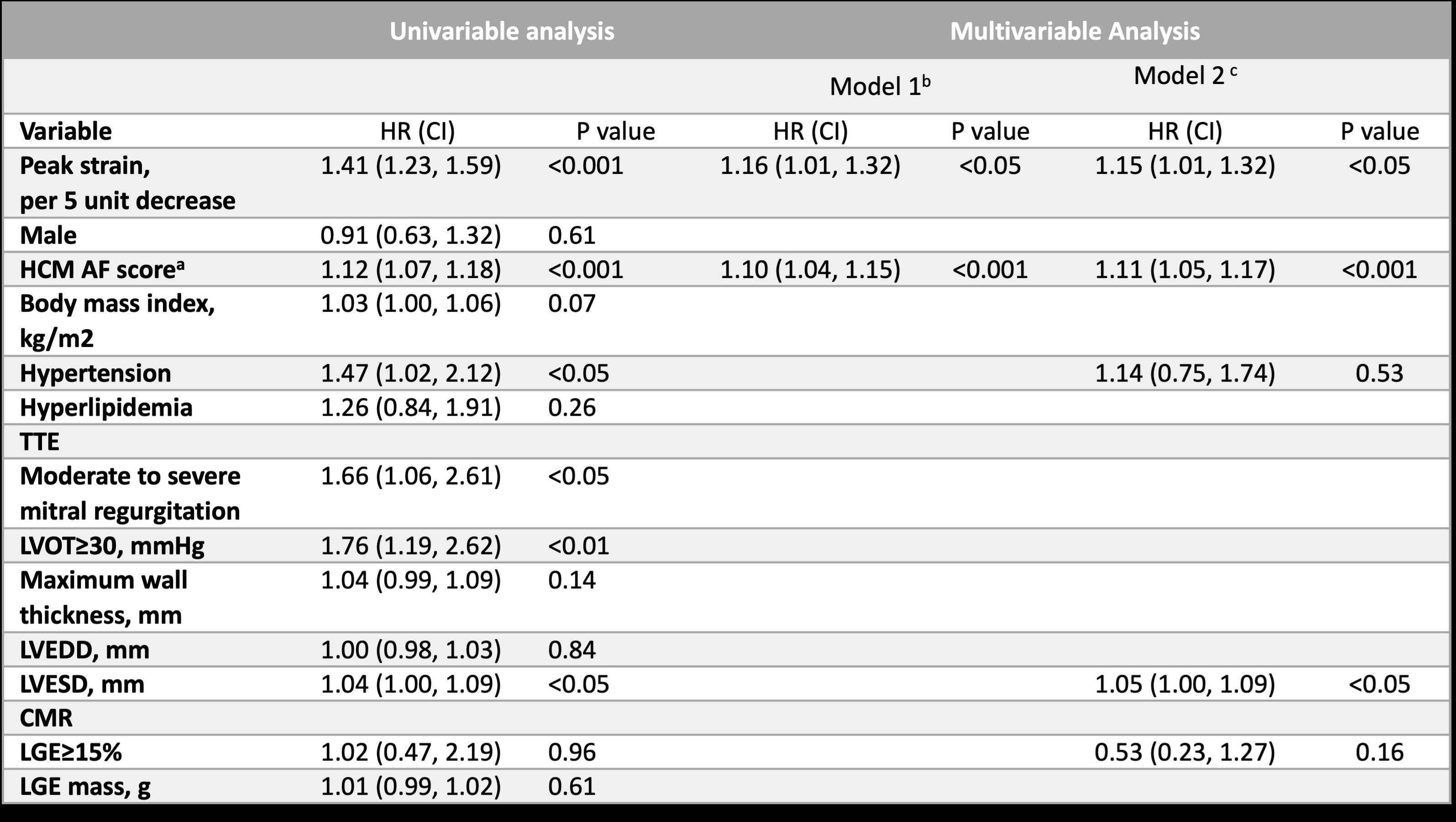
Abstract Body (Do not enter title and authors here): Introduction: Atrial fibrillation (AF) is the most common arrhythmia in patients with hypertrophic cardiomyopathy (HCM) and associated with significant morbidity and mortality. Early identification of patients high risk of AF is vital for closer monitoring and allowing early treatment to improve outcomes. While a novel risk prediction model (HCM-AF score) identifies HCM patients at risk for new-onset AF, there remains ability to improve sensitivity and specificity for select patients. Left atrium (LA) strain is an emerging noninvasive marker, which reflects LA function and remodeling and may identify individuals at higher risk for AF. Therefore, we aim to investigate if LA reservoir strain by cardiovascular magnetic resonance (CMR) is associated with development of new onset AF in patients with HCM. Methods: In this retrospective, multi-center study, we measured LA strain in HCM patients referred for CMR without prior AF history. LA strain was derived from 2-chamber and 4-chamber view using Medis (Medis Medical Imaging, Leiden, the Netherlands, Version 4.0.62.4). Patients were followed for primary endpoint of new onset AF. Univariable and multivariable cox proportional hazard model were performed. Results: A total of 1020 HCM patients were included (62.7% male, 53.4 ± 16.0 years). During a follow up of 3.3±2.0 years, 124 patients (12.2%) developed new onset AF. Reservoir strain was significantly lower in patients with new onset AF (19.3±8.8 vs 24±9.1, p<0.05). Univariable cox regression showed every 5 unit decrease in reservoir strain is significantly associated with increased risk of AF (HR 1.41 [1.23, 1.59], p<0.001). LA reservoir strain remained significant in multivariable analysis when adjusting for HCM AF score (HR 1.16 [1.01, 1.32], p<0.05), and remained independent after further adjusting for hypertension, left ventricular end-diastolic diameter and late gadolinium enhancement (HR 1.15 [1.01, 1.32], p<0.05) (Table 1). Conclusions: CMR-derived LA reservoir strain is an independent predictor of new onset AF in HCM patients and provides incremental prognostic value beyond tradition risk factors. Incorporating LA strain into risk assessment may guide intensity of arrhythmia surveillance, and aid in early identification and treatment of high-risk patients.
Deng, Lixia
( Beth Israel Deconess Medical Center
, Boston
, Massachusetts
, United States
)
Schulz, Alexander
( Harvard Medical School - BIDMC
, Boston
, Massachusetts
, United States
)
Ghanbari, Fahime
( Harvard Medical School - BIDMC
, Boston
, Massachusetts
, United States
)
Amyar, Amine
( Harvard Medical School - BIDMC
, Boston
, Massachusetts
, United States
)
Maron, Martin
( Lahey Hospital and Medical Center
, Burlington
, Massachusetts
, United States
)
Carrick, Richard
( Johns Hopkins Medical Center
, Baltimore
, Maryland
, United States
)
Nezafat, Reza
( Harvard Medical School - BIDMC
, Boston
, Massachusetts
, United States
)
Rowin, Ethan
( Lahey Hospital and Medical Center
, Burlington
, Massachusetts
, United States
)
Author Disclosures:
Lixia Deng:DO NOT have relevant financial relationships
| Alexander Schulz:DO NOT have relevant financial relationships
| Fahime Ghanbari:No Answer
| Amine Amyar:DO NOT have relevant financial relationships
| Martin maron:DO NOT have relevant financial relationships
| Richard Carrick:No Answer
| Reza Nezafat:DO NOT have relevant financial relationships
| Ethan Rowin:DO have relevant financial relationships
;
Consultant:iRhythm:Past (completed)
; Consultant:Cytokinetics:Active (exists now)