Machine learning prediction of myocardial ischemia using quantitative assessment of coronary calcifications in non-contrast CT calcium scoring scans
Abstract Body (Do not enter title and authors here): Introduction Non-contrast computed tomography calcium scoring (CTCS) provides a direct, noninvasive measure of atherosclerotic plaque burden by detecting calcified lesions in the coronary arteries. While its role in risk stratification is well-established, its utility in predicting functional myocardial ischemia remains underexplored. This study aimed to develop a novel machine learning model that predicts ischemia based solely on the quantitative analysis of coronary calcifications in CTCS scans.
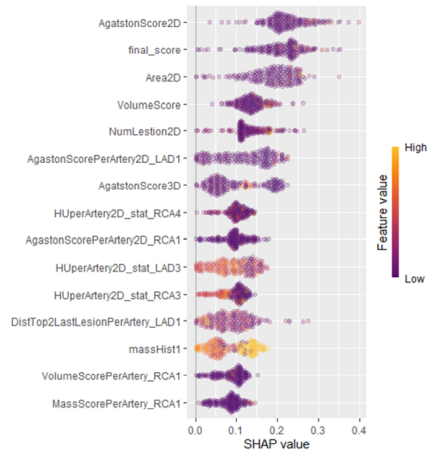
Methods We retrospectively analyzed 987 patients who underwent both non-contrast CTCS and regadenoson stress cardiac positron emission tomography (PET) myocardial perfusion imaging with an NH3 tracer within one year at the University Hospitals of Cleveland. A total of 75 features were extracted, including 4 clinical variables, the total Agatston score, and 70 calcium-omics features. Calcium-omics encompassed metrics from individual calcifications (e.g., mass score), arterial territories (e.g., lesion count), and whole-heart regions (e.g., histogram-based Hounsfield unit statistics). Feature selection was performed using CatBoost with SHapley Additive exPlanations (SHAP) to identify the most predictive subset. A CatBoost classifier was then trained and evaluated using 5-fold cross-validation, repeated 1,000 times to ensure robust performance estimates.
Results Among the 987 patients, 89 (9.0%) had PET-confirmed ischemia. From the 75 original features, the top 9 predictors were selected using CatBoost and SHAP, including the total Agatston score and 8 calcium-omics features. The final model achieved excellent predictive performance, with a precision of 88.7±8.1%, sensitivity of 78.8±8.6%, specificity of 97.9±1.0%, F1 score of 82.9±5.4%, and an area under the curve of 91.1±4.1%. Compared to models using only clinical features (precision 13.2±3.7% and F1 score 21.3±5.3%) or clinical features plus the Agatston score (precision 74.7±9.5% and F1 score 76.4±6.7%), the inclusion of calcium-omics features significantly improved predictive performance (p<0.05), particularly by reducing false positives.
Conclusion We developed a novel machine learning approach for predicting myocardial ischemia using non-contrast CTCS imaging. Our findings suggest that calcium-omics features provide additional predictive value beyond traditional Agatston scoring and may support more cost-effective patient triage by reducing unnecessary downstream testing, especially in low-risk populations.
Lee, Juhwan
(
Harrington Heart and Vascular Institute, University Hospitals of Cleveland
, Cleveland , Ohio , United States )
Makhlouf, Mohamed H.e.
(
Harrington Heart and Vascular Institute, University Hospitals of Cleveland
, Cleveland , Ohio , United States )
Al-kindi, Sadeer
(
DeBakey Heart and Vascular Institute, Houston Methodist Hospital
, Houston , Texas , United States )
Hoori, Ammar
(
Case Western Reserve University
, Westlake , Ohio , United States )
Hu, Tao
(
Case Western Reserve University
, Westlake , Ohio , United States )
Wu, Hao
(
Case Western Reserve University
, Cleveland , Ohio , United States )
Kim, Justin
(
Case Western Reserve University
, Westlake , Ohio , United States )
Rajagopalan, Sanjay
(
Harrington Heart and Vascular Institute, University Hospitals of Cleveland
, Cleveland , Ohio , United States )
Wilson, David
(
Case Western Reserve University
, Cleveland , Ohio , United States )
Author Disclosures:
Juhwan Lee:DO NOT have relevant financial relationships
| Mohamed H.E. Makhlouf:No Answer
| Sadeer Al-Kindi:No Answer
| Ammar Hoori:DO NOT have relevant financial relationships
| Tao Hu:No Answer
| Hao Wu:No Answer
| Justin Kim:DO NOT have relevant financial relationships
| Sanjay Rajagopalan:DO NOT have relevant financial relationships
| David Wilson:DO have relevant financial relationships
;
Ownership Interest:PulseImaging.AI:Active (exists now)