Logo

American Heart Association

  20
  0


Final ID: MP725

Imatinib Mesylate and Sirolimus Inhibit Fibrogenic Activation of Endocardial Endothelial Cells

Abstract Body (Do not enter title and authors here): Background: Clinically, Imatinib mesylate, a tyrosine kinase pathway inhibitor, and sirolimus, an mTOR inhibitor, are used as antiproliferative agents for the treatment of fibroelastic congenital heart disease. Both drugs also have anti-fibrotic properties by modulating the non-canonical TGFβ-1 pathway. We have previously demonstrated that fibroelastic disease is driven by fibrogenic activation of endocardial endothelial cells (EECs), primarily mediated through the TGFβ-1 signaling pathway.
Hypothesis: Imatinib mesylate and sirolimus safely and effectively suppress fibrogenic activation of EECs.
Methods: EECs were isolated from fibroelastic cardiac tissue obtained during routine surgeries and grown in culture. Cells were treated with clinically relevant concentrations of imatinib mesylate (0.1, 0.5, 1μM), sirolimus (5, 10, and 20nM), vehicle control (0.1% DMSO), or left untreated (native control). The medium concentrations within the therapeutic range were used for subsequent experiments. Cytotoxicity was assessed using Annexin V/PI staining by flow cytometry at 24 hours, and cell proliferation by MTT assay after 48 hours. Anti-fibrogenic effects were evaluated following 24 hours of TGFβ-1 stimulation (to induce fibrogenic activation) using immunocytochemistry for co-expression of endothelial marker CD144 and mesenchymal marker α-SMA, and mean α-SMA expression. All experiments were performed in biological triplicate. Flow cytometry analysis of CD31 and fibroblast-specific markers was performed to confirm anti-fibrogenic effects.
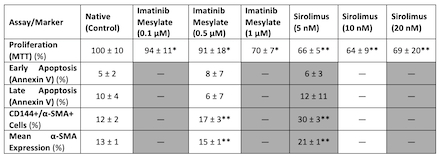
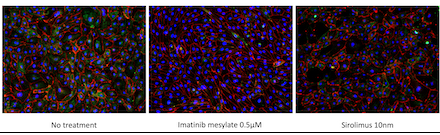
Results: Imatinib and Sirolimus significantly reduced proliferation compared to native and vehicle controls (*p<0.0002, **p<0.0001) (Table 1). Annexin V/PI staining revealed no significant differences in early or late apoptotic cell populations among treated groups and controls (p=0.83 and p=0.75, respectively). Treatment with both Imatinib and Sirolimus resulted in significantly decreased CD144+/α-SMA+ double-positive cell percentages and reduced mean α-SMA expression compared to native controls (Figure 1; **p<0.0001).
Conclusions: This study shows that both drugs have anti-proliferative effects, but more importantly, significantly inhibit fibrogenic activation of human EEC. These findings support their potential therapeutic benefit in treating fibroelastic disease and suggest that their beneficial clinical effects may originate from suppression of fibroelastic remodeling at the endocardial level.
  • Von Mueffling, Alexa  ( Boston Children's Hospital , Boston , Massachusetts , United States )
  • Friehs, Ingeborg  ( Boston Children's Hospital , Boston , Massachusetts , United States )
  • Gaal, Julia  ( Boston Children's Hospital , Boston , Massachusetts , United States )
  • Zajac, Cindy  ( Boston Children's Hospital , Boston , Massachusetts , United States )
  • Lee, Umji  ( Boston Children's Hospital , Boston , Massachusetts , United States )
  • Diaz-gil, Daniel  ( Boston Children's Hospital , Boston , Massachusetts , United States )
  • Jenkins, Kathy  ( Boston Childrens Hospital , Boston , Massachusetts , United States )
  • Melero-martin, Juan  ( Boston Children's Hospital , Boston , Massachusetts , United States )
  • Del Nido, Pedro  ( Boston Children's Hospital , Boston , Massachusetts , United States )
  • Mayer, John  ( Boston Children's Hospital , Boston , Massachusetts , United States )
  • Author Disclosures:
    Alexa von Mueffling: DO NOT have relevant financial relationships | Ingeborg Friehs: No Answer | Julia Gaal: DO NOT have relevant financial relationships | Cindy Zajac: DO NOT have relevant financial relationships | Umji Lee: No Answer | Daniel Diaz-Gil: No Answer | Kathy Jenkins: DO NOT have relevant financial relationships | Juan Melero-Martin: DO NOT have relevant financial relationships | Pedro Del Nido: DO have relevant financial relationships ; Ownership Interest:Autus Valve Technologies:Active (exists now) ; Ownership Interest:CellVie:Active (exists now) ; Consultant:Starlight Cardiovascular:Active (exists now) | John Mayer: DO NOT have relevant financial relationships
Meeting Info:

Scientific Sessions 2025

2025

New Orleans, Louisiana

Session Info:

Genetic and Molecular Mechanisms in Congenital Heart Disease: From Pathogenesis to Targeted Therapies

Saturday, 11/08/2025 , 12:15PM - 01:30PM

Moderated Digital Poster Session

More abstracts on this topic:
Acute Cardiac Function Change After Catheter Ablation of Ventricular Arrhythmias in Patients with Arrhythmogenic Right Ventricular Cardiomyopathy

Davis Nathaniel, Asirvatham Samuel, Friedman Paul, Killu Ammar, Ezzeddine Fatima, Sugrue Alan, Siontis Konstantinos, Kapa Suraj, Kowlgi Gurukripa, Giudicessi John, Bois John, Chang Ian C

A DHX38 Spliceosomal Mutation Impairs MYC Signaling, Cardiac Transcriptome Splicing, and Leads to Diastolic Dysfunction

Iwanski Jessika, Sarvagalla Sailu, Methawasin Mei, Van Den Berg Marloes, Churko Jared

More abstracts from these authors:
Decoding Endocardial Fibroelastosis with Differentially Regulated miR-100-5p and miR-503-5p

Zajac Cindy, Del Nido Pedro, Friehs Ingeborg, Gaal Julia, Costa De Freitas Renata Caroline, Diaz-gil Daniel, Zhu Yonglin, Saraci Kerstin, Gierlinger Gregor, Melero-martin Juan, Axt-fliedner Roland

Fibro-proliferative Remodeling of the Endocardium in Pulmonary Vein Stenosis

Gaal Julia, Jenkins Kathy, Casar Berazaluce Alejandra, Melero-martin Juan, Del Nido Pedro, Yuan Ke, Friehs Ingeborg, Hammer Peter, Lee Umji, Kim Yunhye, Saraci Kerstin, Zajac Cindy, Klouda Tim, Diaz-gil Daniel, Baird Chris

You have to be authorized to contact abstract author. Please, Login
Not Available