
Fulminant Eosinophilic Myocarditis in the Setting of DRESS Syndrome: A Case Report
Abstract Body (Do not enter title and authors here): Introduction Drug Reaction with Eosinophilia and Systemic Symptoms (DRESS) syndrome is a severe hypersensitivity reaction characterized by rash, fevers, eosinophilia and multi-organ involvement. Cardiac involvement in the form of eosinophilic myocarditis is particularly rare, with a mortality rate of 52% within 72 hours of admission.
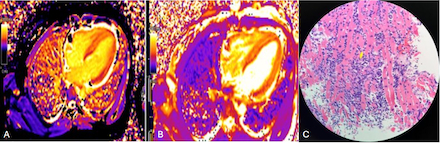
Case Presentation A 34-year-old woman presented epigastric pain and rash following 10-day course of trimethoprim-sulfamethoxazole, metronidazole, and fluconazole for a vaginal infection. Initial evaluation revealed fever of 102°F, eosinophilia (0.7 × 10⁹/L), and elevated liver enzymes (AST 234 U/L, ALT 396 U/L, ALP 365 U/L). Skin biopsy was consistent with a drug-induced hypersensitivity reaction, and despite treatment with 1 mg/kg of prednisone, she developed chest pain, dyspnea, hypotension and elevated troponins (>5000 ng/L). Electrocardiogram revealed diffuse ST-segment elevations, and echocardiograms demonstrated a significant reduction in left ventricular ejection fraction (55% to 25%) with global hypokinesis. Cardiac MRI (Image A/B) confirmed severe myocarditis with endomyocardial biopsy (Image C) revealing eosinophilic infiltration consistent with eosinophilic myocarditis. The patient progressed to cardiogenic shock requiring VA ECMO. Given the lack of improvement with medical management the decision was made to proceed with an orthotopic heart transplant. Post-transplant, she was managed with a regimen of immunosuppressants, and recovery was closely monitored with serial cardiac biopsies and imaging studies.
Discussion Cardiac involvement in DRESS syndrome is exceptionally rare but carries a high mortality rate when complicated by myocarditis. Early recognition and prompt management are crucial for improving outcomes. While systemic corticosteroids are the mainstay of treatment for DRESS, their efficacy in preventing myocarditis may be limited. Other immunomodulating therapies have been attempted with variable success. Our patient’s case highlights the limitations of current therapeutic options for severe DRESS-associated myocarditis. Despite aggressive medical management, progression to cardiogenic shock necessitated mechanical circulatory support and ultimately heart transplantation. Clinicians should maintain a high index of suspicion for cardiac involvement in patients with DRESS who present with hemodynamic instability or elevated cardiac biomarkers, even in the absence of classic cardiac symptoms.
Van Loo, Aiden
( Corewell Health William Beaumont University Hospital
, Royal Oak
, Michigan
, United States
)
Schwocho, Mitchell
( Corewell Health William Beaumont University Hospital
, Royal Oak
, Michigan
, United States
)
Karageorgiou, Ioannis
( Corewell Health William Beaumont University Hospital
, Royal Oak
, Michigan
, United States
)
Mahmood, Shazil
( Corewell Health William Beaumont University Hospital
, Royal Oak
, Michigan
, United States
)
Madanat, Luai
( Corewell Health William Beaumont University Hospital
, Royal Oak
, Michigan
, United States
)
Kondoleon, Nicholas
( Corewell Health William Beaumont University Hospital
, Royal Oak
, Michigan
, United States
)
Sankar, Parvathy
( Corewell Health William Beaumont University Hospital
, Royal Oak
, Michigan
, United States
)
Timmis, Steven
( Corewell Health William Beaumont University Hospital
, Royal Oak
, Michigan
, United States
)
Author Disclosures:
Aiden Van Loo:DO NOT have relevant financial relationships
| Mitchell Schwocho:DO NOT have relevant financial relationships
| Ioannis Karageorgiou:DO NOT have relevant financial relationships
| Shazil Mahmood:No AnswerNicholas Kondoleon:No Answer
| Parvathy Sankar:No Answer
| Steven Timmis:No Answer