
Logo

American Heart Association

  18
  0


Final ID: MP2653

Adult heart transplant practice changes: Early and late impact of the current organ allocation system in the United States

Abstract Body (Do not enter title and authors here): Introduction
After the current allocation system was implemented in 2018, dynamic changes have occurred around heart transplant (HTx) practice such as new donor heart management strategies. The aim of this study is to analyze the practice changes seen between two eras: early (2018-21) vs late (2021-23) after implementation of the current allocation system.

Research Questions
How did the national HTx practice change in these few years?

Methods
Using the United Network of Organ Sharing (UNOS) database, we analyzed singe-organ adult HTx performed under the current allocation system. Multi-organ transplants and repeat HTx were excluded. All donor-recipient matches were divided into two eras. The early era (October 2018 to June 2021) versus the late era (July, 2021 to December, 2023). Donor after cardiac death (DCD) HTx, recipient status at transplant offer, cumulative incidence to HTx, 1 year survival post HTx were analyzed. Continuous variables were examined using t-tests or Mann-Whitney U test and categorical variables were compared using Pearson’s χ2 test. Kaplan-Meier and cumulative incidence curves were used to compare the outcomes between early and late eras, and a Fine and Gray competing risk regression was used to analyze association.

Results
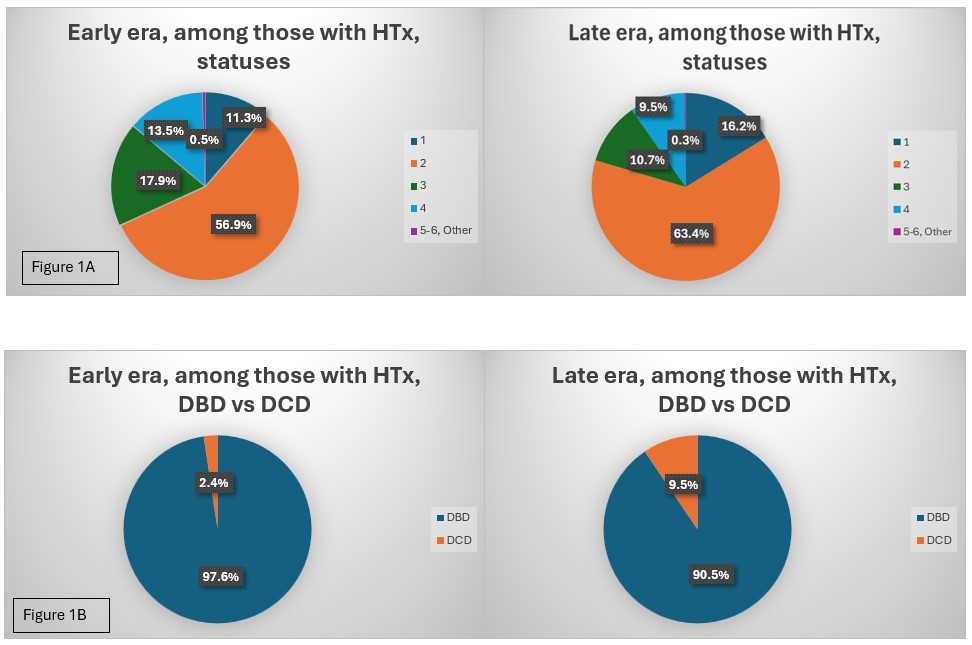
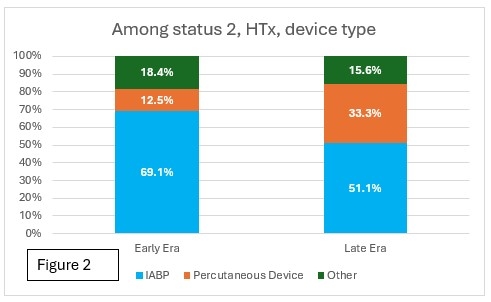
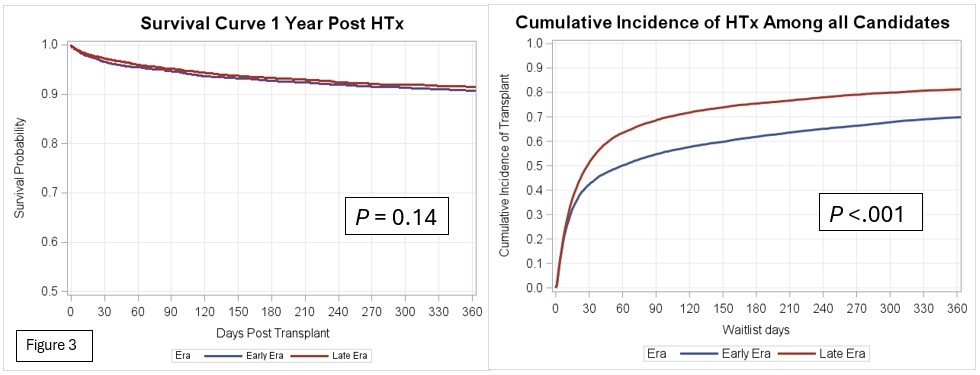
The total cohort had 12,402 donor-recipient pairs (6,269 early, and 6,133 late era). Donor after cardiac death (DCD) HTx has increased from 2.4% to 9.5% (Fig 1B). The late era had shorter median waitlist days in comparison to the early era (24 vs 40 days; P <.001). The number of recipients holding status 1 and 2 at transplant increased in the late era, whereas status 3 and 4 decreased (Fig 1A). Patients in status 2 with intra-aortic balloon pump decreased from 69.1% to 51.1%, whereas those with endovascular mechanical circulatory support had increased from 12.5% to 33.3% (Fig 2). Survival at 1 year post HTx was comparable between the two eras (early 90.7% vs late 91.5%; P=0.14; Fig 3). After adjusting for potential confounders and accounting for competing risks, candidates in the late era were 12.1% more likely to receive a HTx compared to the early era (HR = 1.121; 95% CI, 1.068–1.176; P <.001).

Conclusion
Recent practices have shown an increase in DCD HTx, increase HTx in higher status (1 and 2) recipients which led to a higher incidence of HTx performed with comparable 1 year survival. HTx in candidates listed in status 3 and 4, such as those with a durable LVAD, has continued to decrease over time.
  • Kawabori, Masashi  ( University of Kentucky , Lexington , Kentucky , United States )
  • Katsadouros, Vasili  ( University of Kentucky , Lexington , Kentucky , United States )
  • Johnson, Anna  ( University of Kentucky , Lexington , Kentucky , United States )
  • Chung, Jin Woo  ( University of Kentucky , Lexington , Kentucky , United States )
  • Sekela, Michael  ( University of Kentucky , Lexington , Kentucky , United States )
  • Birks, Emma  ( University of Kentucky , Lexington , Kentucky , United States )
  • Loebe, Matthias  ( University of Kentucky , Lexington , Kentucky , United States )
  • Author Disclosures:
    Masashi Kawabori: No Answer | Vasili Katsadouros: DO NOT have relevant financial relationships | Anna Johnson: DO NOT have relevant financial relationships | Jin Woo Chung: DO NOT have relevant financial relationships | Michael Sekela: No Answer | Emma Birks: No Answer | Matthias Loebe: No Answer
Meeting Info:

Scientific Sessions 2025

2025

New Orleans, Louisiana

Session Info:

Advancing Research in Advanced Heart Failure

Monday, 11/10/2025 , 12:15PM - 01:30PM

Moderated Digital Poster Session

You have to be authorized to contact abstract author. Please, Login
Not Available