
Incidence and Early Outcomes of Hypo-attenuated Leaflet Thrombosis after Surgical Aortic Valve Replacement with Inspiris Resilia Valve
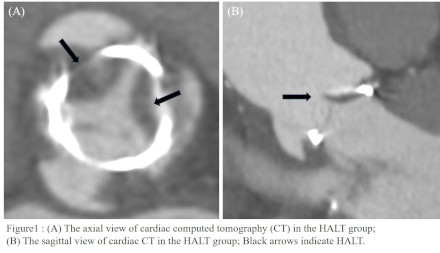
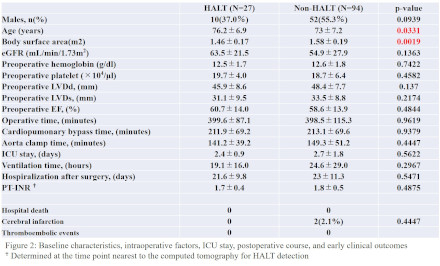
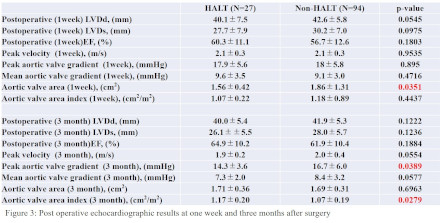
Abstract Body (Do not enter title and authors here): Introduction: Hypo-attenuated leaflet thickening (HALT) is a type of thrombotic lesion that has been identified frequently in recent times owing to the widespread use of transcatheter aortic valve implantation. However, few studies have investigated HALT after surgical aortic valve replacement (SAVR). This study investigates the incidence of HALT after SAVR with Inspiris Resilia valve and the associated postoperative outcomes. Hypothesis: HALT impact early clinical outcomes or increase the incidence of thromboembolic events. Methods: SAVR was performed using Inspiris Resilia valves in 183 patients between August 2020 and January 2025. The present study included 121patients (66.1%) who underwent cardiac CT one week after surgery. HALT was defined as the presence of one or more leaflets with HALT of the prosthetic aortic valve during the early left ventricular diastolic phase (Fig 1A-B). Heparin administration was started post-op (APTT 1.5–2×), followed by warfarin (PT-INR 1.6–2.2). 121 patients were divided into the HALT (n=27) and non-HALT (n-94) groups. Results: The overall incidence of HALT after SAVR was 22.3%. Anticoagulant and antiplatelet therapy (APT) at the time of HALT diagnosis was as follows: warfarin (WF) alone (n=11), WF + single APT (n=8), single APT (n=5), dual APT (n=2), and none (n=1). Compared with the non-HALT group (N=94), the HALT group (N=27) was significantly older (76.2 vs. 73.0 years; p=0.003) and had a smaller body surface area (1.46 vs. 1.58 m2; p=0.002). No significant differences were found in other baseline characteristics, intraoperative factors, ICU stay, and postoperative course (Fig 2). The rate of postoperative anticoagulant and APT use also did not differ significantly. The postoperative echocardiographic data are shown in the figure (Fig 3). Echocardiographic findings showed significant differences in AVA (1 week postoperatively), peak pressure gradient, and AVAi (3 months) were observed between the two groups; however, there was no evidence that HALT affected acute prosthetic valve function, and no cases exhibited a mean pressure gradient >20 mmHg. No in-hospital deaths or thromboembolic events in either group. No strokes in HALT group; two in non-HALT (p=0.445). Conclusions: HALT was observed after SAVR using stented bioprosthetic valves, even under optimal anticoagulation management. HALT did not affect acute prosthetic valve function, early postoperative outcomes, or neurological events.
Kono, Takanori
(
Kurume University
, Fukuoka , Japan )
Takagi, Kazuyoshi
(
Kurume University
, Fukuoka , Japan )
Mine, Hiroki
(
Kurume University
, Fukuoka , Japan )
Saku, Kousuke
(
Kurume University
, Fukuoka , Japan )
Zaima, Yasuyuki
(
Kurume University
, Fukuoka , Japan )
Shojima, Takahiro
(
Kurume University
, Fukuoka , Japan )
Takaseya, Tohru
(
Kurume University
, Fukuoka , Japan )
Arinaga, Koichi
(
Kurume University
, Fukuoka , Japan )
Tayama, Eiki
(
Kurume University
, Fukuoka , Japan )