Sub-optimal guideline-concordant anticoagulation after atrial fibrillation ablation
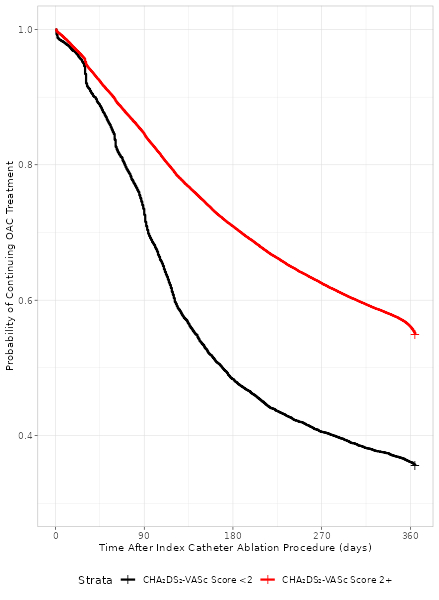
Abstract Body (Do not enter title and authors here): Introduction: Catheter ablation (CA) is a treatment strategy for patients with atrial fibrillation (AF). The 2023 ACC/AHA/ACCP/HRS guidelines recommend oral anticoagulant (OAC) therapy for at least 3 months post-CA with long-term continuation based on individual stroke risk. Research Question: Are US patients with AF after CA treated with guideline-concordant anticoagulation? Methods: The Optum Clinformatics DataMart Date of Death claims data were used for this study, which included patients aged ≥18 years with AF diagnosis who underwent CA (with first such ablation classified as ‘index ablation event’) from Jan 2017 until Oct 2023. Patients were excluded if they: 1) had less than 6 months continuous enrollment prior to the index ablation procedure; 2) underwent a left atrial appendage occlusion procedure prior to the index date. Treatment persistence for OAC in the 1-year period post-CA was assessed using descriptive statistics, including Kaplan-Meier plots and estimates. Automated machine learning was used to predict OAC use within 1-year after CA. Patients’ demographics, baseline medical conditions and clinical events prior to drug discontinuation (e.g., bleeding, repeated ablation, cardioversion) were included as factors of interest in the model. Area under the receiver operator curve (AUROC) was calculated, as well as importance score (w), i.e., contribution to AUROC, for each factor. Results: 65,020 patients (mean age 69, standard deviation 10; 39% female) underwent CA in the study period (89.7% with CHA2DS2-VASc score ≥ 2 at index date). Of these patients, ~ 85% continued OACs for 3 months but only 54.9% at 1 year (Figure 1). The AUROC for the total AF population was 0.685 (95% CI: 0.671 - 0.699). Main predictors for OAC discontinuation at 1-year were CHA2DS2-VASc baseline score (w, 0.034), bleeding incidence in the follow-up period (w, 0.026), and left atrial appendage occlusion post-CA (w, 0.020). The predictors of OAC discontinuation were similar for paroxysmal (AUROC, 0.689 [95%CI 0.666-0.713]) vs persistent (AUROC, 0.668 [0.664-0.701]) AF. Conclusion: Although guidelines recommend continuing OAC after ablation if CHA2DS2-VASc score ≥ 2, discontinuation was common in US patients with AF. Machine learning developed a predictive model with reasonably good performance, identifying CHA2DS2-VASc score as the strongest predictor of guideline concordant OAC therapy in the post ablation period.
Zeitler, Emily
( Dartmouth-Hitchcock Medical Center
, Lebanon
, New Hampshire
, United States
)
Coplan, Paul
( Johnson & Johnson
, New Brunswick
, New Jersey
, United States
)
Lipardi, Concetta
( JNJ
, Raritan
, New Jersey
, United States
)
Lip, Gregory
( University of Liverpool
, Liverpool
, United Kingdom
)
Louder, Anthony
( Johnson & Johnson
, New Brunswick
, New Jersey
, United States
)
Peng, Mingkai
( Johnson & Johnson
, New Brunswick
, New Jersey
, United States
)
Khanna, Rahul
( Johnson & Johnson
, New Brunswick
, New Jersey
, United States
)
Yuan, Zhong
( JOHNSON AND JOHNSON
, Horsham
, Pennsylvania
, United States
)
Zhang, Shumin
( Johnson & Johnson
, New Brunswick
, New Jersey
, United States
)
Rivera, Marcela
( Johnson & Johnson
, Barcelona
, Spain
)
Iglesias, Maximiliano
( Biosense Webster
, Toronto
, Ontario
, Canada
)
Oztop, Ilker
( Johnson & Johnson
, New Brunswick
, New Jersey
, United States
)
Author Disclosures:
Emily Zeitler:DO have relevant financial relationships
;
Advisor:medtronic:Active (exists now)
; Consultant:philips:Active (exists now)
; Researcher:biosense webster/ J&J:Active (exists now)
; Researcher:boston scientific:Active (exists now)
; Researcher:sanofi:Active (exists now)
; Consultant:boston scientific:Active (exists now)
| Paul Coplan:No Answer
| Concetta Lipardi:DO have relevant financial relationships
;
Employee:JNJ:Active (exists now)
| Gregory Lip:DO NOT have relevant financial relationships
| Anthony Louder:DO have relevant financial relationships
;
Individual Stocks/Stock Options:Johnson and Johnson:Active (exists now)
; Employee:Johnson and Johnson:Active (exists now)
| Mingkai Peng:No Answer
| Rahul Khanna:DO have relevant financial relationships
;
Employee:Johnson & Johnson:Active (exists now)
| Zhong Yuan:DO have relevant financial relationships
;
Employee:Johnson and Johnson:Active (exists now)
| Shumin Zhang:DO have relevant financial relationships
;
Employee:Johnson & Johnson:Active (exists now)
| Marcela Rivera:No Answer
| Maximiliano Iglesias:DO have relevant financial relationships
;
Employee:Johnson & Johnson:Active (exists now)
| Ilker Oztop:No Answer