Comprehensive Proteomics Profiling Identifies a Small Set of Circulating Biomarkers to Predict New-Onset Atrial Fibrillation, Worsening Heart Failure, and Major Adverse Cardiovascular Events in Patients with Hypertrophic Cardiomyopathy
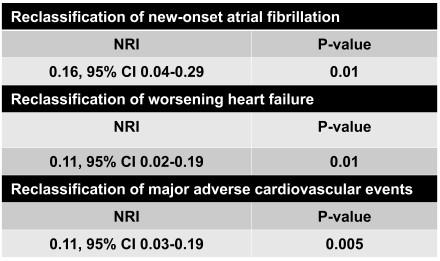
Abstract Body (Do not enter title and authors here): Background: Hypertrophic cardiomyopathy (HCM) is the most common genetic heart disease and can lead to atrial fibrillation (AF), heart failure (HF), and major adverse cardiovascular events (MACE) such as AF, HF, transplant, ventricular arrhythmias, and sudden cardiac death. However, circulating biomarkers to predict all 3 outcomes remain unidentified. Hypothesis: A small set of circulating protein biomarkers improves the prediction of AF, HF, and MACE in patients with HCM when added to NT-proBNP. Methods: In this 2-center prospective cohort study, we conducted plasma proteomics profiling of 4,979 proteins in 895 patients with HCM. We defined 1 center as the training set and the other as the test set. We identified proteins predictive of AF, HF, or MACE with P < 0.05 in both sets. With these proteins, we constructed a Lasso-regularized logistic regression model for each outcome and specified important proteins. Using candidate proteins important in all 3 models, we developed a logistic regression model to predict each outcome. We calculated the net reclassification improvement (NRI) comparing a combined model (i.e., NT-proBNP + candidate proteins) to NT-proBNP. We compared the risk of each outcome in 4 groups stratified by median levels of NT-proBNP and the threshold probability based on the candidate proteins. We also performed pathway analysis using proteins predictive of all 3 outcomes. Results: During a median follow-up time of 2.4 [1.4-5.0] years, 14% of patients developed new-onset AF, 23% worsening HF, and 31% MACE. The final prediction model included 4 candidate proteins (fatty-acid binding protein [heart], tropomodulin-3, ectonucleotide pyrophosphatase, and E3 ubiquitin-protein ligase RNF146). The NRI showed that our combined model appropriately reclassified patients compared to NT-proBNP in each outcome (Table 1). Our model provided additional risk stratification for AF and MACE in patients with high NT-proBNP (Figure 1). Moreover, our model successfully risk-stratified for HF in both the high- and low-NT-proBNP groups. Signaling pathways dysregulated (FDR<0.001) in patients with worse prognosis included MAPK, VEGF, PI3K-Akt, and HIF-1 pathways (Figure 2). Conclusions: This study is the first to apply comprehensive proteomics profiling to identify a small set of circulating biomarkers predictive of all 3 important outcomes – AF, HF, and MACE – in patients with HCM. When added to NT-proBNP, the 4-protein model improved prediction of all 3 outcomes.
Lu, Ree
(
Columbia University Irving Medical Center
, NYC , New York , United States )
Akita, Keitaro
(
Columbia University Irving Medical Center
, NYC , New York , United States )
Osawa, Itsuki
(
Columbia University Irving Medical Center
, NYC , New York , United States )
Fifer, Michael
(
Massachusetts Gen Hospital
, Boston , Massachusetts , United States )
Tower Rader, Albree
(
Massachusetts Gen Hospital
, Boston , Massachusetts , United States )
Reilly, Muredach
(
Columbia University Irving Medical Center
, NYC , New York , United States )
Maurer, Mathew
(
Columbia University Irving Medical Center
, NYC , New York , United States )
Shimada, Yuichi
(
Columbia University Irving Medical Center
, NYC , New York , United States )
Author Disclosures:
Ree Lu:DO NOT have relevant financial relationships
| Keitaro Akita:No Answer
| Itsuki Osawa:DO NOT have relevant financial relationships
| Michael Fifer:DO have relevant financial relationships
;
Consultant:Cytokinetics:Active (exists now)
; Consultant:Imbria:Past (completed)
; Consultant:Edgewise:Active (exists now)
; Consultant:Bristol-Myers Squibb:Past (completed)
; Research Funding (PI or named investigator):Cytokinetics:Past (completed)
| Albree Tower Rader:DO have relevant financial relationships
;
Research Funding (PI or named investigator):Bristol Myers Squibb:Active (exists now)
; Research Funding (PI or named investigator):Edgewise Therapeutics:Active (exists now)
; Research Funding (PI or named investigator):Cytokinetics:Active (exists now)
| Muredach Reilly:No Answer
| Mathew Maurer:DO have relevant financial relationships
;
Advisor:Pfizer:Active (exists now)
; Advisor:Intellia:Active (exists now)
; Advisor:BrigdeBio:Active (exists now)
; Advisor:AstraZeneca:Active (exists now)
; Advisor:Ionis:Active (exists now)
; Advisor:Alnylam:Active (exists now)
| Yuichi Shimada:No Answer