
Logo

American Heart Association

  353
  0


Final ID: MDP1372

Endothelial Cell-Related Proteins in Plasma Predict Major Adverse Cardiovascular Events and Worsening Heart Failure in Patients with Hypertrophic Cardiomyopathy

Abstract Body (Do not enter title and authors here): Introduction:
Hypertrophic cardiomyopathy (HCM) often causes major adverse cardiovascular events (MACE) and worsening heart failure (WHF). Endothelial cell (EC) dysfunction is known to occur in patients with HCM. However, the prognostic value of proteins related to EC function in HCM is unknown. The present study aimed to test the hypothesis that the levels of plasma proteins related to EC function predict future MACE and WHF in patients with HCM.

Methods:
In this multicenter prospective cohort study of patients with HCM, we measured plasma levels of 90 proteins related to EC function upon enrollment. The primary outcome measure was MACE, defined as the composite of sudden cardiac death, death due to HF, heart transplant, HF hospitalization, any increase of New York Heart Association (NYHA) class, new-onset atrial fibrillation, and stroke. The secondary outcome measure was WHF, defined as increase in NYHA class or HF hospitalization. We developed EC protein-based LASSO classification models to predict MACE or WHF using data from one institution (training set). We tested the predictive ability in independent samples from the other institution (test set) and performed time-to-event analyses.

Results:
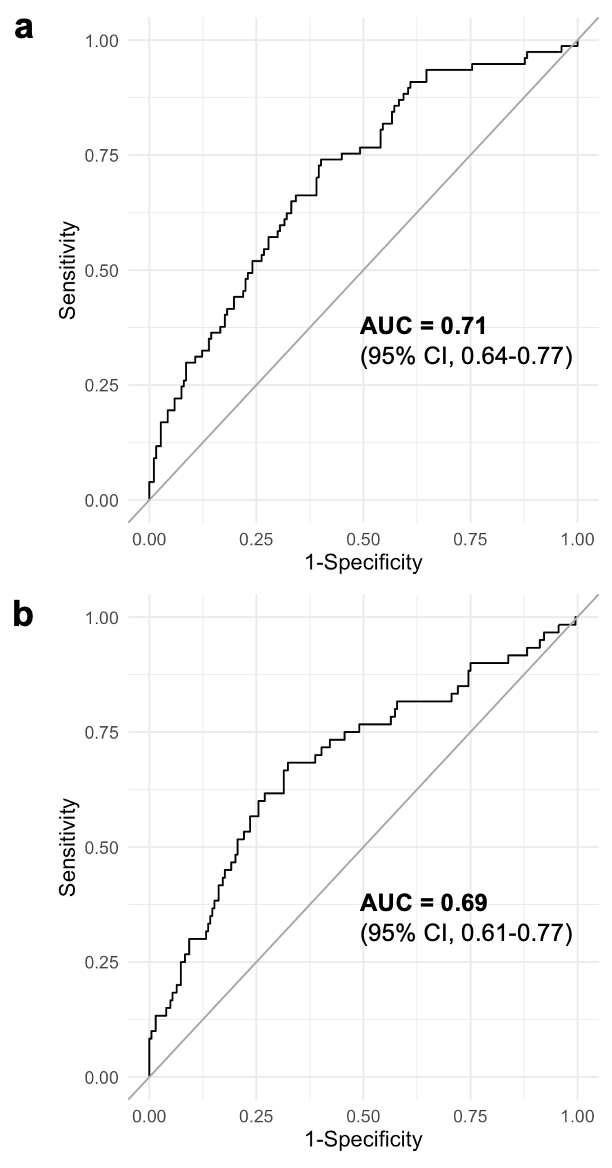
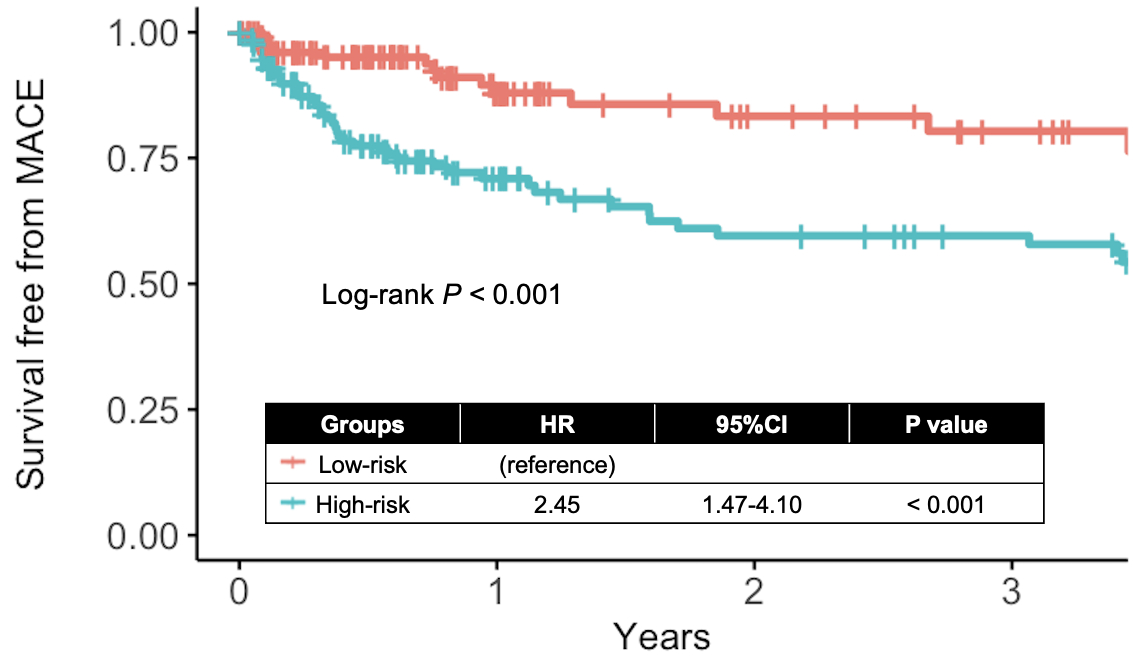
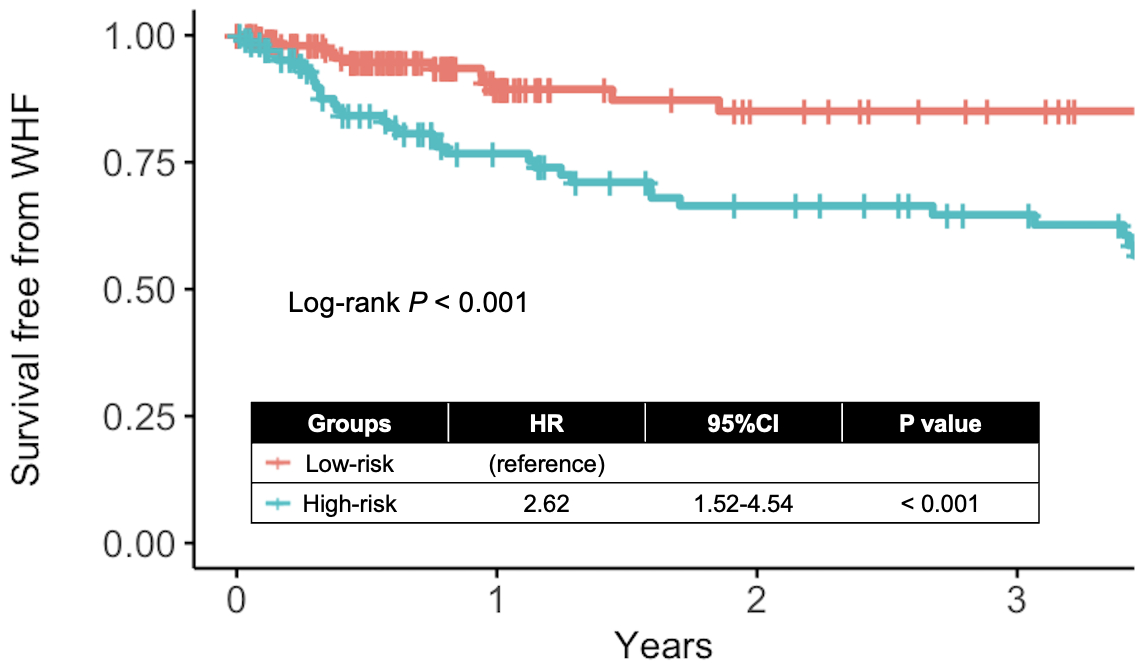
The study included 722 patients (n=458 in the training set and n=264 in the test set). During the median follow-up period of 3.3 years, the outcome event of MACE occurred in 192 (27%) patients and WHF in 139 (19%) patients. The area under the receiver-operating-characteristics curve to predict MACE was 0.71 (95% confidence interval [CI] 0.64-0.77. Figure 1a) and that for WHF was 0.69 (95% CI 0.61-0.77. Figure 1b). When we divided the test set into high- and low-risk groups according to the predicted probabilities derived from the training set, log-rank tests and Cox proportional hazards models revealed that the high-risk groups had significantly higher risks of developing MACE and WHF (log-rank P<0.001, HR 2.45 [95% CI 1.47-4.10], P=0.0006. Figure 2) and WHF (log-rank P<0.001, HR 2.62 [95% CI 1.52-4.54], P=0.0006. Figure 3) compared with the low-risk groups.

Conclusions:
The present multicenter prospective study demonstrated that plasma proteins related to EC function predict MACE and WHF in patients with HCM. These EC-related proteins have a potential to become novel biomarkers for risk stratification in HCM to improve current prediction models.
  • Tamura, Shogo  ( Columbia University , New York , New York , United States )
  • Akita, Keitaro  ( COLUMBIA UNIVERSITY MEDICAL CENTER , New York , New York , United States )
  • Fifer, Michael  ( MASSACHUSETTS GEN HOSP , Boston , Massachusetts , United States )
  • Tower Rader, Albree  ( MASSACHUSETTS GEN HOSP , Boston , Massachusetts , United States )
  • Maurer, Mathew  ( COLUMBIA UNIVERSITY MEDICAL CENTER , New York , New York , United States )
  • Reilly, Muredach  ( COLUMBIA UNIVERSITY MEDICAL CENTER , New York , New York , United States )
  • Shimada, Yuichi  ( COLUMBIA UNIVERSITY MEDICAL CENTER , New York , New York , United States )
  • Author Disclosures:
    Shogo Tamura: DO NOT have relevant financial relationships | Keitaro Akita: DO NOT have relevant financial relationships | Michael Fifer: DO have relevant financial relationships ; Consultant:Cytokinetics:Active (exists now) ; Consultant:Imbria:Past (completed) ; Consultant:Edgewise:Active (exists now) ; Consultant:Bristol-Myers Squibb:Past (completed) ; Research Funding (PI or named investigator):Cytokinetics:Past (completed) | Albree Tower Rader: DO have relevant financial relationships ; Employee:American Heart Association:Active (exists now) ; Research Funding (PI or named investigator):Edgewise Therapeutics:Expected (by end of conference) ; Research Funding (PI or named investigator):Cytokinetics:Active (exists now) ; Research Funding (PI or named investigator):Bristol Myers Squibb:Active (exists now) | Mathew Maurer: DO have relevant financial relationships ; Advisor:Intellia:Active (exists now) ; Advisor:Alnylam:Active (exists now) ; Advisor:Ionis:Active (exists now) ; Advisor:Bridge Bio:Active (exists now) ; Advisor:AZ:Active (exists now) ; Advisor:Novo Nordisk:Active (exists now) | Muredach Reilly: No Answer | Yuichi Shimada: No Answer
Meeting Info:

Scientific Sessions 2024

2024

Chicago, Illinois

Session Info:

A Motley of Myopathies

Monday, 11/18/2024 , 12:50PM - 02:15PM

Moderated Digital Poster Session

More abstracts on this topic:
A prognostic molecular signature of hepatic steatosis is spatially heterogeneous and dynamic in human liver

Perry Andrew, Huang Shi, Martens Liesbet, Kendall Timothy, Thone Tinne, Amancherla Kaushik, Bailin Samuel, Gabriel Curtis, Koethe John, Carr John, Terry James, Hadad Niran, Vaitinadin Nataraja Sarma, Freedman Jane, Tanriverdi Kahraman, Alsop Eric, Van Keuren-jensen Kendall, Sauld John, Mahajan Gautam, Khan Sadiya, Colangelo Laura, Nayor Matthew, Chatterjee Emeli, Fisher-hoch Susan, Mccormick Joseph B, North Kari, Below Jennifer, Wells Quinn, Abel Dale, Kalhan Ravi, Scott Charlotte, Guilliams Martin, Gamazon Eric, Jimenez Ramos Maria, Fallowfield Jonathan, Banovich Nicholas, Das Saumya, Shah Ravi, Farber-eger Eric, Roshani Rashedeh, Stolze Lindsey, Betti Michael, Zhao Shilin

Acetylation of Electron Transfer Flavoprotein Alpha Is a Possible Regulatory Mechanism of Fatty Acid Oxidation in Diabetic Hearts

Tatekoshi Yuki, Yano Masaki, Hosoda Ryusuke, Saga Yukika, Kuno Atsushi

You have to be authorized to contact abstract author. Please, Login
Not Available