
Improved Cardiac Sympathetic Tone Following Transcatheter Aortic Valve Implantation in Real-World Aortic Stenosis Patients
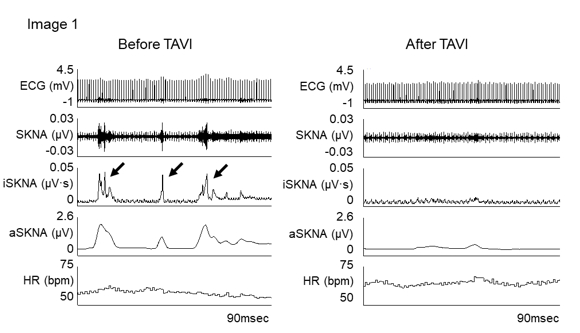
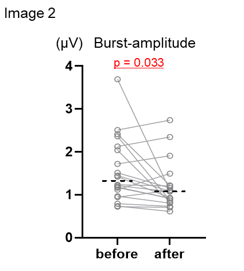
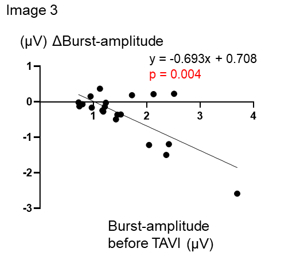
Abstract Body (Do not enter title and authors here): BACKGROUND: Transcatheter aortic valve implantation (TAVI) has become an established treatment option in patients with severe AS, and the indication for the procedure has recently expanded. Cardiac sympathetic nerve activity (CSN) dysfunction and its improvement after TAVI have been reported in patients with severe AS. However, previous studies often included patients with advanced heart failure, potentially confounding the accurate assessment of CSN. These patient characteristics may not reflect the typical profile of real-world AS candidates undergoing TAVI. The primary objective of this study was to evaluate the neurological effects of TAVI on skin sympathetic nerve activity (SKNA) in severe AS patients reflecting real-world TAVI backgrounds and to identify clinical predictors of SKNA changes. METHODS: This prospective, single-center observational cohort study enrolled severe AS patients undergoing TAVI at Kanazawa University Hospital (Aug 2022-Apr 2025). Key inclusion criteria were severe AS and TAVI suitability. Patients with conditions affecting sympathetic nerves were excluded. The primary exposure was TAVI; the primary outcome was the change in SKNA Burst amplitude pre- and post-procedure. SKNA was recorded 2-5 days before and after TAVI was performed. Paired tests compared SKNA parameters. Multivariate regression identified predictors of Burst amplitude change, including baseline Burst amplitude and cardiac output index. RESULTS: TAVI significantly decreased Burst amplitude (from median 1.330 µV [IQR 1.008-2.107] to 1.082 µV [IQR 0.839-1.220], p<0.05)(Image 1,2). On multivariate analysis, baseline Burst amplitude was independently associated with the degree of its change after TAVI (β = -0.608, p = 0.001), indicating that higher baseline CSN predicted greater postprocedural improvement(Image 3). Furthermore, when examining hemodynamic parameters, cardiac output index measured by Swan-Gantz catheter showed the strongest association with baseline Burst amplitude (β=-1.242, p= 0.003), indicating that low cardiac output is associated with higher baseline CSN. CONCLUSION: In patients with severe AS, TAVI significantly decreased SKNA, particularly in those with elevated CSN before the procedure, which was linked to low cardiac output. These findings suggest that TAVI-induced CSN reduction depends on the baseline hemodynamic severity of AS, potentially guiding clinical decision-making in these patients.
Nagamori, Yuta
(
Kanazawa University Hospital
, Kanazawa , Japan )
Kusayama, Takashi
(
Kanazawa University Hospital
, Kanazawa , Japan )
Kazutaka, Takeuchi
(
Kanazawa University Hospital
, Kanazawa , Japan )
Iwaisako, Shuhei
(
Kanazawa University Hospital
, Kanazawa , Japan )
Takeji, Yasuaki
(
Kanazawa University Hospital
, Kanazawa , Japan )
Nakagawa, Yoichiro
(
Kanazawa University Hospital
, Kanazawa , Japan )
Yoshida, Shohei
(
Kanazawa University Hospital
, Kanazawa , Japan )
Usui, Soichiro
(
Kanazawa University Hospital
, Kanazawa , Japan )
Sakata, Kenji
(
Kanazawa University Hospital
, Kanazawa , Japan )
Takamura, Masayuki
(
Kanazawa University Hospital
, Kanazawa , Japan )
Author Disclosures:
Yuta Nagamori:DO NOT have relevant financial relationships
| Masayuki Takamura:DO NOT have relevant financial relationships
| Takashi Kusayama:DO NOT have relevant financial relationships
| Takeuchi Kazutaka:No Answer
| shuhei iwaisako:No Answer
| Yasuaki Takeji:No Answer
| ??? ??:DO NOT have relevant financial relationships
| Shohei Yoshida:No Answer
| Soichiro Usui:DO NOT have relevant financial relationships
| Kenji Sakata:DO NOT have relevant financial relationships