Logo

American Heart Association

  24
  0


Final ID: Su4093

Autonomic inflexibility in Response to Mental Stress in Women with Coronary Microvascular Dysfunction: A Pilot Study

Abstract Body (Do not enter title and authors here): Background: Many women with chest pain suspected of having myocardial ischemia have no obstructive coronary artery disease (oCAD) but instead demonstrated coronary microvascular dysfunction (CMD). One mechanism proposed for CMD-related ischemia is autonomic nervous system (ANS) dysfunction, triggering abnormal microvascular reactivity.
Hypothesis: Women with CMD have abnormal autonomic reactivity with sympathetic predominance in response to mental stress.
Methods: This prospective study enrolled post-menopausal women with angina and CMD (n=10) or oCAD (n=12), and asymptomatic healthy controls with a normal exercise treadmill test (n=27). CMD was diagnosed by coronary flow reserve ≤ 2.5 by coronary function testing or cardiac Positron Emission Tomography. Women with oCAD had coronary revascularization for significant epicardial stenosis. Women with heart failure and arrhythmias were excluded. All subjects underwent standardized laboratory-induced mental stress with 4 minutes of anger recall and 4 minutes of counterbalanced arithmetic stress. During the stress protocol, synchronized ECG and ICG signals were recorded using BIOPAC®. Autonomic reactivity was assessed via heart rate variability (HRV) and impedance cardiography (ICG). HRV parameters in time, nonlinear, and frequency domains were analyzed using BIOPAC®. ICG parameters were computed via open-source Physionet toolbox. HRV and ICG percent changes were calculated as (stress−baseline)/stress, and group differences were analyzed using Kruskal-Wallis tests. For significant findings (P< 0.05), post-hoc Wilcoxon rank-sum tests with Bonferroni correction were conducted.
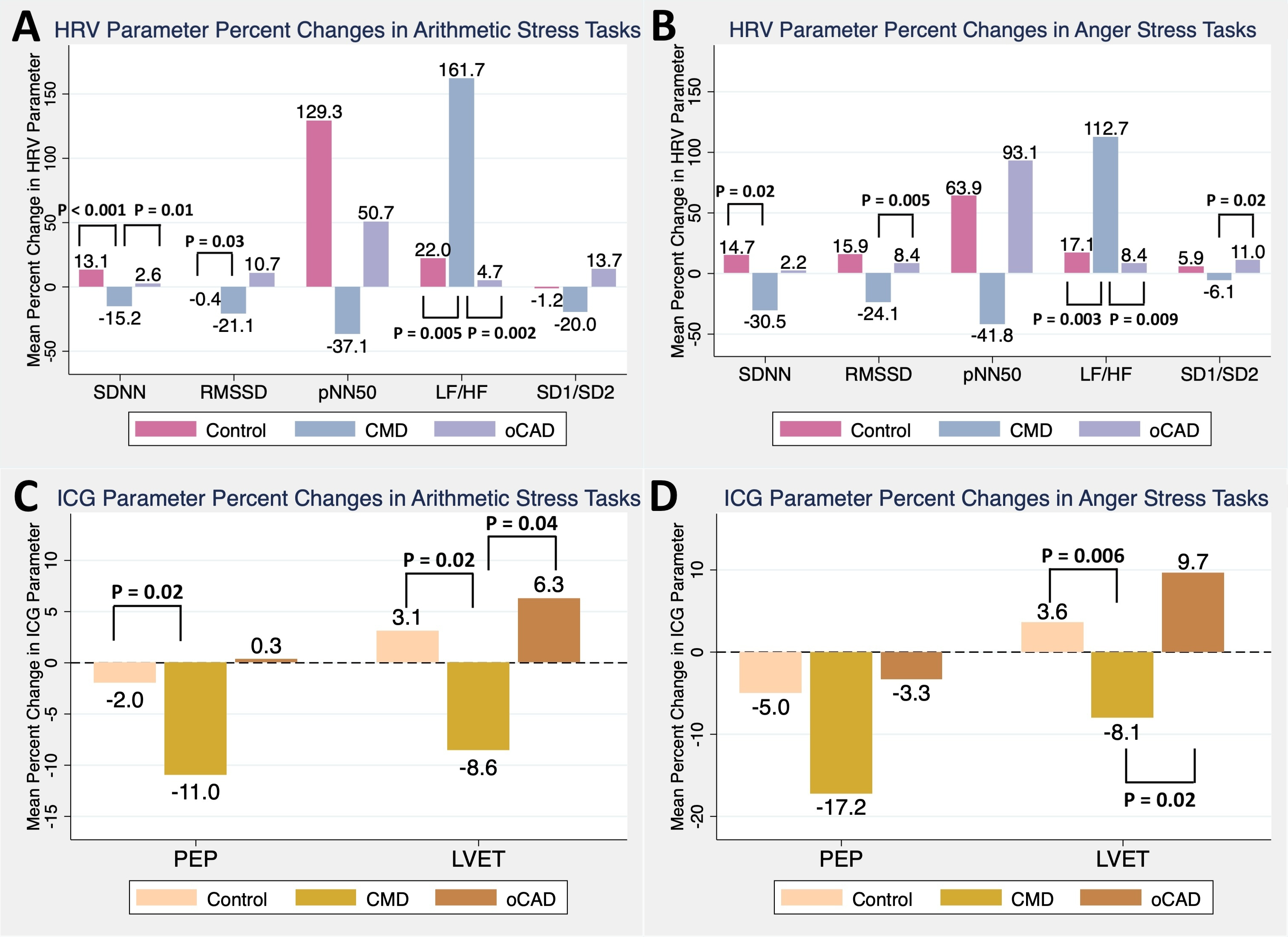
Results: The mean age was 63 ±9 years. Cardiovascular risk factors were comparable among 3 groups. There were no differences in autonomic function at baseline among the groups. The CMD group had significantly attenuated time and nonlinear domains and increased frequency domains on HRV, suggesting impaired autonomic flexibility with stress. ICG results showed that CMD group demonstrated enhanced sympathetic activation with mental stress compared to oCAD and control groups. No significant HRV or ICG differences were found between oCAD and control participants (Figure).
Conclusion: Mental stress-induced ANS dysfunction is suggested in CMD, with greater autonomic inflexibility responses than controls and oCAD groups. These findings support further investigation of neurobiological pathways and autonomic modulation as a treatment target in CMD.
  • Huang, Jingwen  ( Emory University School of Medicine , Atlanta , Georgia , United States )
  • Mcclellan, Olivia  ( Emory University , Duluth , Georgia , United States )
  • Ibrahim, Rand  ( Emory University , Atlanta , Georgia , United States )
  • Sterling, Trevor  ( Emory University , Duluth , Georgia , United States )
  • Rashid, Fauzia  ( Emory University , Atlanta , Georgia , United States )
  • Shah, Amit  ( EMORY UNIVERSITY , Atlanta , Georgia , United States )
  • Murtala, Abdulkareem  ( Emory University , Atlanta , Georgia , United States )
  • Bremner, James Douglas  ( Emory University , Atlanta , Georgia , United States )
  • Vaccarino, Viola  ( Emory Univesity , Atlanta , Georgia , United States )
  • Quyyumi, Arshed  ( EMORY UNIVERSITY , Atlanta , Georgia , United States )
  • Mehta, Puja  ( EMORY UNIVERSITY , Atlanta , Georgia , United States )
  • Sheikh, Shafa-at  ( Emory University , Duluth , Georgia , United States )
  • Dave, Esha  ( Emory University , Duluth , Georgia , United States )
  • Thaker, Vishrut  ( Emory University School of Medicine , Morrow , Georgia , United States )
  • Ahmed, Taha  ( Emory University , Atlanta , Georgia , United States )
  • Harris, Kristen  ( Emory University , Duluth , Georgia , United States )
  • Medina-inojosa, Jose  ( Emory University , Atlanta , Georgia , United States )
  • Hashmi, Hania  ( Emory University School of Medicine , Atlanta , Georgia , United States )
  • Evenhuis, Bernard  ( Emory University , Atlanta , Georgia , United States )
  • Author Disclosures:
    Jingwen Huang: DO NOT have relevant financial relationships | Olivia McClellan: No Answer | Rand Ibrahim: DO NOT have relevant financial relationships | Trevor Sterling: DO NOT have relevant financial relationships | Fauzia Rashid: No Answer | Amit Shah: DO NOT have relevant financial relationships | Abdulkareem Murtala: No Answer | James Douglas Bremner: DO NOT have relevant financial relationships | Viola Vaccarino: DO NOT have relevant financial relationships | Arshed Quyyumi: DO NOT have relevant financial relationships | Puja Mehta: DO NOT have relevant financial relationships | Shafa-at Sheikh: No Answer | Esha Dave: DO NOT have relevant financial relationships | Vishrut Thaker: DO NOT have relevant financial relationships | Taha Ahmed: No Answer | Kristen Harris: No Answer | Jose Medina-Inojosa: DO NOT have relevant financial relationships | Hania Hashmi: No Answer | Bernard Evenhuis: No Answer
Meeting Info:

Scientific Sessions 2025

2025

New Orleans, Louisiana

Session Info:

Emerging Mechanisms in Heart Disease and Obesity

Sunday, 11/09/2025 , 11:30AM - 12:30PM

Abstract Poster Board Session

More abstracts from these authors:
Psychological Distress and Impaired Physical Function in Women Diagnosed with Coronary Microvascular Dysfunction

Rashid Faaris, Vaccarino Viola, Mehta Puja, Ahmed Taha, Rashid Fauzia, Dave Esha, Hashmi Hania, Shah Amit, Michopoulos Vasiliki, Bremner James Douglas, Quyyumi Arshed

Functional Capacity, Average Daily Step Count, and Angina among Women with Coronary
Microvascular Dysfunction Compared to Obstructive Coronary Artery Disease and Healthy Control

Rashid Zaira, Shah Amit, Vaccarino Viola, Sperling Laurence, Quyyumi Arshed, Mehta Puja, Haghjoo Azin, Dave Esha, Chen Yunyun, Evenhuis Bernard, Rubin Jake, Harris Kristen, Thaker Vishrut, Rashid Faaris

You have to be authorized to contact abstract author. Please, Login
Not Available