Both Infarct and Non-infarcted Brain Regions Drive Acute Deep Learning Based MRI Prediction of Stroke Outcome
Abstract Body: Purpose: Predicting long-term outcomes from early acute ischemic stroke (AIS) information is crucial for prognostication, resource management, and clinical trials. Current methods predominantly depend on infarct-related features, such as size and location, for outcome predictions, and demonstrate limited correlation with outcomes. This study examines how deep learning leverages different brain regions, including non-infarct areas, to improve the accuracy of 90-day outcome predictions in AIS patients.
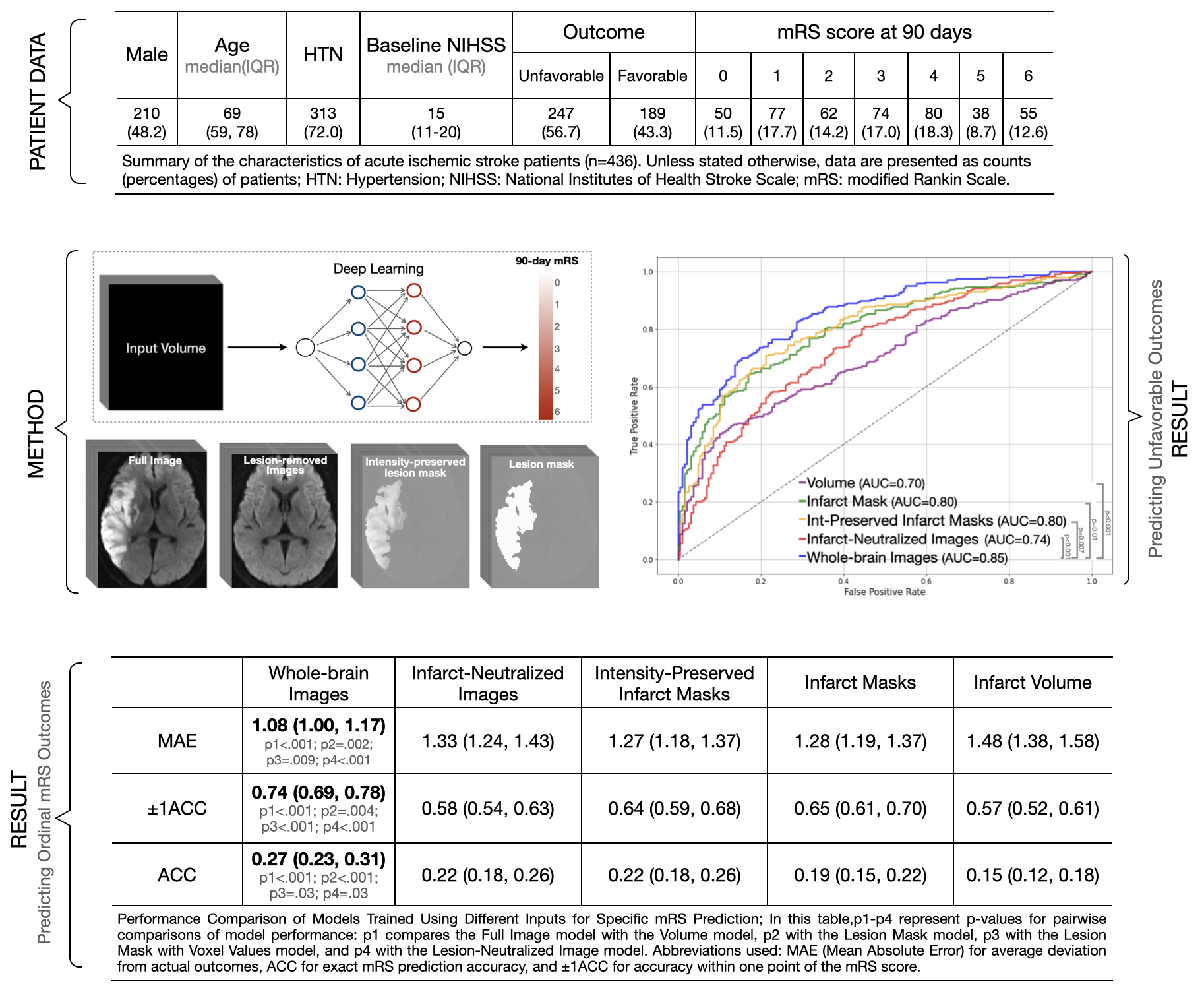
Materials and Methods: We developed and validated deep learning (DL) models on a cohort of 436 AIS patients, using MRI diffusion-weighted imaging scans from 1-7 days post-stroke and 90-day modified Rankin Scale (mRS) follow-up data. These models were trained on various inputs— infarct volumes, whole-brain images, infarct masks, intensity-preserved infarct masks, and images in which the infarct region is removed, which we call infarct-neutralized images, and which enable an assessment of overall brain health. Model performance was assessed based on the accuracy of predicting the specific mRS score, accuracy within ±1 mRS category, mean absolute error (MAE), and the ability to predict unfavorable outcomes (mRS > 2) using receiver operator curve (ROC) metrics.
Results: The infarct volume model had the highest (worst) MAE of 1.48 points (95% CI: 1.38-1.58, p < 0.001), while the whole-brain model achieved the lowest (best) MAE of 1.08 points (95% CI: 1.00-1.17). Models with intermediate imaging information—such as infarct masks (MAE 1.28, 95% CI: 1.19-1.37, p = .002), intensity-preserved infarct masks (MAE 1.27, 95% CI: 1.18-1.37, p = .009), and infarct-neutralized images (MAE 1.33, 95% CI: 1.24-1.43, p < .001)—improved upon the volume-only predictions. For predicting unfavorable outcomes, the infarct volume model had the lowest performance (AUC 0.70, 95% CI: 0.65-0.75; p < .001), while the whole-brain model achieved the highest AUC of 0.85 (95% CI: 0.82-0.89), outperforming the infarct mask (AUC 0.80, 95% CI: 0.76-0.84; p = .01), intensity-preserved infarct mask (AUC 0.80, 95% CI: 0.76-0.84; p = .007), and infarct-neutralized images (AUC 0.74, 95% CI: 0.69-0.79; p < .001)
Conclusions: The best predictive performance was achieved using voxel values from the entire brain, showing that both infarcted and non-infarcted regions contribute significantly to accuracy. Non-infarcted areas may reflect overall brain health and resilience, informing potential outcomes.
Liu, Yongkai
(
Stanford University
, Stanford , California , United States )
Van Voorst, Henk
(
Stanford University
, Stanford , California , United States )
Jiang, Bin
(
Stanford University
, Stanford , California , United States )
Yu, Yannan
(
Stanford University
, Stanford , California , United States )
Zaharchuk, Greg
(
Stanford University
, Stanford , California , United States )
Author Disclosures:
Yongkai Liu:DO NOT have relevant financial relationships
| Henk van Voorst:DO have relevant financial relationships
;
Research Funding (PI or named investigator):Dutch Scientific Council (NWO):Active (exists now)
; Research Funding (PI or named investigator):Dutch Heart Foundation:Past (completed)
; Royalties/Patent Beneficiary:Stanford School of Medicine:Active (exists now)
; Researcher:Amsterdam UMC:Past (completed)
| Bin Jiang:No Answer
| Yannan Yu:DO NOT have relevant financial relationships
| Greg Zaharchuk:DO have relevant financial relationships
;
Ownership Interest:Subtle Medical Inc.:Active (exists now)
Xu Xiaohong, Preeti Preeti, Yu Ruoying, Shaykhalishahi Hamed, Zhang Cheng, Shen Chuanbin, Li Bei, Tang Naping, Chang Yan, Xiang Qian, Cui Yimin, Lei Xi, Ni Heyu, Zhu Guangheng, Liu Zhenze, Hu Xudong, Slavkovic Sladjana, Neves Miguel, Ma Wenjing, Xie Huifang