Sex-specific Thresholds for Energy Loss Index to Predict Survival in Paradoxical Low Flow Low Gradient Severe Aortic Stenosis
Abstract Body (Do not enter title and authors here): Background The prognosis of patients with paradoxical low flow, low gradient, severe aortic stenosis (LFLGAS) is variable, necessitating improved risk stratification. Although this entity is more common in women, the impact of sex on outcomes remains unclear. Energy loss index (ELI), which accounts for aortic root size in estimating the severity of aortic valve stenosis, may enhance risk prediction in LFLGAS. This study aims to investigate sex-based ELI prognostic value in patients with paradoxical LFLGAS.
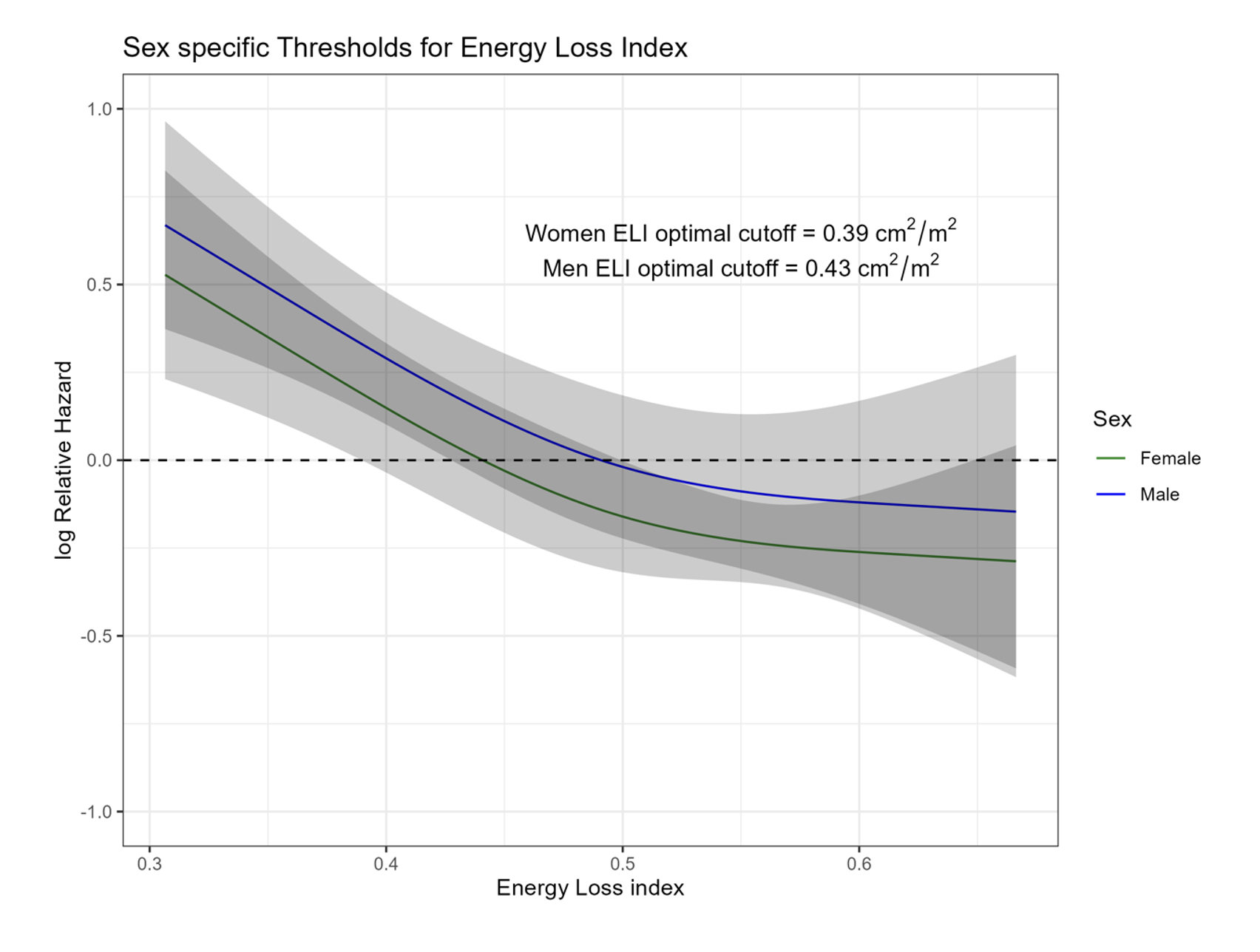
Methods This study analyzed clinical, echocardiographic, and outcome data collected in 294 patients with paradoxical LFLGAS, with AVA<1 cm2, mean transaortic gradient<40mmHg, preserved left ventricular ejection fraction (LVEF>50%) and low flow state, defined as transvalvular flow rate (Q)<210 ml/sec. ELI was calculated using the formula ELI= [AVA x Aa / (Aa - AVA)] / BSA, where Aa is the cross-sectional area of the aorta at the level of the ascending aorta and BSA is the body surface area. Spline curve graphs and maximally selected rank statistics (maxstat package in R) were used to determine optimal sex-specific thresholds.
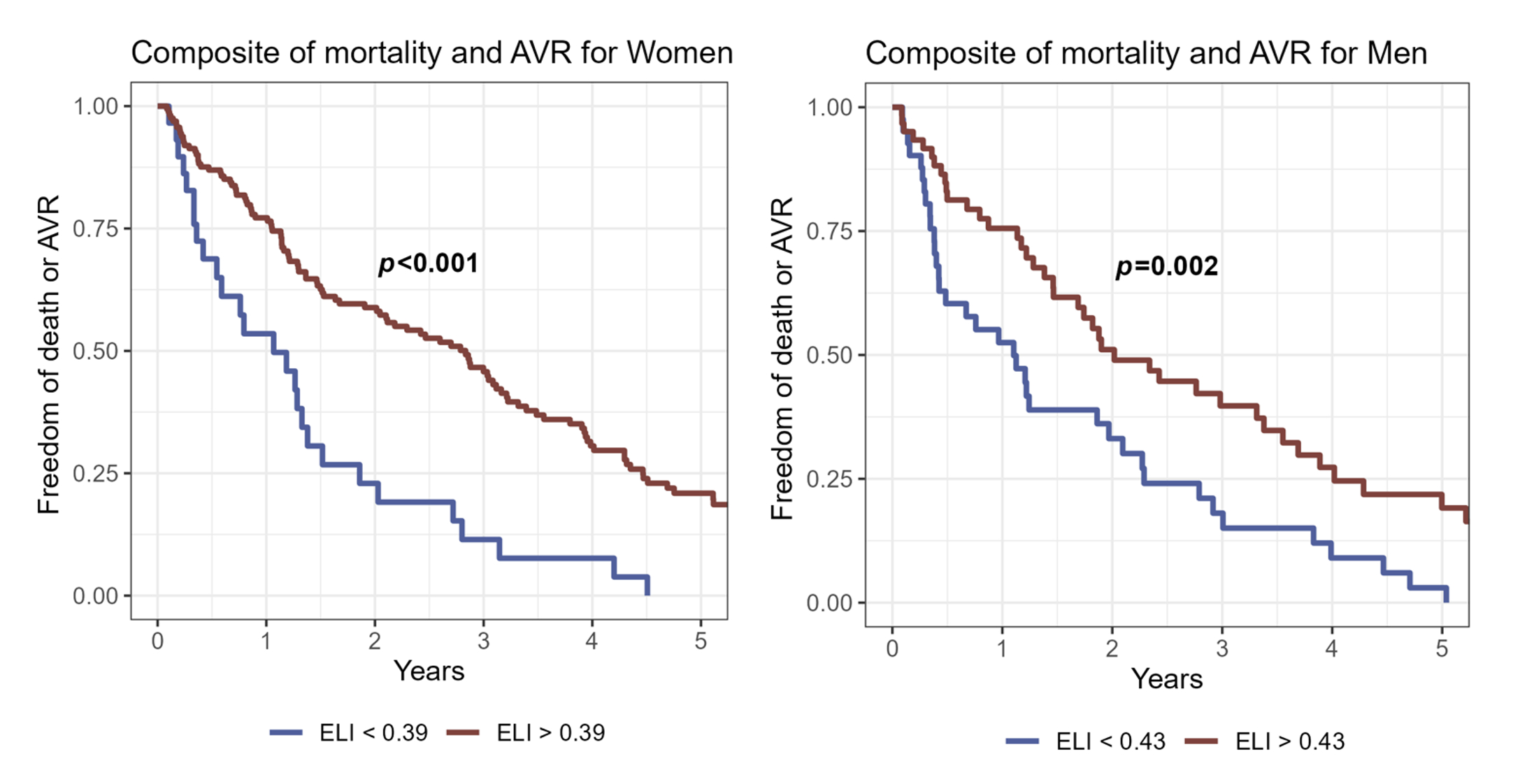
Results Optimal ELI thresholds were identified for men (0.43 cm2/m2, n=102) and women (0.39 cm2/m2, n=192). After adjusting for clinically relevant risk factors (age, LVEF, diabetes mellitus, hypertension), a lower ELI was independently associated with an increased composite outcome of mortality and need for aortic valve replacement for both women [HR 2.88 (95% CI 1.85-4.54), p<0.001] and men [HR 2.63 (95% CI 1.61-4.35), p<0.001], whereas the more commonly used threshold for ELI (0.6 cm2/m2) was not predictive.
Conclusion In the challenging landscape of paradoxical low flow, low gradient, severe aortic stenosis, our results suggest that using sex-specific energy loss index thresholds is a promising strategy for risk stratification, and better than the more commonly used threshold.
Dahan, Shani
(
Massachusetts General Hospital
, Boston , Massachusetts , United States )
Bach, Rasmus
(
Massachusetts General Hospital
, Boston , Massachusetts , United States )
Namasivayam, Mayooran
(
Massachusetts General Hospital
, Boston , Massachusetts , United States )
Tran, Nathanael
(
Massachusetts General Hospital
, Boston , Massachusetts , United States )
Levine, Robert
(
Massachusetts General Hospital
, Boston , Massachusetts , United States )
Hung, Judy
(
Massachusetts General Hospital
, Boston , Massachusetts , United States )
Dal-bianco, Jacob
(
Massachusetts General Hospital
, Boston , Massachusetts , United States )
Author Disclosures:
Shani Dahan:DO NOT have relevant financial relationships
| Rasmus Bach:DO NOT have relevant financial relationships
| Mayooran Namasivayam:No Answer
| Nathanael Tran:DO NOT have relevant financial relationships
| Robert Levine:No Answer
| Judy Hung:DO NOT have relevant financial relationships
| Jacob Dal-Bianco:No Answer