
Logo

American Heart Association

  113
  0


Final ID: MDP1467

Associations between Accelerated Aging Phenotypes with Cancer-Specific and Cardiovascular-Specific Mortality in Long-Term Cancer Survivorship

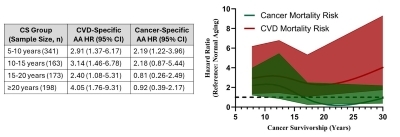
Abstract Body (Do not enter title and authors here): Background. The consequences of cancer and anti-cancer treatments are often described as representing an “accelerated aging” phenotype. However, little is known about how the “accelerated aging” phenotype affects mortality risks in long-term cancer survivors. Purpose. To investigate the association between accelerated aging phenotype and cause-specific mortality in a sample of long-term cancer survivors. Methods. Data for cancer survivors (CS) were extracted from the National Health and Nutrition Examination Survey between the years 1999-2010. Participants missing vital data and those diagnosed with multiple cancers, childhood cancers, cancer within the previous 5 years, or skin cancer were excluded. Mortality outcomes were collected from the National Death Index through December 2019. The Phenotype Age score was derived from blood biochemistry measures such as albumin, creatinine, and c-reactive protein. Accelerated Aging (AA) was defined as a Phenotype Age greater than the participants’ chronological age. CS were grouped by time since diagnosis: 5-10, 10-15, 15-20, and ≥20 years. Within each group, hazard ratios (HR) were derived from competing-risk hazard regression for the AA phenotype association with cancer-specific and cardiovascular-specific mortality. Regressions were modeled with participant age as the time-scale to account for the predictive nature of chronological age. Results. A total of 875 CS (65.6±12.9 years, 62% female, 31% non-white, 15.6±9.4 years from cancer diagnosis) were included. The most common cancer types were prostate (16%) and breast (21%) cancer. There were 107 cancer and 113 cardiovascular deaths over a 10.8±4.6 year follow-up. The AA phenotype was significantly associated with cardiovascular-specific mortality in each survivor group (all p<0.05). Conversely, the AA phenotype was only significantly associated with cancer-specific mortality in the 5-10 years of survivorship group (p=0.01). Results are displayed in Figure 1, along with cubic splines fit to the HR of each survivorship group. Conclusions. Present results suggest that the AA phenotype may demonstrate time-dependent associations with cancer-specific and cardiovascular-specific risks, two leading causes of death in CS.
  • Scheuermann, Britton  ( Kansas State University , Manhattan , Kansas , United States )
  • Ade, Carl  ( Kansas State University , Manhattan , Kansas , United States )
  • Author Disclosures:
    Britton Scheuermann: DO NOT have relevant financial relationships | Carl Ade: DO NOT have relevant financial relationships
Meeting Info:

Scientific Sessions 2024

2024

Chicago, Illinois

Session Info:

Risky Business: What We Know and Don't Know about Cardiovascular Health in Cancer Survivors

Monday, 11/18/2024 , 11:10AM - 12:35PM

Moderated Digital Poster Session

More abstracts on this topic:
A Multimodal Artificial Intelligence Signature of Advanced Cardiac and Vascular Aging Defines Elevated Risk of Cardiovascular Disease

Perera Sudheesha, Biswas Dhruva, Dhingra Lovedeep, Aminorroaya Arya, Coppi Andreas, Khera Rohan

Age and Sex Multiplicatively Moderate the Association of Daily Sedentary Time with Depressive Symptoms in Rural Patients with Cardiovascular Diseases

Kang Junghee, Moser Debra, Cha Geunyeong, Lin Chin-yen, Wu Jia-rong, Okoli Chizimuzo, Latimer Abigail, Lennie Terry, Biddle Martha, Chung Misook

More abstracts from these authors:
Cardiovascular Health and Cardiovascular Disease Risk: Trends and Projections to 2040

Scheuermann Britton, Fenn Sarah, Morrison Kristina, Ade Carl

The Effects of Autoimmune Rheumatic Diseases on the Development of Clonal Hematopoiesis

Scheuermann Britton, Morrison Kristina, Fenn Sarah, Ade Carl

You have to be authorized to contact abstract author. Please, Login
Not Available