
Trends In Temperature Control After Cardiac Arrest In Cardiac Intensive Care Units: An Analysis From The Critical Care Cardiology Trials Network (CCCTN) Registry
Abstract Body (Do not enter title and authors here): Introduction: Temperature control (TC) is recommended for comatose patients after cardiac arrest (CA). In the Targeted Hypothermia versus Targeted Normothermia after Out-of-Hospital Cardiac Arrest (TTM2) trial, targeted normothermia (≤37.5°C) resulted in similar mortality and functional outcomes as targeted hypothermia (33°C).
Aim:To examine temporal trends in TC use and targets in CICUs before and after the TTM2 trial.
Methods: The Critical Care Cardiology Trials Network (CCCTN) is a multinational registry of advanced CICUs coordinated by the TIMI Study Group (Boston, MA). Consecutive admissions were captured during annual 2-month collection periods across participating CICUs (2018-2023). Comatose CA patients were classified as being admitted before (2018-2021) or after (2021-2023) publication of TTM2. TC utilization rates, and temperature targets were compared between the pre- and post-TTM2 eras, including in subgroups of shockable (VT/VF) and non-shockable (PEA/asystole) rhythms.
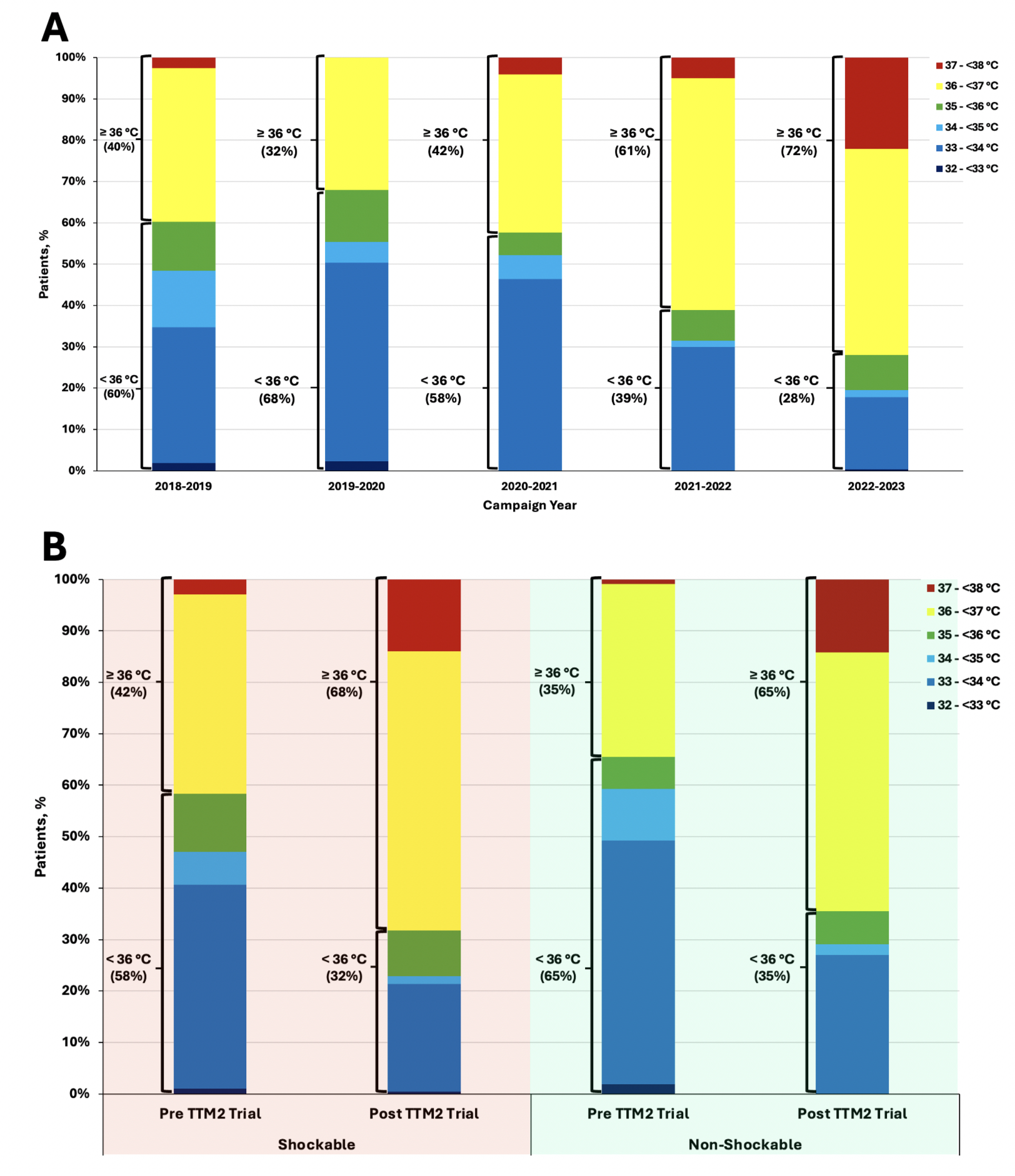
Results: Of 1,355 comatose CA admissions (median age 64y, 30% women, 69% OHCA, 52% shockable/40% non-shockable/8% unknown, 70% in shock, 28% acute MI), 773 were pre-TTM2 and 582 were post-TTM2. Rates of TC use were similar pre- and post-TTM2 (74% vs. 75%; p=0.45), including in the subgroups of shockable (84% vs 82%; p=0.45) and non-shockable rhythms (64% vs. 67%; p=0.53). As compared to pre-TTM2 admissions, post-TTM2 admissions had significantly higher median target temperatures (38% [pre] vs 67% [post] with target temperature ≥36°C; p < 0.001; Figure 1A). This trend was consistent in the subgroups of shockable and non-shockable rhythms (Figure 1B).
Conclusion: In a large CICU cohort of comatose CA patients, overall TC utilization remained stable, but temperature targets were higher after publication of the TTM2 trial. These data provide reassurance that temperature control remains a focus of post-arrest care despite a shift in clinical practice patterns favoring normothermia.
Ariss, Robert
(
Brigham and Women's Hospital
, Boston , Massachusetts , United States )
Guo, Jianping
(
Brigham and Women's Hospital
, Boston , Massachusetts , United States )
Morrow, David
(
Brigham and Women's Hospital
, Boston , Massachusetts , United States )
Berg, David
(
Brigham and Women's Hospital
, Boston , Massachusetts , United States )
Author Disclosures:
Robert Ariss:DO NOT have relevant financial relationships
| Jianping Guo:DO have relevant financial relationships
;
Other (please indicate in the box next to the company name):I am a member of the TIMI Study Group which has received institutional research grant support through Brigham and Women’s Hospital from: : Abbott, Abiomed, Inc., Amgen, Anthos Therapeutics, ARCA Biopharma, Inc., AstraZeneca, Boehringer Ingelheim, Daiichi-Sankyo, Ionis Pharmaceuticals, Inc., Janssen Research and Development, LLC, MedImmune, Merck, Novartis, Pfizer, Regeneron Pharmaceuticals, Inc., Roche, Saghmos Therapeutics, Inc., Softcell Medical Limited, The Medicines Company, Verve Therapeutics, Inc., Zora Biosciences:Active (exists now)
| David Morrow:No Answer
| David Berg:DO NOT have relevant financial relationships