Logo

American Heart Association

  113
  0


Final ID: MDP1388

Prevalence and Characteristics of Hypertrophic Cardiomyopathy Phenotype in Patients with Cardiac Sarcoidosis

Abstract Body (Do not enter title and authors here): Introduction: Hypertrophic cardiomyopathy (HCM) and cardiac sarcoidosis (CS) are distinct cardiomyopathies that can lead to heart failure and arrhythmias. Both diseases are under-diagnosed in the general population and often misdiagnosed due to overlapping phenotype.
Research Question: This study aimed to investigate the co-occurrence of HCM and CS, define the expected prevalence, and outline their co-existent phenotypes.
Goals: To define the prevalence and characteristics of coexistent HCM and CS.
Methods: We calculated the expected population prevalence of CS and of HCM. We identified consecutive cases of patients with a CS diagnosis at OHSU and included those meeting CS criteria based on the Heart Rhythm Society (HRS) 2014 guidelines. These patients were then screened for HCM phenotype which was determined by the presence of left ventricular wall thickness greater than or equal to 15 mm that is otherwise unexplained, left ventricular outflow tract obstruction (LVOTO), pathogenic or likely pathogenic genetic variant and findings on cardiac magnetic resonance imaging (CMR). The diagnosis of CS and HCM were based on comprehensive detailed evaluation by expert multidisciplinary team with histological confirmation frequently employed.
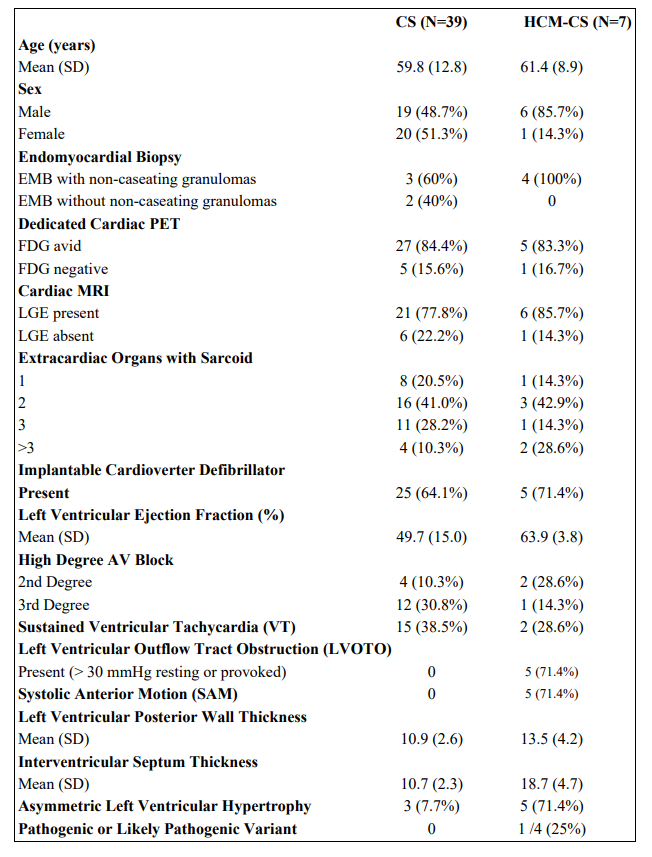
Results: Among the 46 patients meeting HRS criteria, 7 (15%) were identified with concomitant HCM phenotype. Based on published literature, the expected prevalence of HCM is 0.2%-0.4% and assuming independence between CS and HCM, we should have had 1 or no patients with HCM in our cohort. Notably, patients with the HCM-CS phenotype were predominantly male compared to the CS cohort (85.7% vs. 48.7%), had higher left ventricular (LV) ejection fraction (63.9%±3.8% vs 49.7±15.0%), and higher LV wall thickness (18.7±4.7 mm vs 10.7±2.3 mm). Among the HCM-CS patients, LV hypertrophy was asymmetric in 71.4%, and 71.4% had LV outflow tract obstruction. Characteristics of the two populations are shown in Table.
Conclusions: Our data suggest a potential overlap between HCM and CS beyond the expected prevalence. Larger and more detailed pathologic studies will elucidate whether CS can have HCM phenotype versus the presence of common pathobiological processes linking the two entities.
  • Zia, Abdul  ( OHSU , Portland , Oregon , United States )
  • Lal, Mallika  ( OHSU , Portland , Oregon , United States )
  • Nazer, Babak  ( University of Washington , Seattle , Washington , United States )
  • Levin, Benjamin  ( OHSU , Portland , Oregon , United States )
  • Masri, Ahmad  ( OHSU , Portland , Oregon , United States )
  • Author Disclosures:
    Abdul Zia: DO NOT have relevant financial relationships | Mallika Lal: DO NOT have relevant financial relationships | Babak Nazer: DO NOT have relevant financial relationships | Benjamin Levin: No Answer | Ahmad Masri: DO have relevant financial relationships ; Research Funding (PI or named investigator):Pfizer; Attralus; Cytokinetics:Active (exists now) ; Other (please indicate in the box next to the company name):Akros; Prothena; Tenaya (fees):Past (completed) ; Other (please indicate in the box next to the company name):Cytokinetics; BMS; BridgeBio; Pfizer; Ionis; Lexicon; Attralus; Alnylam; Haya; Alexion; BioMarin; AstraZeneca (fees):Active (exists now) ; Research Funding (PI or named investigator):Ionis:Past (completed)
Meeting Info:

Scientific Sessions 2024

2024

Chicago, Illinois

Session Info:

Burning Questions: Clinical Scenarios for Inflammatory Cardiomyopathies

Monday, 11/18/2024 , 11:10AM - 12:35PM

Moderated Digital Poster Session

More abstracts on this topic:
Constrictive Pericarditis Due to Sarcoidosis: Role of Multimodality Imaging in a Patient with a Metal Jacket Full of Calcification

Syed Alveena, Motairek Issam, El Hajjar Abdel Hadi, Abdulhai Farah, Saraswati Ushasi, Safdar Ahmad, Bhalla Jaideep Singh, Wang Tom Kai Ming, Ramchand Jay, Klein Allan

AI-Driven Electrocardiographic Detection and Subtyping of Hypertrophic Cardiomyopathy: A Deep Learning Approach Using 12-Lead ECGs

Soh Moon Seung, Yu Taehyung, Na Yeongyeon, Joo Sunghoon, Shin Joon-han

More abstracts from these authors:
Prevalence of FDG-avidity in genetic cardiomyopathy and prediction of arrhythmic free survival

Bevan Graham, Nazer Babak, Tabaghi Shiva, Lal Mallika, Memar Kimia, Pico Madison, Cheng Richard, Stempien-otero April, Chatterjee Neal, Levin Benjamin

Co-existence And Prognosis of 18FDG-avidity And Genetic Cardiomyopathies

Tabaghi Shiva, Di Carli Marcelo, Chatterjee Neal, Cheng Richard, Stempien-otero April, Levin Benjamin, Divakaran Sanjay, Nazer Babak, Bevan Graham, Hankinson Stephen, Lal Mallika, Pico Madison, Lakdawala Neal, Sauer William, Tedrow Usha, Blankstein Ron

You have to be authorized to contact abstract author. Please, Login
Not Available