
Diagnosing Hemorrhagic Myocardial Infarction with 3D Cardiac MRI Under 15 minutes
Abstract Body (Do not enter title and authors here): Background: Hemorrhagic myocardial infarction (hMI) has emerged as the most serious form of reperfusion injury in MI patients. Cardiac MRI (CMR) is the gold standard for characterizing hMI. Given the challenges in imaging these patients (difficulty with breath-holding and patient discomfort with long scans), we developed a free-breathing, non-ECG gated, motion-resolved whole LV 3D CMR to integrate multiple quantitative measurements to limit acquisitions to be within 15 min.
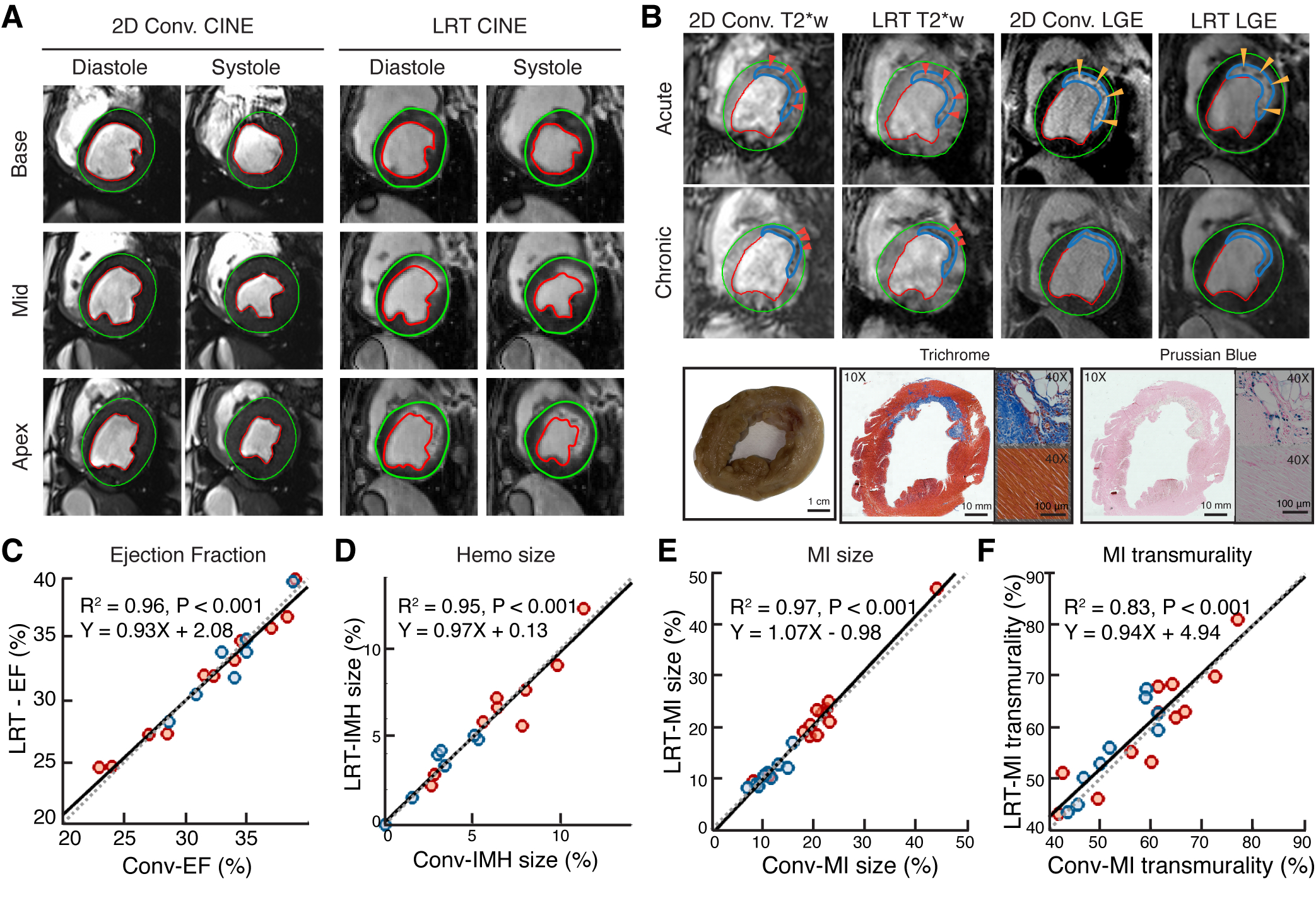
Method: A free-running 3D Cartesian readout with IR preparation and multiple readouts were used to collect image data interleaved with subspace training data. Images were represented as a 6-way tensor with a combined spatial and 5 temporal dimensions and then were jointly reconstructed. The post-Gd acquisition was time-resolved to trace the Gd kinetics (last time point used to determine LGE). The time-resolved images were assigned to 15 bins (~1 min/bin) and the temporal coefficients were estimated from subspace training data. Data acquisition: Canines with reperfused MIs were imaged at weeks 1 (n=12) and 8 (n=9), post MI. Reference 2D CINE, T2* and LGE images were acquired at diastole during end-expiration breath-holds. Data Analysis: Left Ventricle Ejection Fraction (LVEF), MI size and transmurality, microvascular obstruction (MVO) and intramyocardial hemorrhage (IMH) size were computed from conventional CINE, (Early Gadolinium Enhancement) EGE, LGE, T2*-weighted (T2*-w) images (TE=11.42 ms), respectively and compared with those determined using the proposed 3D method. Trichrome and Prussian Blue staining were used to validate MI and IMH, respectively.
Results: Representative CINE, T2*-w and LGE images obtained using conventional and proposed methods are shown in Fig. 1A&B. There was excellent agreement in LVEF, IMH size, extent of MI (Fig. 1C-F), as well as early and late enhancement (Fig. 2) between the approaches.
Conclusion: Accurate characterization of hMI can be performed under 15 minutes without gating. Patients studies are needed for clinical validation.
Zhang, Xinheng
(
University of California, Los Angeles
, Los Angeles , California , United States )
Guan, Xingmin
(
Krannert Cardiovascular Research Center
, Indianapolis , Indiana , United States )
Yang, Hsin-jung
(
Cedars Sinai Medical Center
, Los Angeles , California , United States )
Huang, Yuheng
(
Krannert Cardiovascular Research Center
, Indianapolis , Indiana , United States )
Yoosefian, Ghazal
(
Krannert Cardiovascular Research Center
, Indianapolis , Indiana , United States )
Christodoulou, Anthony
(
University of California, Los Angeles
, Los Angeles , California , United States )
Li, Debiao
(
Cedars Sinai Medical Center
, Los Angeles , California , United States )
Dharmakumar, Rohan
(
Krannert Cardiovascular Research Center
, Indianapolis , Indiana , United States )
Author Disclosures:
Xinheng Zhang:DO NOT have relevant financial relationships
| Xingmin Guan:DO NOT have relevant financial relationships
| Hsin-jung Yang:DO NOT have relevant financial relationships
| Yuheng Huang:DO NOT have relevant financial relationships
| Ghazal Yoosefian:No Answer
| Anthony Christodoulou:DO have relevant financial relationships
;
Research Funding (PI or named investigator):Siemens Healthineers:Expected (by end of conference)
| Debiao Li:No Answer
| Rohan Dharmakumar:DO NOT have relevant financial relationships