Novel Sonothrombolysis Approach to Left Circumflex Thrombus
Abstract Body (Do not enter title and authors here): Sonothrombolysis, the use of ultrasound waves to augment thrombolysis, has been reported in prior limited studies as an adjunctive therapy in the management of acute myocardial infarct (MI) during percutaneous coronary intervention (PCI). By facilitating the dissolution of thrombi and improving microvascular perfusion, sonothrombolysis offers a potential strategy to enhance the efficacy of PCI and improve clinical outcomes. We present a case report utilizing a novel sonothrombolysis approach with successful application of ultrasound contrast directly to the coronary vasculature to reduce thrombus burden in a left circumflex lesion.
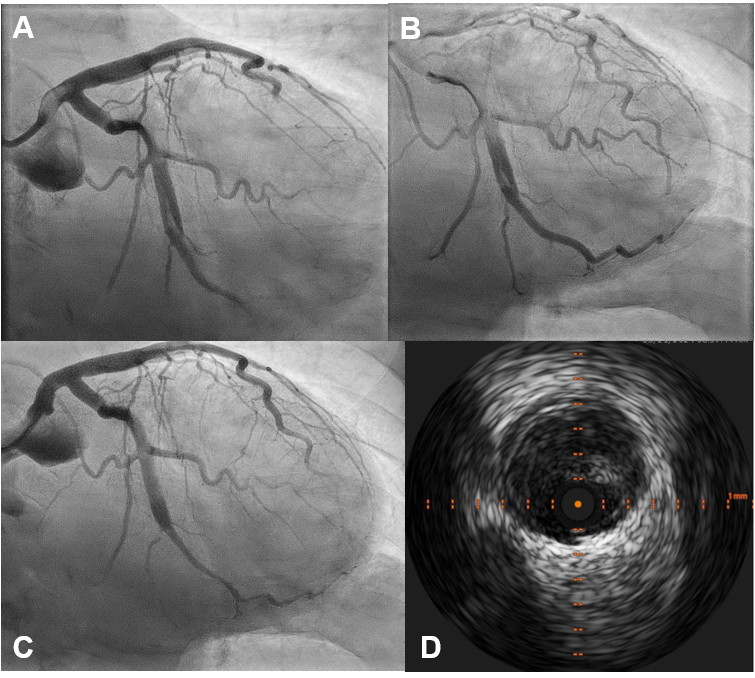
Case: A 78 year old male presented with ventricular tachycardia and NSTEMI. After stabilization he underwent a left heart catheterization which demonstrated thrombus in the mid left circumflex. Distal flow was decreased, TIMI grade 2. Intravascular ultrasound & optical coherence tomography was used for visualization of thrombus, no atherosclerosis or significant calcification was seen. Mechanical thrombectomy was performed with significant residual thrombus. Sonothrombolysis was performed with ultrasound enhancing agent injected directly intracoronary through a guide catheter and high mechanical index pulses applied via echo probe. There was marked reduction in thrombus burden and TIMI 3 flow.
Discussion: Despite advancements in PCI techniques, achieving optimal myocardial reperfusion remains a challenge in patients with MI, particularly those with extensive thrombotic burden. Traditional thrombolytic agents have limitations, including incomplete thrombus dissolution and delayed reperfusion. Sonothrombolysis utilizing an ultrasound enhancing agent adminsitered intravascularly with echo probe delivering high mechanical index pulses has emerged as a novel approach to address these limitations. This is the first reported case with direct application of ultrasound contrast to the coronaries via guide catheter for sonothrombolysis in the setting of an NSTEMI. There have been prior reports of pre-procedural sonothrombolysis delivered to peripheral vasculature in STEMI cases which had limited evidence demonstrating improvement in post MI outcomes. This case report contributes to the growing body of literature by providing insights into the clinical application and efficacy of sonothrombolysis in the management of MI during PCI.
Brush, Kelli
( Dartmouth Hitchcock Medical Center
, Lebanon
, New Hampshire
, United States
)
Kalkur, Roshni
( Dartmouth Hitchcock Medical Center
, Lebanon
, New Hampshire
, United States
)
Shah, Kajal
( Dartmouth-Hitchcock Medical Center
, Lebanon
, New Hampshire
, United States
)
Helisch, Armin
( Dartmouth-Hitchcock Medical Center
, Lebanon
, New Hampshire
, United States
)
Rothstein, Eric
( Dartmouth-Hitchcock Medical Center
, Lebanon
, New Hampshire
, United States
)
Author Disclosures:
Kelli Brush:DO NOT have relevant financial relationships
| Roshni Kalkur:DO NOT have relevant financial relationships
| Kajal Shah:No Answer
| Armin Helisch:No Answer
| Eric Rothstein:DO NOT have relevant financial relationships