Identifying Factors Influencing Response to Dual Antiplatelet Therapy in Non-Cardioembolic Ischemic Stroke and Transient Ischemic Attack: A Meta-analysis of Randomized Controlled Trials
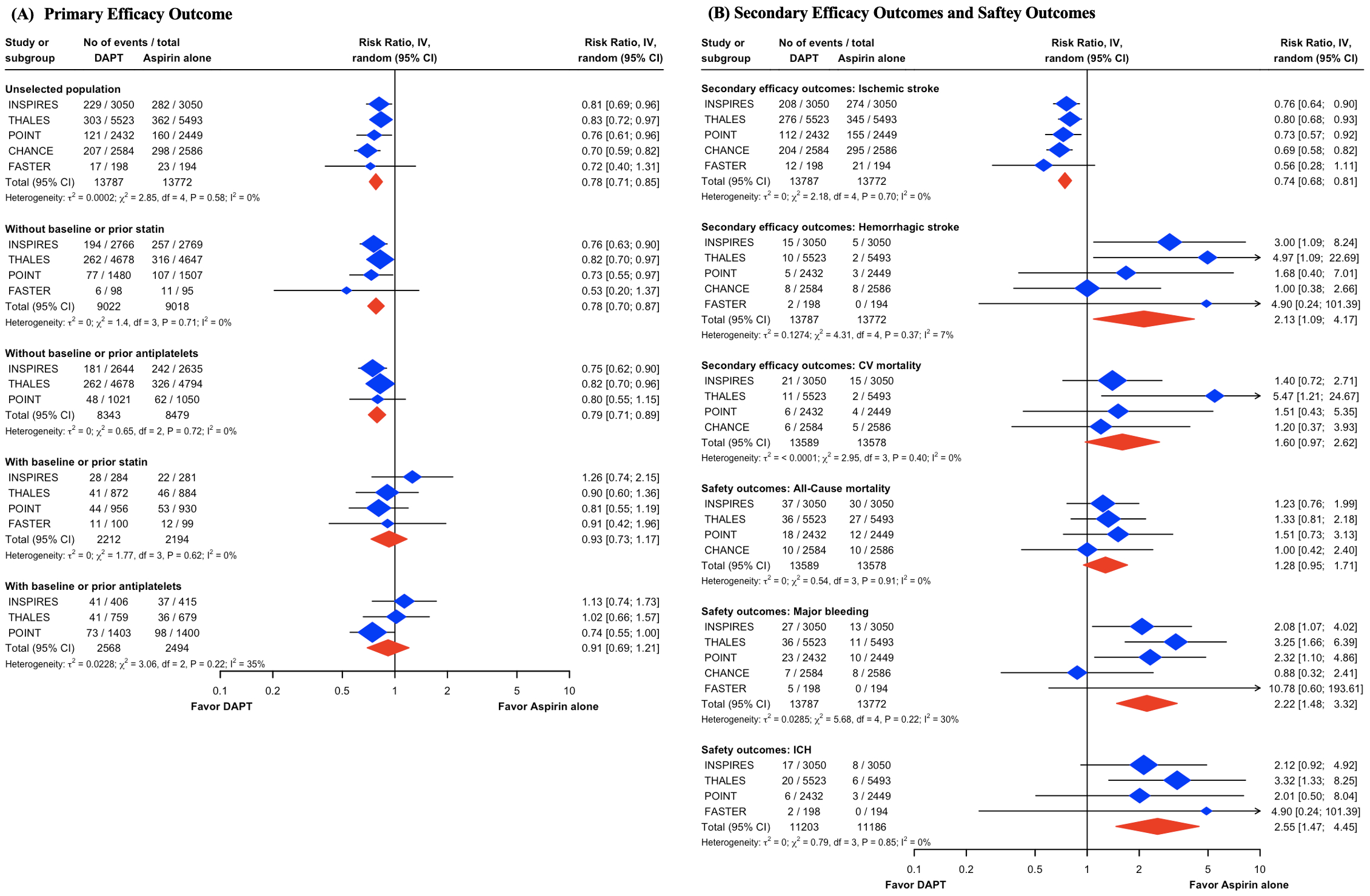
Abstract Body (Do not enter title and authors here): Background While dual antiplatelet therapy (DAPT) has been shown to significantly decrease recurrent stroke in patients with mild ischemic stroke or high-risk transient ischemic attack (TIA) of non-cardioembolic origin, it comes with a substantial increase in the risk of bleeding. Research Question Do all patients with non-cardioembolic, mild ischemic stroke/high-risk TIA derive benefits from DAPT for secondary prevention? Aims To identify patients who derive attenuated benefit from DAPT to avoid excessive bleeding risk. Methods We searched 6 databases from inception to May 10, 2024 to identify randomized-controlled trials (RCTs) comparing short-term DAPT (up to 3 months) with aspirin for secondary prevention of non-cardioembolic ischemic stroke or TIA. The primary efficacy outcome was major adverse cardiac and cerebrovascular events (MACCE), a composite of any stroke, myocardial infarction, and cardiovascular (CV) death, with prespecified subgroups based on participants’ pre-stroke treatment with statins and antiplatelet agents. Secondary efficacy outcomes comprised of recurrent ischemic events and hemorrhagic stroke. Safety outcomes included major bleeding, CV mortality, and all-cause mortality. A random-effects meta-analysis was performed using restricted maximum likelihood method. Results There were 5 RCTs including 27,559 patients. In the unselected population, DAPT significantly reduced MACCE (RR, 0.78; 95% CI, 0.71 to 0.85; I2 = 0%; Figure 1A), compared to aspirin. However, patients with baseline statin (RR, 0.93; 95% CI, 0.73 to 1.17; I2 = 0%; Figure 1A) or antiplatelet (RR, 0.91; 95% CI, 0.69 to 1.21; I2 = 0%; Figure 1A) before index events did not derive benefits from DAPT. While DAPT led to significantly lower recurrent ischemic stroke (RR, 0.74; 95% CI, 0.68 to 0.81; I2 = 0%; Figure 1B), it resulted in a significantly higher risk of hemorrhagic stroke, major bleeding, and intracerebral hemorrhage, compared to aspirin (Figure 1B). Moreover, the use of DAPT trended toward an increased risk of all-cause and CV mortality (Figure 1B). Conclusions Patients with baseline statin/antiplatelts use may not derive the same benefits from DAPT for secondary prevention of non-cardioembolic ischemic stroke or TIA.
Chi, Kuan Yu
(
Jacobi Medical Center, Albert Einstein College of Medicine
, Bronx , New York , United States )
Akman, Zafer
(
Yale School of Medicine
, New Haven , Connecticut , United States )
Lee, Pei-lun
(
Jacobi Medical Center, Albert Einstein College of Medicine
, Bronx , New York , United States )
Borkowski, Pawel
(
Jacobi Medical Center
, Bronx , New York , United States )
Chowdhury, Ishmum
(
Jacobi Medical Center
, Bronx , New York , United States )
Song, Junmin
(
Jacobi Medical Center
, Bronx , New York , United States )
Chang, Yu
(
National Cheng Kung University Hospital
, Tainan , Taiwan )
Romero Acero, Laura
(
Cardiac Care and Vascular Medicine
, Bronx , New York , United States )
Nanna, Md, Facc, Michele
(
Albert Einstein Coll of Med
, Bronx , New York , United States )
Nanna, Michael
(
Yale School of Medicine
, New Haven , Connecticut , United States )
Author Disclosures:
Kuan Yu Chi:DO NOT have relevant financial relationships
| Michael Nanna:DO have relevant financial relationships
;
Consultant:Merck:Active (exists now)
; Research Funding (PI or named investigator):Yale Claude D. Pepper Older Americans Independence Center:Active (exists now)
; Research Funding (PI or named investigator):PCORI:Active (exists now)
; Research Funding (PI or named investigator):National Institute on Aging:Active (exists now)
; Consultant:HeartFlow, Inc:Active (exists now)
; Consultant:Novo Nordisk:Active (exists now)
| Zafer Akman:DO NOT have relevant financial relationships
| Pei-Lun Lee:DO NOT have relevant financial relationships
| Pawel Borkowski:DO NOT have relevant financial relationships
| Ishmum Chowdhury:DO NOT have relevant financial relationships
| Junmin Song:DO NOT have relevant financial relationships
| Yu Chang:No Answer
| Laura Romero Acero:DO NOT have relevant financial relationships
| Michele Nanna, MD, FACC:DO NOT have relevant financial relationships