
The Prognostic Role of Glucagon-like Peptide-1 Receptor Agonist in Transthyretin Amyloid Cardiomyopathy
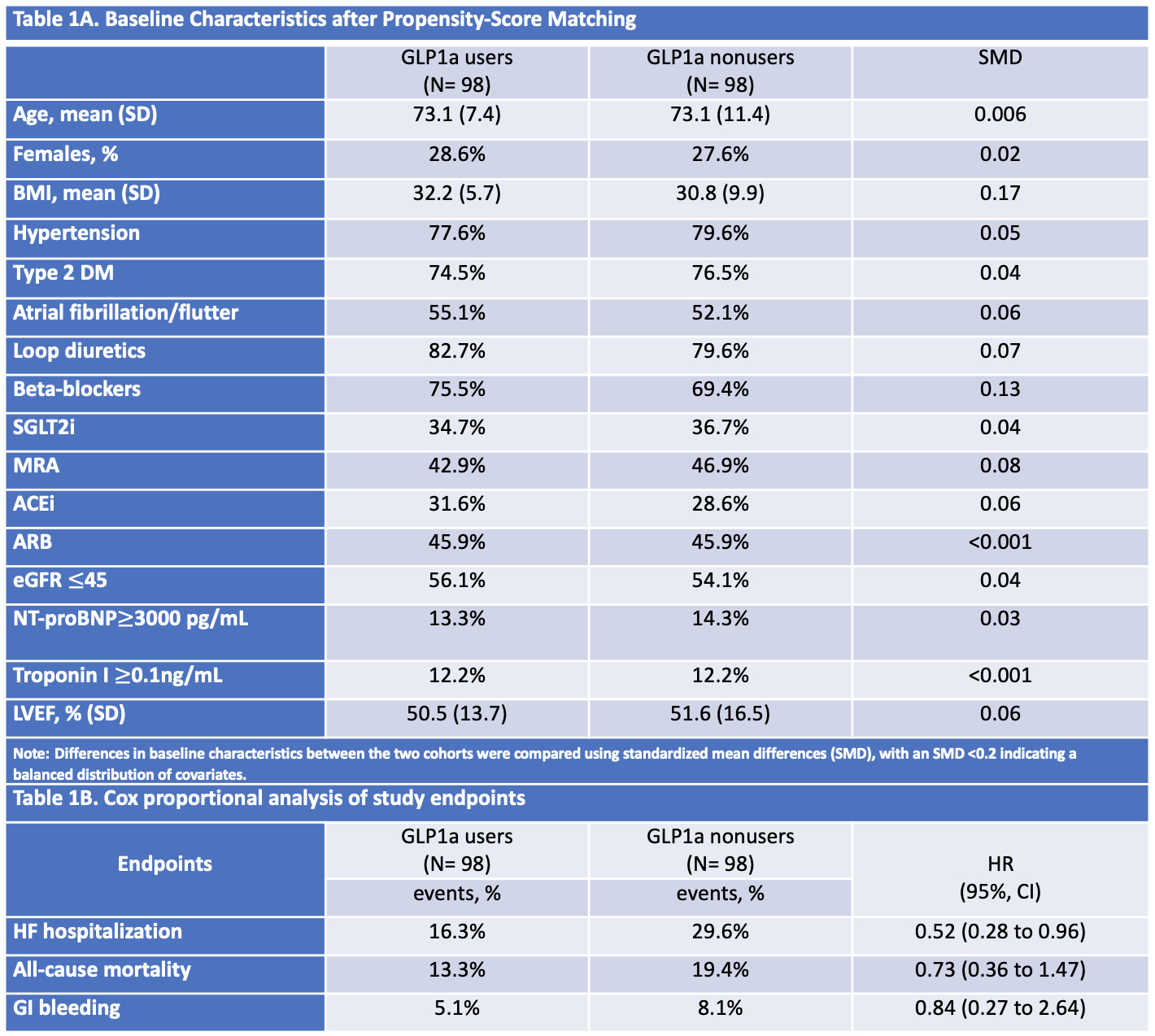
Abstract Body (Do not enter title and authors here): Background Guideline-directed medical therapy (GDMTs) for heart failure is often poorly tolerated in patients with transthyretin amyloid cardiomyopathy (ATTR-CM) and has unclear efficacy. Contrasting with GDMTs, glucagon-like peptide-1 receptor agonist (GLP1a) does not affect cardiovascular hemodynamics in patients with restrictive physiology. Research Question What is the association between GLP1a treatment and survival outcomes in patients with ATTR-CM? Aims To examine the prognostic role of GLP1a in patients with ATTR-CM. Methods We used the TriNetX Global Collaborative Network database to conduct a retrospective propensity-score matching (PSM) study including adult patients with ATTR-CM, identified through tafamidis records, between September 1, 2019, and January 1, 2024. GLP1a users were defined as those having at least one prescription for GLP1a after the first dispense of tafamidis. GLP1a non-users were those who had no GLP1a prescription in the database but had at least one ambulatory visit after the first tafamidis prescription. The index date for study follow-up was set as the first GLP1a dispense for users and the first ambulatory visit after the first tafamidis prescription for non-users. The primary endpoint was heart failure (HF) hospitalization. The secondary endpoint was all-cause mortality. Incident gastrointestinal bleeding was set as a falsification endpoint. Cox proportional hazard ratios (HR) were calculated to compare study endpoints occurring within two years of the index date between two arms. Results Of 5,241 ATTR-CM patients treated with tafamidis, 98 GLP1a users were matched to 98 nonusers. Before PSM, the mean BMI (33.4 vs 27.1) and the prevalence of type 2 diabetes (79.0% vs 19.0%) were higher in GLP1a users. After PSM, key covariates were balanced between the two cohorts (Table 1A). The use of GLP1a was associated with a significant reduction in HF hospitalization (HR, 95% CI, 0.52; 0.28 to 0.96) (Table 1B), compared with non-users. There was no significant difference in all-cause mortality (HR, 95% CI, 0.73; 0.36 to 1.47) and the falsification endpoint between the two groups (Table 1B). Conclusions In ATTR-CM, GLP1a use was associated with a significant reduction in HF hospitalization.
Chi, Kuan Yu
( Jacobi Medical Center, Albert Einstein College of Medicine
, Bronx
, New York
, United States
)
Nanna, Michael
( Yale School of Medicine
, New Haven
, Connecticut
, United States
)
Borkowski, Pawel
( Jacobi Medical Center
, Bronx
, New York
, United States
)
Song, Junmin
( Jacobi Medical Center
, Bronx
, New York
, United States
)
Chang, Yu
( National Cheng Kung University Hospital
, Tainan
, Taiwan
)
Chiang, Cho Han
( Harvard Medical School
, Cambridge
, Massachusetts
, United States
)
Nanna, Md, Facc, Michele
( Albert Einstein Coll of Med
, Bronx
, New York
, United States
)
Sikand, Nikhil
( Yale-New Haven Hospital, Yale University School of Medicine
, Milford
, Connecticut
, United States
)
Gallegos, Cesia
( Yale University School of Medicine
, Guilford
, Connecticut
, United States
)
Samsky, Marc
( Yale University School of Medicine
, Guilford
, Connecticut
, United States
)
Author Disclosures:
Kuan Yu Chi:DO NOT have relevant financial relationships
| Michael Nanna:DO have relevant financial relationships
;
Consultant:Merck:Active (exists now)
; Research Funding (PI or named investigator):Yale Claude D. Pepper Older Americans Independence Center:Active (exists now)
; Research Funding (PI or named investigator):PCORI:Active (exists now)
; Research Funding (PI or named investigator):National Institute on Aging:Active (exists now)
; Consultant:HeartFlow, Inc:Active (exists now)
; Consultant:Novo Nordisk:Active (exists now)
| Pawel Borkowski:DO NOT have relevant financial relationships
| Junmin Song:DO NOT have relevant financial relationships
| Yu Chang:No Answer
| Cho Han Chiang:DO NOT have relevant financial relationships
| Michele Nanna, MD, FACC:DO NOT have relevant financial relationships
| Nikhil Sikand:No Answer
| Cesia Gallegos:No Answer
| Marc Samsky:No Answer