Logo

American Heart Association

  113
  0


Final ID: Sa2008

Endothelial and microvascular dysfunction in adults with congenital heart disease: a systematic review and meta-analysis

Abstract Body (Do not enter title and authors here): Background: Adults with congenital heart disease (ACHD) are lifelong at high risk for premature cardiovascular events and life-threatening complications, suggestive of early or accelerated cardiovascular disease. Endothelial and microvascular dysfunction as well as arterial stiffness play a key role in the emergence and progression of cardiovascular complications. As vascular dysfunction may precede the occurrence of adverse events, early identification of endothelial damage markers in ACHD is crucial.
Aim: This is the first systematic review and meta-analysis of studies investigating the endothelial and microvascular function in ACHD patients versus healthy controls.
Methods: We systematically searched four major electronic databases (PubMed, CENTRAL, Scopus, Web of Science), ClinicalTrials.gov and grey literature. We included studies evaluating endothelial and microvascular function with any semi- or non-invasive method in adult patients with and without ACHD. Studies exploring arterial stiffness indices were also investigated.
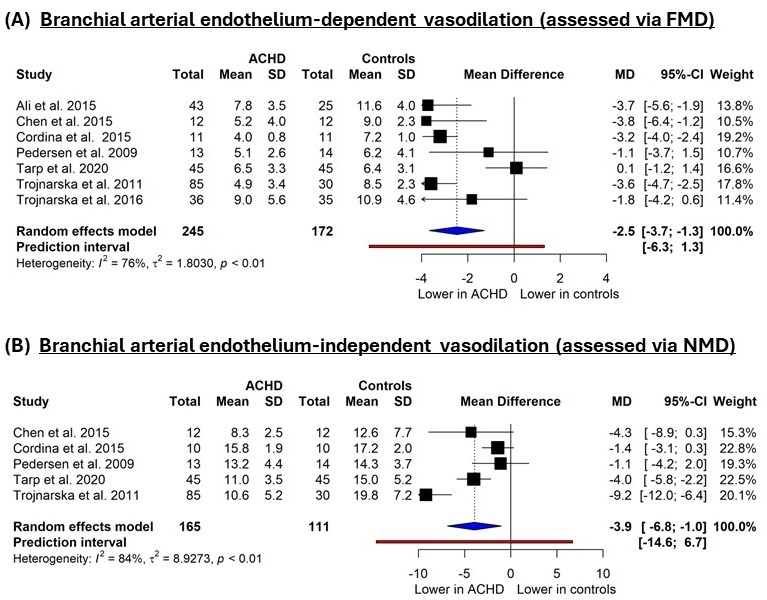
Results: In total, 31 studies (1118 ACHD patients, 794 controls) were included in this systematic review. Branchial arterial endothelium-dependent (assessed via flow-mediated dilatation, FMD) and -independent vasodilation (assessed via nitroglycerine-mediated dilatation, NMD) were impaired in ACHD patients versus controls (mean difference [MD] -2.5, 95% confidence intervals [CI] -3.7; -1.3 and MD -3.9, 95%CI -6.8; -1.0, respectively). Microvascular dysfunction was also evident; significantly lower reactive hyperemia index and peripheral arterial tonometry (PAT) ratio were found in ACHD patients compared with controls (MD −0.26, 95%CI −0.48; −0.04 and MD −0.26, 95%CI −0.5; −0.4, respectively). Regarding arterial stiffness, pooled analysis revealed non-significant differences in pulse wave velocity between the study groups (standardized MD 0.2, 95%CI -0.2; 0.6). However, augmentation index was significantly higher in ACHD (standardized MD 1.6, 95%CI 0.8; 2.4).
Conclusions: ACHD patients have impaired endothelial and microvascular function and increased arterial stiffness, factors that may be responsible for the increased adverse cardiovascular events in this population.
  • Baroutidou, Amalia  ( AHEPA UNIVERSITY HOSPITAL , Thessaloniki , Greece )
  • Dimitroulas, Theodoros  ( Hippokration University Hospital , Thessaloniki , Greece )
  • Arvanitaki, Alexandra  ( AHEPA UNIVERSITY HOSPITAL , Thessaloniki , Greece )
  • Grantza, Triantafyllia  ( AHEPA UNIVERSITY HOSPITAL , Thessaloniki , Greece )
  • Otountzidis, Nikolaos  ( AHEPA UNIVERSITY HOSPITAL , Thessaloniki , Greece )
  • Farmakis, Ioannis  ( AHEPA UNIVERSITY HOSPITAL , Thessaloniki , Greece )
  • Kamperidis, Vasileios  ( AHEPA UNIVERSITY HOSPITAL , Thessaloniki , Greece )
  • Ziakas, Antonios  ( AHEPA UNIVERSITY HOSPITAL , Thessaloniki , Greece )
  • Giannakoulas, George  ( AHEPA UNIVERSITY HOSPITAL , Thessaloniki , Greece )
  • Author Disclosures:
    Amalia Baroutidou: DO NOT have relevant financial relationships | Theodoros Dimitroulas: No Answer | Alexandra Arvanitaki: No Answer | Triantafyllia Grantza: DO NOT have relevant financial relationships | Nikolaos Otountzidis: DO NOT have relevant financial relationships | Ioannis Farmakis: DO NOT have relevant financial relationships | Vasileios Kamperidis: DO NOT have relevant financial relationships | Antonios Ziakas: No Answer | George Giannakoulas: DO NOT have relevant financial relationships
Meeting Info:

Scientific Sessions 2024

2024

Chicago, Illinois

Session Info:

Basic Science Related to Pediatric Heart Disease

Saturday, 11/16/2024 , 10:30AM - 11:30AM

Abstract Poster Session

More abstracts on this topic:
A Therapeutic Vaccine Against Transforming Growth Factor-β Prevents Aortic Aneurysm Formation in a Mouse Model of Marfan Syndrome

Okamura Shun, Yagi Hiroki, Hayashi Hiroki, Ueda Tomomi, Shindo Akito, Kadowaki Hiroshi, Nakagami Hironori, Takeda Norihiko, Akazawa Hiroshi

A Novel Cardiac Simulator "ped UT-Heart" to Support Decision-Making in Surgical Procedures for Complex Congenital Heart Disease

Shiraishi Isao, Kurosaki Kenichi, Iwai Shigemitsu, Washio Takumi, Sugiura Seiryo, Hisada Toshiaki

More abstracts from these authors:
Comparison of non-calcified to calcified plaque ratio versus noncalcified plaque burden to predict adverse cardiovascular outcomes in the CONFIRM2 registry

Kalra Dinesh, Nurmohamed Nick, Fisher Rebecca, Gräni Christoph, Feuchtner Gudrun, Alsaid Amro, Karlsberg Ronald, Buechel Ronny, Kamperidis Vasileios, Alasnag Mirvat, Andreini Daniele, Van Rosendael Alexander, Bhatti Sabha, Bloom Stephen, Foldyna Borek, Branch Kelley, Cademartiri Filippo, Cardoso Rhanderson, Cheng Victor, Cho Geoffrey, Choi Andrew, De Cecco Carlo, Park Jisuk, Deano Roderick, German David, Hadamitzky Martin, Khalique Omar, Knaapen Paul, Al-mallah Mouaz, Mills Jim, Nagpal Prashant, Nakanishi Rine, Pontone Gianluca, Oehler Andrew, Patel Amit, Polsani Venkateshwar, Pursnani Amit, Mushtaq Saima, Singh Vasvi, Van Assen Marly, De Carvalho Singulane Cristiane, Danad Ibrahim, Bax Jeroen, Budoff Matthew, Gupta Himanshu, Ferencik Maros, Wesbey George

Combining novel lipid biomarkers with deep learning algorithms to develop an initial non-invasive screening approach for ruling out obstructive coronary artery disease

Karagiannidis Efstratios, Gika Helen, Giannakoulas George, Papazoglou Andreas, Mouskeftara Thomai, Deda Olia, Liapikos Theodoros, Panteris Eleftherios, Fyntanidou Barbara, Fragakis Nikolaos, Theodoridis George

You have to be authorized to contact abstract author. Please, Login
Not Available